
Case 691: How to Check Which Security Rate Applies to Your Window Supplier
The security rate on your window order belongs to the exporter named on your commercial documents, not the brand on the quote. Find that legal name in the Dumping Commodity Register and match its CCID. This is a guide to reading the register, not advice on your entry.
Key takeaways
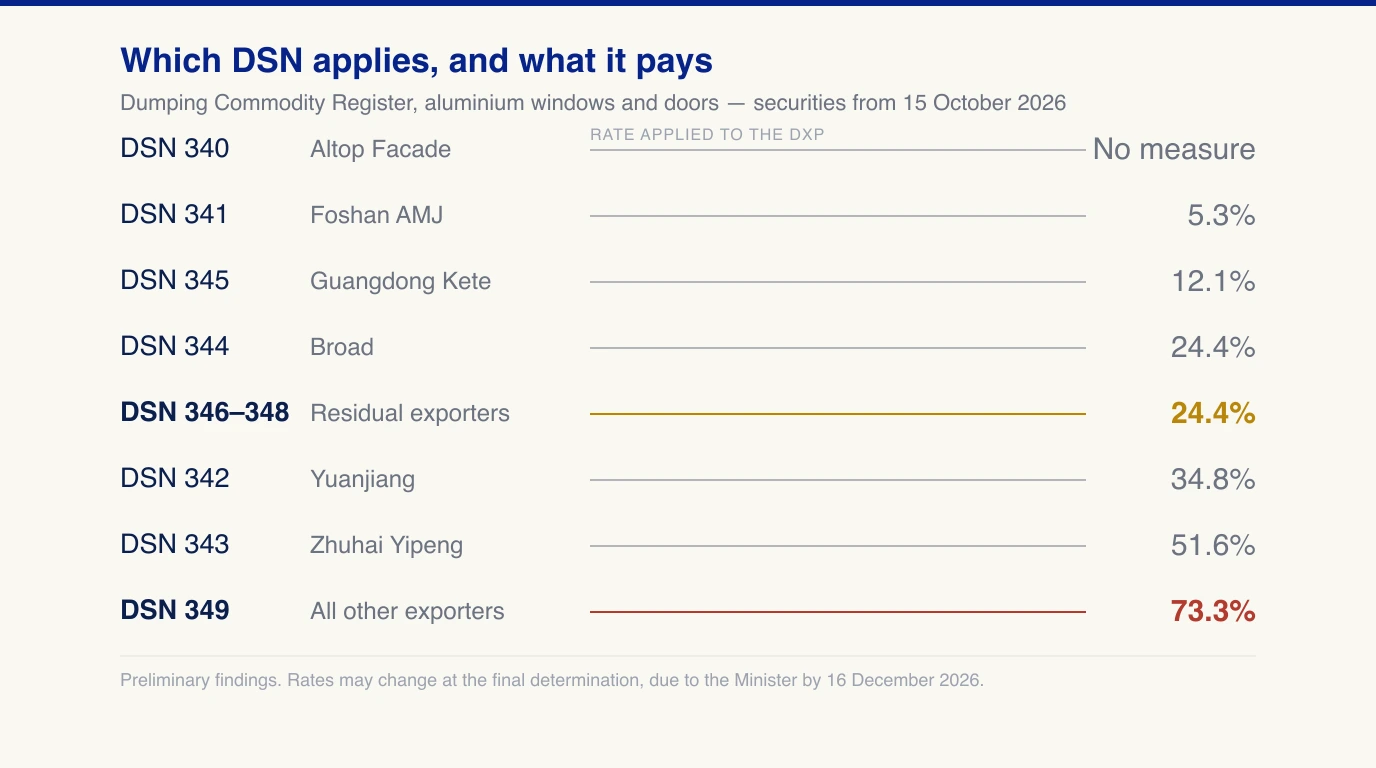
Three tiers apply from 15 October 2026: 5.3% to 51.6% for five of the six exporters examined individually, with the sixth exempt; 24.4% for residual exporters; 73.3% for everyone else.
The residual list is three blocks, not one, under DSN 346, 347 and 348 on register pages 8 to 10. Match a supplier on its CCID rather than its trading name.
The security is the ad valorem rate applied to the Dumping Export Price, which is the invoice price adjusted to FOB, cash. It is not applied to the invoice as issued.
The 30-second answer: which of the three rates applies
Six exporters were examined individually. Five of them pay between 5.3% and 51.6%. The sixth, Altop Facade, was found not to have dumped and is listed on the register as exempt. Exporters that answered the Commission's preliminary information request share 24.4%. Everyone else pays 73.3%, made up of 70.4% dumping and 2.9% countervailing.
Those effective rates sit in Table 2 of Trade Remedies Notice TRN 2026/147, published 14 October 2026 by the Australian Trade Remedies Commission, which takes the securities under section 42 of the Customs Act 1901. The agency was renamed from the Anti-Dumping Commission on 29 September 2026.
A security is an undertaking to pay held by the Commonwealth while the investigation finishes. It is not a duty: it is either cancelled or converted to interim duty at the end, and the amount converted cannot exceed the amount taken. Submissions close 3 November 2026 and the Commissioner reports to the Minister by 16 December 2026.
Why the rate follows the exporter and not the brand
Assessing a margin means assessing a legal entity that exported goods to Australia during the investigation period. Nothing in that process attaches to a product, a system name or a brand. Deloitte's tax@hand note of 15 October 2026 states the rule plainly: the rate follows the exporter of the goods, not the brand or the Australian supplier.
The register supplies its own demonstration. Guangdong Xingfa Aluminium Co., Ltd sits in the DSN 347 residual block at CCID CCL4663433G, on the 24.4% tier, while six exporters were examined individually and given their own rates. The tier turns on whether the exporter took part early and was selected for sampling, not on the product or the brand. Deloitte notes more than 2,000 Chinese businesses exported these goods to Australia during the investigation period, so most importers are likely to fall into the second or third tier.
The trading company is the common shape of the problem. The Commission's exporter questionnaire tells a company that does not manufacture the goods to forward it to the relevant manufacturers, and states the trading company must still complete it except Section G, cost to make and sell. The company named as supplier on the commercial invoice is one of the facts the Commission weighs in deciding who the exporter is, so check it early rather than last. If the supplier named on the invoice is not the company on the register entry you assumed, that entry does not apply.
First, is your order even in scope
Before the rate matters, the goods have to fall inside the description. It covers aluminium windows and doors whether fully or partly assembled, including frames, panels and sashes, with or without glass, whether or not thermally broken, and whether or not hardware is included. Windows and window partial assemblies are in scope up to 3.0 metres high and 4.0 metres wide; doors and door partial assemblies up to 3.0 metres high and 7.0 metres wide. Curtain wall products are excluded. The tariff classification is 7610.10.00 with statistical code 12, but the register states that the listed codes are indicative and the goods description itself is the authority.
Partial assemblies matter here, because they are the reason a reader might assume the measure does not reach them. A fabricated frame or sash shipped for glazing or finishing in Australia is inside the description.
How to read the register so you don't miss your supplier
The residual list is not one table. It is published in three blocks under three Dumping Specification Numbers, DSN 346, 347 and 348, on pages 8, 9 and 10 of the Dumping Commodity Register. A reader who searches one flat list, fails to find their supplier and concludes they must be at 73.3% may have searched the wrong block.
Read it in this order. Question 6 carries the DSN table and the rates; question 10 carries the residual lists. The map is DSN 340 Altop Facade, exempt; 341 Foshan AMJ, 5.3%; 342 Guangdong Yuanjiang, 34.8%; 343 Zhuhai Yipeng, 51.6%; 344 Broad, 24.4%; 345 Guangdong Kete, 12.1%; 346 to 348 residual exporters, 24.4%; and 349 all other exporters, 73.3%.
The CCID is the field to match on, not the trading name. A CCID is a Customs Client Identifier, the number the Integrated Cargo System issues to identify a person or organisation that does not have, or chooses not to use, an Australian Business Number. The register carries it in the exporter table next to each name, and two companies with near-identical names are the practical hazard: within a single residual block, neighbouring entries can differ by one word, and only the CCID tells them apart.
The register is also visibly incomplete. Nineteen entries carry no CCID: Aluquest Co., Ltd in DSN 346, Guangdong Xingqiu Aluminum Co., Ltd in DSN 347, and in DSN 348 a further seventeen including Shandong Auwin Windows and Doors Pty Ltd, Jangho HongKong Holdings Limited and most of the closing block. The register states any missing CCIDs will be updated shortly. Names can also repeat across blocks with different or missing identifiers: Jiangsu YY Facades Co., Ltd appears at CGN9369949E under DSN 347 and CGL7994349G under DSN 348, and Shan Dong Auwin appears twice inside DSN 348, once with a CCID and a different spelling and once without one.
A blank CCID does not mean a supplier is at 73.3%, but the register then gives your broker no identifier to work with. Get the exporter's exact registered legal name and CCID in writing and reconcile it with the broker before the container sails. To work the check: read question 6 for the DSN and the rate, search all three blocks of question 10 rather than one, and match on the CCID where one exists. If the name appears in none of the three blocks, treat the entry as DSN 349 until the supplier proves otherwise. The register does not explain what separates the three blocks, so treat the DSN as the filing position for that entry rather than a description of the exporter.
Five questions that identify your exporter
The Commission publishes its own test for who the exporter is. In its comparative analysis of Altop Facade it found Altop was the exporter because the company produced the goods exported to Australia, is named as the supplier on commercial invoices, is named as the consignor on the bill of lading, arranged and paid for port handling charges at the port of export, and arranged and paid for inland transport to that port.
Put those to your supplier as five questions. Does your entity produce the goods? Does it appear as supplier on the invoice? Does it appear as consignor on the bill of lading? Did it arrange and pay the port handling charges at the port of export? Did it arrange and pay inland transport to that port? These are the facts the Commission relied on in this investigation, applied to the entity it was assessing.
The mirror test appears in the Commission's importer verifications: the importer is the beneficial owner of the goods at importation, and in this case the Commission found that Kete Australia was the importer because it was named on the commercial invoice from its supplier, named as the consignee on the bill of lading, and declared as the importer on the importation declaration to the Australian Border Force. In the same verification the Commission found that Kete Australia had bought on a delivered duty unpaid basis from its related parent, Guangdong Kete, and that the purchases were not arm's length transactions; subject to further inquiries it recommended the export price be established under paragraph 269TAB(1)(b) of the Customs Act rather than from the invoiced figure.
The consequence is the part buyers most often miss. Where a trading company in the chain does not produce the goods and the invoice names the trading company, the trading company is the entity the Commission is assessing for a rate, and the factory behind it is not automatically the rated party. That is where a buyer assumes the factory's rate and gets the trading company's instead. Exporter identity is not set by a formula, though, and is decided on the facts of the transaction, so the practical move is to put the five questions above to whichever entity actually appears on your documents. An importer using an intermediary supplier or trader can also apply to link that supplier or trader to the exporter's duty rate, using form ATRC3. The invoice, bill of lading and import declaration should name the same entities the same way; a mismatch is where the rate you assumed stops being defensible.
What the percentage is actually multiplied against
The security is not a percentage of the invoice total. It is the ad valorem rate applied to the Dumping Export Price, which is the export price expressed at FOB, cash. An invoice on other terms has to be adjusted down to that basis first, and the register sets out how.
The register's worked example: an invoice at CIF, 60 days, for $1,000 with $100 of marine insurance and ocean freight. Step one is a credit adjustment, 1% per month applied to the credit terms, so 60 days is 2% and the CIF cash price is $980. Step two subtracts the $100 to reach a DXP of $880 at FOB, cash. The 24.4% or the 73.3% is applied to $880, not to $1,000. Where the importer cannot evidence the actual interest rate, the register directs 1.0% per month, or 0.033% per day.
One point worth being precise about, because it is easy to read the adjustment backwards. The register requires the DXP to be recorded in the same terms as the specified export terms, which for every exporter on this measure are FOB, cash. The deduction of freight and insurance is what brings a CIF invoice down to that basis, so it is the same deal expressed the same way, not a discount on the rate. A DDP invoice carries further costs again, import clearance and delivery inside Australia, and the register gives no worked method for that case. How those costs are treated is a question for your broker rather than an assumption to make. What buying on DDP does not do is remove the Australian importer's exposure if the entry is wrong or the contract is unclear.
One caveat from the notice itself. The actual security liability may be higher than the effective rate shown because of a number of factors, and the notice directs affected parties to its contact number for the calculation in their particular circumstances.
Shipments that sailed before 15 October
The default rule is the entry date. Securities apply to goods entered for home consumption on or after 15 October 2026, not on the purchase date, the sailing date or the arrival date.
There is a documented exception, and a separate rule sitting just outside it that is not the same thing. The register states that goods which left the country of export before the securities date may be subject to a Goods on the Water DSN removing the requirement for a Security ID. To request it the importer submits the bill of lading showing a shipped on board date before the securities date, showing the goods, and provides the tariff and statistical code for the shipment, to clientsupport@atrc.gov.au. That carve-out is about the Security ID; the register does not say it changes which rate applies.
Separately, the Commission's current measures guidance states that goods exported before a duty notice is published but entering Australia after it are subject to the duty rate that applied on the date of export, and the Australian Border Force says the same and adds that the importer must provide evidence of that date. That is the general rule for duty notices, running alongside the specific Goods on the Water instruction, and the two are not the same statement.
Entry date is the trigger under this notice unless the bill of lading evidence exists. A reader holding a shipped on board date before 15 October has something actionable; a reader without one does not.
If your supplier is already sitting at 73.3%
73.3% is the current position, not the final one. Requests for individual examination, residual treatment and exporter-specific treatment were filed through August, September and into October 2026, right up to the eve of the determination, including a request from Xing Fa Aluminium Australia Pty Ltd listed on the public record on 13 October 2026.
The most instructive case is Shenzhen Hongtai Doors and Windows, which lodged its preliminary information response on 8 December 2025, the day before the deadline, as a PDF while the spreadsheet the Commission had asked for arrived on 13 March 2026. Its submission argues that an exporter which engaged at the outset and completed its response once the omission was identified is not the exporter the uncooperative category is aimed at. The tiers turn on administrative conduct inside a narrow window.
A supplier at 73.3% is therefore worth a conversation about whether it completed the preliminary information request and when, because that is the fact the tier turns on. Once measures are imposed, three routes exist: exporter-specific treatment, an application under form ATRC3 to link a supplier or trader to an exporter's rate, and duty assessment, where an importer who has paid interim duty can apply on form ATRC2 for a final assessment and a refund of any overpayment. Duty assessment runs to legislated importation and application periods, which the register lists, and the Commission has 155 days to examine an application. None of the routes is quick, and the Commissioner's recommendation to the Minister is due by 16 December 2026.
Frequently asked questions
Is the security rate the same as the anti-dumping duty?
No. A security is an undertaking held while the investigation continues. It is either cancelled or converted to interim duty at the end, and the amount converted cannot exceed the amount of security taken.
My supplier says their rate is 24.4%. How do I confirm it?
Get the exporter's registered legal name and CCID in writing, then find that name in one of the three residual blocks, DSN 346, 347 or 348, on pages 8 to 10 of the Dumping Commodity Register. Match the CCID, not the trading name. If the entry has no CCID, put it to the broker before the container sails.
Does buying on DDP take the exposure away?
No. DDP describes the seller's delivery obligation under the sale contract. It does not remove the Australian importer's exposure if the entry is wrong or the contract is unclear. Establish who is importer of record, who calculated the duty, and what happens if the case position changes.
Is 73.3% final?
No. The determination is preliminary. Submissions close 3 November 2026 and the Commissioner reports to the Minister by 16 December 2026. Exporter treatment requests are already on the public record, and the rate can move.
The answer in one paragraph
Identify the exporter of record, not the brand on the quote. Find that legal name and its CCID in the Dumping Commodity Register, searching all three residual blocks rather than one. Apply the right percentage to the DXP expressed at FOB, cash, not to the invoice as issued. And get the bill of lading and the invoice to name the same entities before the container sails.
This is not legal, customs or financial advice, and it is not a statement of any particular importer's liability. The register directs importers to obtain independent professional advice, and states that it is outside the Commission's role to advise whether specific goods are exempted from or subject to measures.
Source and further readingTrade Remedies Notice TRN 2026/147 — findings of a preliminary affirmative determinationAustralian Trade Remedies Commission, 14 October 2026. Table 1 and Table 2 set the dumping and subsidy margins and the securities payable by importers for goods entered for home consumption on or after 15 October 2026.Source and further readingDumping Commodity Register — aluminium windows and doors (securities)Australian Trade Remedies Commission, October 2026. Carries the DSN table and rates in question 6, the DXP method and worked example in question 5, the Security ID and Goods on the Water instructions, and the three residual exporter lists in question 10.Source and further readingStatement of Essential Facts 691, and the case electronic public recordAustralian Trade Remedies Commission, 14 October 2026. SEF 691 carries the exporter status table on pages 30 to 35; the case index holds the verification reports, submissions and exporter questionnaire cited above.Source and further readingDumping and countervailing duties — importer obligationsAustralian Border Force. Security ID, the date-of-export rule for goods on the water, and the offence provision for false or misleading statements.Source and further readingAluminium windows and doors from China: securities start nowDeloitte tax@hand, 15 October 2026. Source of the 2,000-plus exporter count and the statement that the rate follows the exporter rather than the brand or the Australian supplier.