
Policy
How will NSW's proposed rental energy standards and window fall safety rules impact windows and doors?
By Sheng Xu · 28 August 2026
NSW is actively considering two major regulatory shifts for residential windows and doors. Under the 2026 Minimum Energy Efficiency Rental Standards (MEERS) consultation, potential draught-sealing rules are being weighed against condensation and mould risks, favouring balanced airtightness and ventilation. Concurrently, NSW is reviewing a proposed expansion of child window fall-prevention rules to older non-strata houses and townhouses, requiring certified 125mm restrictors (250N force resistance) on high-risk upper-floor windows.
New South Wales residential windows and doors are at the centre of two major regulatory policy developments in 2026. On one front, the NSW Government completed public consultation on its proposed Minimum Energy Efficiency Rental Standards (MEERS) on 31 May 2026, investigating mandatory ceiling insulation, space heating and cooling, and draught sealing for the state's 900,000+ private rental homes. On a parallel but distinct front, NSW Fair Trading is evaluating a long-anticipated expansion of child window fall-prevention regulations from strata schemes to older non-strata houses and townhouses. For window fabricators, landlords, property managers, and retrofitters, understanding the interplay between airtightness, ventilation, and physical window safety devices is critical to specifying compliant, future-proof building envelopes.
What Are the Proposed NSW Minimum Energy Efficiency Rental Standards (MEERS)?
In April 2026, the NSW Department of Climate Change, Energy, the Environment and Water (DCCEEW) released a comprehensive consultation paper exploring mandatory energy efficiency standards for rental properties, with formal public submissions closing on 31 May 2026 (NSW DCCEEW, 2026). The initiative targets a systemic thermal gap in NSW housing: private renters occupy homes with less than half the ceiling insulation rate of owner-occupied dwellings (22 per cent versus 54 per cent), are twice as likely to report freezing indoor conditions during winter, and face an average of 8 per cent higher annual energy costs.
The DCCEEW consultation paper models three potential regulatory pathways for NSW rental accommodation:
The first is a prescriptive approach mandating specific physical upgrades, such as topping up ceiling insulation to R4.0, installing minimum 3-star reverse-cycle air conditioning in main living areas, replacing end-of-life hot water systems with heat pumps, converting to LED lighting, and applying perimeter draught sealing to doors and windows. The second is a performance-based pathway requiring rental properties to achieve a minimum NatHERS rating (modelled at 2.5 to 3.0 stars for existing homes), giving property owners freedom to choose the most cost-effective package of improvements. The third is a hybrid model establishing mandatory baseline features while offering a star-rating alternative for complex buildings (giantA Consulting, 2026).
A final policy recommendation is expected in late 2026. Following government approval, legislation amending the Residential Tenancies Act 2010 is anticipated in 2027, followed by an industry transition period through 2028 and 2029, with full mandatory compliance phased in toward 2030.
The Draught Sealing Dilemma: Why NSW Links Airtightness with Ventilation and Mould
While Victoria has enacted a direct requirement to weather-strip all external doors and windows from July 2027, the NSW MEERS consultation paper adopts a more cautious, building-science perspective on draught sealing. The NSW regulatory analysis explicitly warns that sealing older, leaky building envelopes without simultaneously managing ventilation can trigger severe indoor condensation and toxic mould growth (NSW DCCEEW, 2026; Tenants' Union of NSW, 2026).
In coastal and temperate NSW climates, older weatherboard, brick-veneer, and fibro houses have historically relied on uncontrolled background air infiltration through loose window sashes, unsealed timber floorboards, and wall vents to disperse moisture generated by cooking, showering, washing, and breathing. When external doors and windows are sealed tightly with perimeter weather-stripping, natural air changes plummet and indoor relative humidity climbs.
When warm, moisture-laden indoor air encounters cold, single-glazed glass panes (with a high U-value around 5.8 to 6.5 W/m²K) or standard non-thermally broken aluminium frames on winter mornings, the air temperature drops below the dew point. Water condenses rapidly across the glass and pools on window sills, creating ideal breeding conditions for black mould (Stachybotrys and Aspergillus). This outcome directly threatens occupant respiratory health and conflicts with a landlord's statutory obligation under Section 52 of the Residential Tenancies Act 2010 to provide premises fit for habitation.
The balanced ventilation requirement
Because of this risk, industry submissions from the Energy Efficiency Council and building science consultants emphasize that NSW draughtproofing standards should not simply mirror Victoria's stick-on seal approach. Instead, NSW is expected to require balanced airtightness: ensuring perimeter seals are paired with functional trickle ventilators in window heads, ducted mechanical exhaust fans with backdraft dampers in wet areas, or upgrading to thermally broken double glazing that eliminates the cold interior condensing surface.
The Window Fall Safety Expansion: From Strata Schemes to Older Houses
Parallel to the MEERS energy debate is a major child safety regulatory initiative: expanding mandatory window safety devices beyond strata schemes to include standalone houses, townhouses, and non-strata rental accommodation across NSW (NSW Fair Trading, 2026).
Under the current Strata Schemes Management Act 2015 and Strata Schemes Management Regulation 2016 (Clauses 30 and 31), all residential strata buildings in NSW have been legally required since 13 March 2018 to install compliant window safety devices on every openable window classified as high-risk. However, non-strata properties—which represent the vast majority of older detached rental homes in Sydney and regional NSW—currently fall outside this mandatory regime.
Under existing tenancy legislation, landlords of non-strata homes must allow a tenant to install child window safety devices if requested, but the landlord is not legally obligated to supply or fit them proactively. NSW Fair Trading, supported by pediatric trauma data from the Sydney Children's Hospitals Network, has been reviewing reforms to close this gap by making window safety devices a standard habitability requirement for all residential rental leases. As of mid-2026, this reform remains classified as 'proposed / under consideration', but it marks a clear compliance trajectory for property owners and window suppliers.
Technical Rules: What Defines a 'High-Risk Window' and Compliant Hardware?
The proposed expansion applies the exact technical benchmark established under Clause 30 of the Strata Schemes Management Regulation 2016. A window is legally classified as high-risk and requires a safety device if it meets two simultaneous geometric measurements:
First, the lowest level of the internal window sill must be less than 1.7 metres above the finished internal floor level. Second, the finished internal floor level must be 2.0 metres or more above the ground or external surface directly beneath the window. In practice, this encompasses almost all openable upper-storey windows in two-storey houses, split-level homes, townhouses, and elevated ground-floor dwellings.
To achieve full legal compliance in NSW, the safety device fitted to a high-risk window must satisfy four strict performance conditions:
1. The 125mm restriction rule: The device must physically restrict the maximum openable gap of the window sash so that a 125-millimetre sphere cannot pass through any part of the opening at any point.
2. The 250 Newton outward force resistance: The device, its fixings, and the window frame assembly must withstand a static horizontal outward force of 250 Newtons (approximately 25 kilograms of force) applied directly against the window sash at the point of maximum opening without yielding, breaking, or dislodging.
3. Child-resistant release mechanism: If the safety device can be disengaged or unlocked (to allow full opening for maintenance, cleaning, or emergency fire egress), the release mechanism must be child-resistant—requiring a physical key, a specialized dual-action tool, or a complex two-handed operation that a child under five years cannot operate.
4. Permanent mechanical attachment: The device must be securely screwed, riveted, or mechanically fastened into the window frame extrusion or jamb. Temporary wedges, adhesive stops, and tool-free removable clips do not comply.
The AS 5039 security screen alternative
Under NSW regulations, a security screen or barrier screen fitted across the entire openable window area serves as a complete, fully compliant alternative to a window restrictor lock, provided the screen and its structural frame fasteners have been tested and certified to Australian Standard AS 5039 (Security Screen Doors and Window Grilles). This allows the window sash behind the screen to open to its full travel, maximizing natural ventilation while maintaining total fall protection.
Practical Retrofits: How to Fit Safety Devices Across Different Window Types
Selecting the right fall-prevention hardware depends on the operating mechanism of the window. Incorrect hardware selection can damage frames, impair weather seals, or fail the 250N load test.
For aluminium sliding windows, the standard retrofit solution is a surface-mounted or semi-concealed keyed track lock (vent lock). Positioned on the upper or lower track extrusion 125mm from the closed position, the lock stops the sliding sash from opening beyond the safety threshold while allowing adults to unlock the sash for full opening. On high-end architectural sliding suites, fabricators incorporate factory-fitted internal stop blocks inside the upper head track.
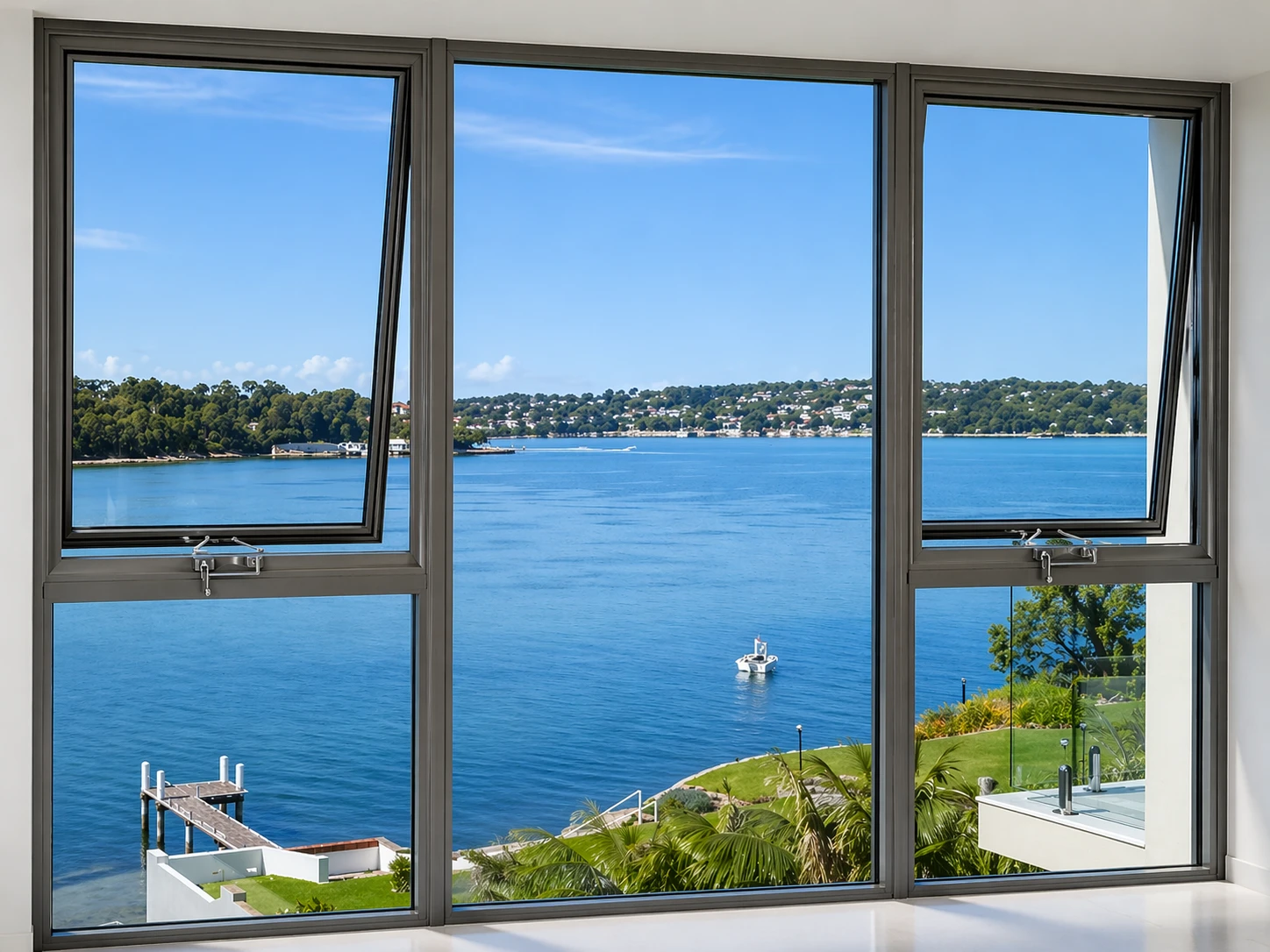
For awning windows, compliance is achieved either by installing short-travel chain winders engineered with a built-in 125mm mechanical travel stop, or by fitting heavy-duty concealed stainless steel friction restrictor stays to the side jambs. The restrictor stays allow the sash to push out only to the 125mm limit, and feature a concealed release button accessible only with a specific tool or key.
For timber double-hung sash windows, brass dual-action stop bolts or keyed sash pins installed into the stiles of the upper sash prevent the lower sash from rising more than 125mm. Dual-action pins require two distinct physical motions (pushing and turning) to disengage, providing child-resistant compliance without defacing heritage timber joinery.
For louvre windows, individual blade openings must not exceed 125mm when fully rotated, or an external barrier screen tested to AS 5039 must be fitted across the frame perimeter.
The Combined Strategy: High-Performance Glazing, Airtightness, and Safety
Rather than treating energy efficiency and window fall safety as disconnected maintenance tasks, forward-thinking landlords and specifiers are adopting an integrated window upgrade strategy. Replacing aging, leaky single-glazed windows with modern high-performance window assemblies resolves both regulatory challenges in a single capital investment.
A modern thermally broken aluminium or uPVC window system fitted with argon-filled Low-E double glazing drops the whole-window U-value from 6.5 W/m²K down to between 1.8 and 2.2 W/m²K. This cuts window heat loss by over 60 per cent, lowers heating and cooling energy use, and keeps interior frame and glass surfaces warm, permanently eliminating the condensation that breeds mould.
When ordered from accredited Australian manufacturers, these high-performance windows are tested to AS 2047 for structural wind load and water penetration resistance, feature factory-certified 125mm fall-prevention restrictors, and deliver acoustic attenuation of Rw 32 to 38—delivering a 7-star energy rating and complete safety compliance that protects long-term rental asset value.
Action Plan for NSW Landlords, Property Managers, and Specifiers
With the MEERS policy decision expected in late 2026 and window safety reviews ongoing, rental providers and property managers should implement a proactive audit-and-plan workflow during regular tenancy inspections.
The first step is a property safety audit: identify all upper-storey openable windows, measure sill heights from the floor, and verify whether a 2.0-metre drop exists outside. For any high-risk openings in older houses or townhouses, install certified 125mm restrictor locks or AS 5039 security screens proactively.
The second step is a ventilation and moisture review: before applying DIY draught seals to doors and windows, inspect bathroom and kitchen exhaust fans to ensure they vent to the outdoor atmosphere and are fitted with backdraft dampers. If the home shows existing signs of window condensation or mould, prioritize double glazing or trickle ventilation over standalone perimeter seals.
The third step is specifier alignment: when planning major renovations or window replacements, specify complete window systems that combine AS 2047 weather performance, Low-E double glazing, and integrated child safety hardware to future-proof the property against emerging NSW tenancy laws.
Frequently Asked Questions
Is draughtproofing currently mandatory for all NSW rental properties?
No. Unlike Victoria's mandatory draughtproofing standard starting 1 July 2027, NSW is currently evaluating Minimum Energy Efficiency Rental Standards (MEERS) following the close of consultation on 31 May 2026. Any mandatory energy efficiency or draughtproofing requirements in NSW are expected to be legislated in 2027 and phased in between 2028 and 2030.
Are child window safety devices mandatory on older houses in NSW right now?
Child window safety devices are currently mandatory on high-risk windows in all residential strata buildings (apartments and strata townhouses) under the Strata Schemes Management Act 2015. Extending this mandate to older standalone houses and non-strata rental accommodation is under formal review by the NSW Government as a proposed reform, but is not yet enacted legislation.
What is the 125mm window rule in NSW?
The 125mm rule requires that openable windows classified as high-risk (internal sill under 1.7m and outside drop of 2.0m or more) must be fitted with a device that prevents the window from opening wider than 125mm. The device must withstand a 250 Newton (approx. 25kg) horizontal outward force, preventing young children from falling through.
Can security screens be used instead of window restrictor locks?
Yes. A security screen or barrier screen tested and certified to Australian Standard AS 5039 that covers the entire openable window area complies fully with NSW child window safety requirements. This allows the window sash behind the screen to open fully for natural ventilation while providing permanent fall protection.
Why does sealing older NSW homes create condensation and mould risks?
Sealing door and window gaps stops natural air infiltration. In humid coastal NSW environments, without adequate mechanical or passive ventilation, indoor humidity builds up. When warm, moist air contacts cold, single-glazed windows and non-thermally broken aluminium frames, heavy condensation forms, creating ideal conditions for toxic black mould growth.
Our Products
Fixed Windows
View system
Sliding Windows
View system
Sliding Doors
View system
Stacker Doors
View system
Awning Windows
View system