

Glass & Glazing
What is a double glazed window?
By Sheng Xu · 6 August 2026
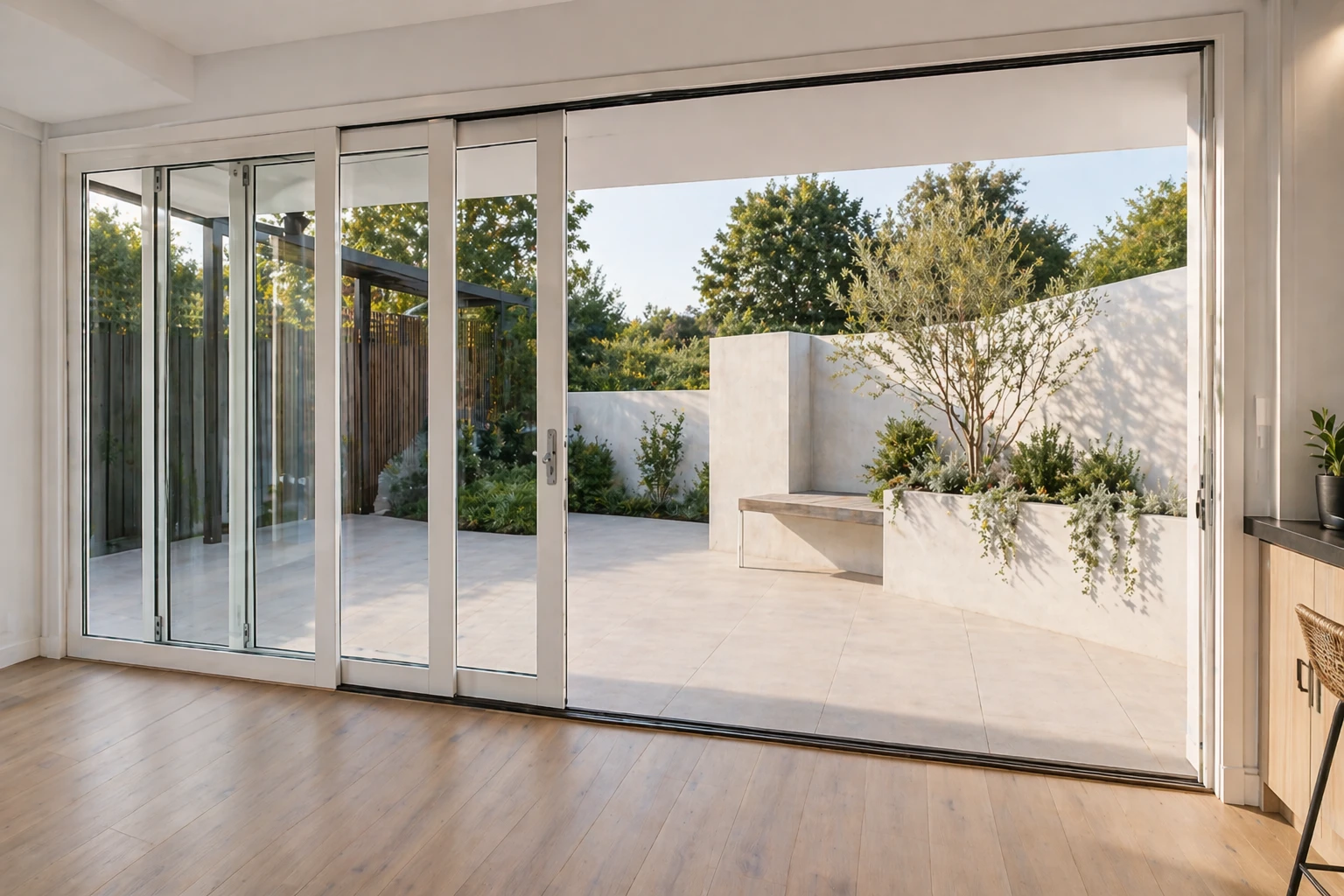
AI-generated illustrative image. Not a product test, certification record or project evidence.
A double glazed window is an assembly built around an Insulated Glass Unit (IGU)—two panes of glass separated by a hermetically sealed cavity filled with dry air or inert argon gas. The trapped cavity acts as an insulating barrier that dramatically slows conductive heat transfer, cutting winter heat loss by up to 30% to 50% compared to single glazing, raising interior glass surface temperatures to prevent condensation, and muffling outdoor noise.
A double glazed window is a window assembly built around an Insulated Glass Unit (IGU)—a sealed system comprising two panes of glass separated by a continuous spacer bar and a hermetically sealed cavity filled with dry air or inert gas such as argon. In Australian residential architecture, double glazing replaces the traditional single sheet of clear float glass that dominated post-war construction. While single glazing acts as an open thermal bridge, losing heat in winter and allowing radiant heat in summer, double glazing creates a thermal break across the glazed aperture, reducing heat transfer, preventing interior condensation, and buffering outdoor acoustic disturbance.
Under the National Construction Code (NCC 2022) 7-star NatHERS energy baseline, single glazed windows have virtually disappeared from new residential home approvals across southern and temperate Australian climate zones. However, double glazing is not a generic commodity. Performance varies significantly depending on glass thickness, cavity gas fill, spacer technology, Low-E coatings, and the window frame into which the unit is installed. Understanding how an IGU works—and what it cannot achieve on its own—is essential for any homeowner or builder planning a renovation or new build.
The anatomy of an Insulated Glass Unit (IGU)
In the fenestration industry, the sealed glass component of a double glazed window is formally called an Insulated Glass Unit (IGU), governed in Australia by Australian Standard AS 4666. An IGU is not two pieces of glass loosely installed into a timber or aluminium frame; it is a factory-manufactured, hermetically sealed micro-environment made up of five interdependent components:
1. Glass Panes: Two sheets of architectural glass, typically ranging from 3mm to 10mm in thickness. Depending on engineering needs and Australian Standard AS 1288 (human impact safety requirements), these panes may be standard float glass, toughened safety glass, laminated security glass, or acoustic laminated glass.
2. The Sealed Cavity: The space between the two glass panes, typically measuring between 6mm and 20mm in width. In thermodynamic testing, cavity widths between 12mm and 16mm represent the optimal threshold for argon-filled units, balancing conductive suppression against internal convective looping.
3. Cavity Gas Fill: The cavity is filled either with dehydrated ambient air or an inert gas—most commonly argon. Argon is a non-toxic, odourless noble gas that has approximately 34% lower thermal conductivity and 38% higher density than air. Filling an IGU with a minimum 90% argon concentration improves the centre-of-glass U-value by roughly 10% to 15% compared to an identical air-filled unit.
4. Spacer Bar & Desiccant: The perimeter spacer sets the precise cavity width and holds the glass panes apart. Hollow aluminium spacers were historically standard, but conduct heat readily, creating a 'cold edge' around the perimeter. Modern high-performance windows increasingly employ composite or foam warm-edge spacers, which reduce perimeter heat loss and mitigate edge condensation. Inside the hollow spacer is a molecular sieve desiccant (drying agent) that chemically absorbs any residual moisture inside the cavity during manufacture.
5. Dual-Seal Barrier: A reliable IGU utilizes a dual-seal system. The primary seal is polyisobutylene (PIB), an elastomeric compound applied between the spacer and glass that acts as an impermeable vapour barrier, preventing moisture ingress and gas escape. The secondary seal—typically polysulphide or structural silicone applied around the outer perimeter—provides structural bond strength against wind loads, thermal expansion, and mechanical vibration.
In architectural manufacturing, glass make-ups are written in standard notation. For example, SMIRO's Living and Vista series utilise a 5mm + 9Ar + 5mm make-up (5mm outer glass, 9mm argon cavity, 5mm inner glass), while the Urban and Urban Reinforced series specify a 5mm + 12Ar + 5mm configuration, and the thermally broken Comfort series incorporates a generous 5mm + 20Ar + 5mm make-up.
How double glazing controls heat transfer
Heat naturally flows from warmer zones to cooler zones through three physical mechanisms: conduction, convection, and radiation. A standard single sheet of glass performs poorly against all three. Double glazing alters how heat interacts with the window envelope:
Conduction is the direct transfer of thermal energy through a solid material. Architectural glass has a thermal conductivity of roughly 1.0 W/m·K. When indoor air is warm in winter, heat conducts rapidly through a single pane of glass into the cold outdoor air. In a double glazed unit, the gas cavity interrupts this solid pathway. Because argon gas conducts heat at roughly 0.016 W/m·K—over 60 times slower than solid glass—it acts as a powerful thermal brake.
Convection occurs when air or gas circulates within a space, transferring heat from a warmer surface to a colder surface. If the cavity between panes is too narrow (under 8mm), heat conducts straight across the gap. If the cavity is made too wide (over 18mm to 20mm in vertical domestic windows), convective air currents begin to circulate up the warm inner pane and down the cold outer pane, accelerating heat loss. Australian fenestration standards recognise 12mm to 16mm as the sweet spot where convective movement remains suppressed while conductive resistance remains high.
Radiation is the transfer of heat via electromagnetic waves, such as solar heat from the sun or infrared heat emitted by indoor heaters and furniture. Clear glass is largely transparent to radiant heat. By applying a microscopically thin low-emissivity (Low-E) metal coating to one of the cavity glass faces, radiant heat can be selectively reflected. In winter, Low-E reflects indoor heating back into the room; in summer, solar-control Low-E reflects radiant solar heat away from the home.
The glass is not the whole window: understanding Uw, Ug, and Uf
One of the most frequent specification mistakes in Australian building projects is confusing centre-of-glass performance (Ug or Uc) with certified whole-window performance (Uw). Window performance in Australia is calculated according to Australian Fenestration Rating Council (AFRC) protocols based on ISO 15099 area-weighting methodology.
The three critical metric values are: Ug (heat transfer through the central glass unit), Uf (heat transfer through the window frame profile), and Uw (the certified, area-weighted heat transfer of the entire assembled window, including glass, frame, and perimeter spacer). A brochure may advertise an impressive centre-of-glass Ug of 1.3 W/m²K, but if that IGU is glazed into an uninsulated standard aluminium frame with a high Uf, the certified whole-window Uw will land between 2.8 and 3.5 W/m²K.
Aluminium is an exceptionally durable, fire-resistant, and structural framing material, but it is a natural thermal conductor (~160 W/m·K). In severe winter climates (such as Canberra, Ballarat, or the Snowy Mountains), pairing double glazing with a thermally broken aluminium frame—which incorporates an insulating polyamide strip separating the inner and outer aluminium profiles—lowers whole-window Uw toward 1.8 to 2.4 W/m²K. However, in moderate and temperate coastal climates across NSW, Queensland, South Australia, and Western Australia, high-performance non-thermally broken aluminium frames with double glazing (Uw 2.5–3.5 W/m²K) reliably achieve NCC 2022 7-star compliance at a significantly more accessible price point.
The fixed window benchmark: pure glass performance in action
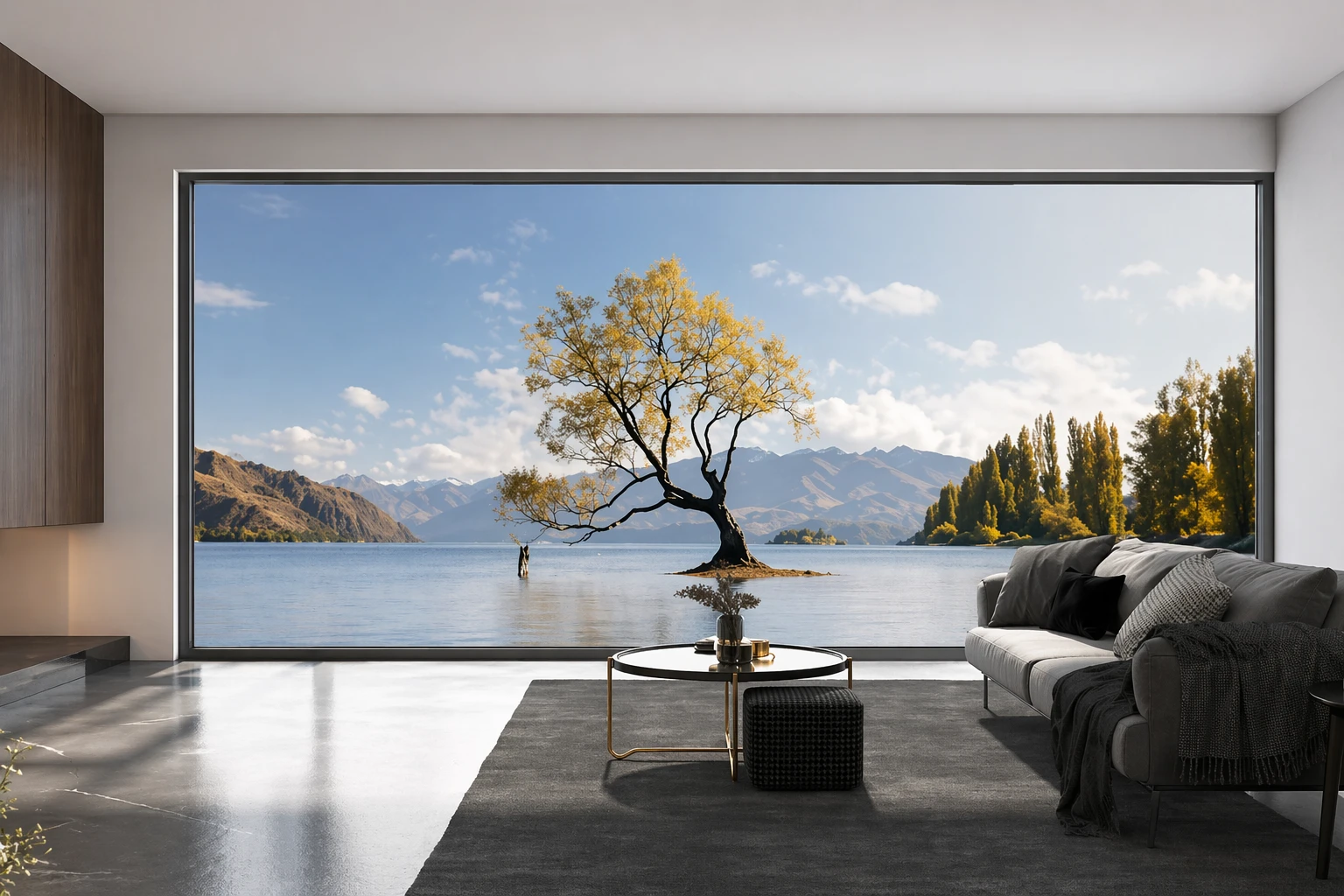
To understand how double glazing performs without the mechanical compromises of operable sashes, look at fixed aluminium windows (picture windows). In operable windows such as sliding, awning, or double-hung units, framing extrusions, sliding tracks, and interlocking stiles can account for 25% to 35% of the total wall opening. By contrast, a fixed window contains no moving sashes, no operating hardware, and no friction seals.
Because glass accounts for 80% to 85% of a fixed window's total surface area, the insulated glass unit does virtually all the thermal and acoustic work. Fixed windows provide superior airtightness, eliminating air infiltration through perimeter pile seals, and their certified whole-window Uw stays closer to the centre-of-glass Ug than any operable window style. For living rooms, stairwells, and architectural facade openings where maximum natural daylight and panoramic views are prioritized, double glazed fixed windows deliver the highest energy efficiency per square metre of aperture.
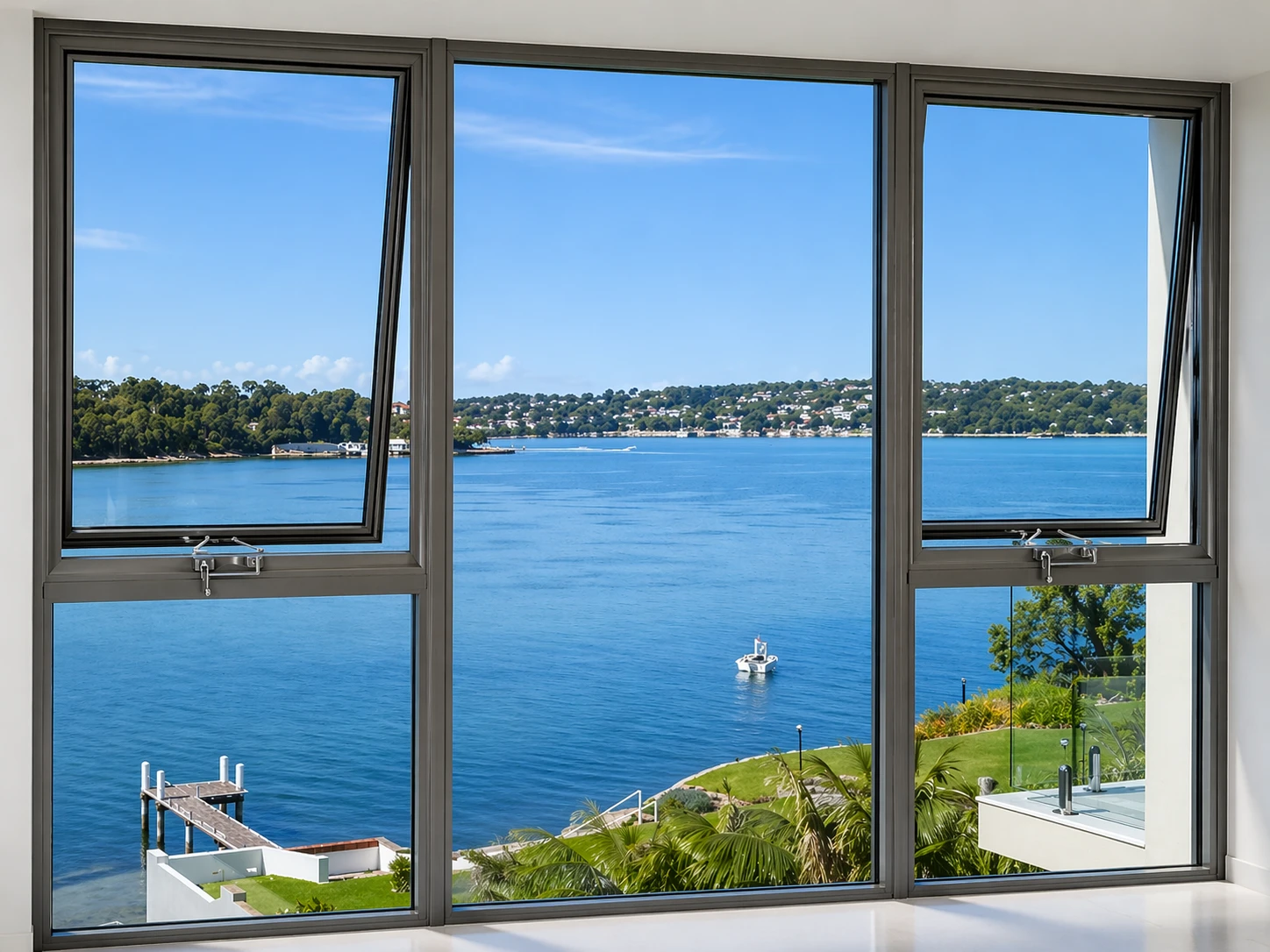
When specifying architectural elevations, designers frequently pair large double glazed aluminium fixed windows with operable awning or sliding windows. This strategy delivers expansive daylighting, airtight thermal control, and reliable acoustic dampening through the fixed panes, while reserving operable windows for focused, cross-flow natural ventilation.
What double glazing physically improves
When properly specified and installed, double glazing provides tangible performance advantages over single glazed windows across four key areas:
1. Winter Thermal Comfort and Energy Savings: By halving conductive heat transfer across the window aperture, double glazing retains indoor heat generated by heaters or reverse-cycle air conditioning. Australian government data indicates windows account for up to 40% of winter home heat loss; upgrading to double glazing cuts this loss substantially, eliminating the 'cold draught' feeling caused by room air cooling rapidly against cold glass.
2. Interior Condensation Control: Condensation forms when warm, humid indoor air comes into contact with a surface at or below the dew point temperature. On a single glazed window in winter, the glass temperature drops close to outside freezing levels, causing water to bead and run down sills, leading to mould growth. Double glazing keeps the interior glass pane significantly warmer, preventing room-side condensation under normal household relative humidity.
3. Airborne Acoustic Damping: Outside sound waves cause a single pane of glass to vibrate, transmitting noise indoors. The dual-pane structure of an IGU introduces a gas dampener that reduces medium and high-frequency noise (such as voices, dog barking, and lawnmowers), improving certified sound reduction from Rw 25–28 dB for single glass up to Rw 31–32 dB for standard double glazing, and up to Rw 35–38 dB when acoustic laminated glass is specified.
4. Security and Structural Resilience: Breaking through two panes of glass requires substantially more impact energy and time than shattering a single 3mm or 4mm float pane. When combined with toughened safety glass (which resists blunt impacts up to five times greater than float glass) or laminated safety glass, double glazing acts as a formidable security barrier against forced entry.
What double glazing does NOT do on its own
While double glazing provides exceptional thermal and comfort benefits, widespread marketing myths often lead homeowners to expect results that standard double glazing cannot deliver in isolation:
Myth 1: Double glazing automatically stops summer heat. This is the single biggest misconception in warm Australian climates. Double glazing reduces conductive heat transfer, but standard clear double glazing allows 70% to 77% of radiant solar heat (Solar Heat Gain Coefficient / SHGC 0.70–0.77) to pass directly into the building. Once inside, that solar heat is absorbed by floors and walls, converts to long-wave radiant heat, and becomes trapped by the insulating glass—creating a greenhouse effect. To block summer solar heat gain, double glazing must be combined with a solar-control Low-E coating, tinted glass, or proper external architectural shading.
Myth 2: Standard double glazing completely soundproofs against heavy traffic. Standard symmetrical double glazing (e.g. 5mm glass + 12mm air + 5mm glass) has a known acoustic weakness: the 'coincidence dip'. Because both glass panes are the same thickness, they resonate at the exact same frequency (typically around 2500–3000 Hz), causing an acoustic transmission dip. To block low-frequency traffic rumble or aircraft noise, windows require asymmetrical glass thicknesses (e.g. 6mm + 4mm) or dedicated acoustic laminated interlayers.
Myth 3: The glass alone fixes thermal bridging in standard aluminium frames. In an uninsulated aluminium window, the metal frame acts as a continuous thermal conductor. While the double glazed IGU will stay warm and free of condensation, moisture may still form along the metal frame edges during freezing weather unless a thermally broken frame or warm-edge spacer system is specified.
Specifying double glazing for Australian climates (NCC 2022)
Under NCC 2022, Australia is divided into eight distinct climate zones. Specifying double glazing requires matching thermal resistance (Uw) and solar gain (SHGCw) to your regional climate and building orientation:
In Southern Heating Climates (Zones 6, 7, and 8—including Melbourne, Hobart, the ACT, and highland NSW/Victoria), the primary winter objective is retaining internal heat while harvesting free winter sun. North-facing elevations should specify double glazing with a low Uw (below 2.5 W/m²K) paired with a high SHGC (0.45 to 0.60) to allow passive solar heating during the cooler months.
In Northern and Coastal Cooling Climates (Zones 1, 2, and 5—including Brisbane, coastal Queensland, Darwin, and Perth), the dominant energy cost is summer air conditioning. Here, double glazing should prioritize a low SHGC (0.25 to 0.35) using solar-control Low-E glass on eastern and western elevations to prevent intense morning and afternoon radiant heat from overwhelming the home.
Frequently asked questions
What is the lifespan of a double glazed IGU?
A certified double glazed unit manufactured to AS 4666 standards has an expected service life of 20 to 30 years or more. High-quality aluminium frames typically outlast the sealed unit. The most common point of eventual failure is the perimeter hermetic seal, usually caused by poor frame drainage allowing water to pool around the base of the IGU. Premium manufacturers provide a minimum 10-year warranty on sealed glass units.
Can you install double glazing into existing window frames?
In some cases, yes—known as retrofit double glazing. However, older residential aluminium frames were engineered for 3mm or 4mm single glass and lack the rebate depth (typically 18mm to 28mm) required to seat an IGU. While timber frames can sometimes be routered to accommodate an IGU, retrofitting into existing frames retains the original frame's air leaks and conductive thermal bridging. Full frame replacement delivers a fully certified, airtight AS 2047 system with matched thermal performance.
How do you tell if double glazing has failed?
The definitive sign of IGU failure is condensation, moisture droplets, or a cloudy white haze forming between the two panes of glass. This indicates that the perimeter seal has breached, allowing ambient moisture to enter and saturate the internal desiccant. When an IGU fails, it cannot be wiped clean; the glass unit must be deglazed and replaced with a fresh sealed unit.
Is double glazing worth the cost in Australia?
For new builds in climate zones 4 through 8, double glazing is effectively required to reach 7-star NatHERS ratings. In existing homes, the upfront investment pays immediate dividends in year-round thermal comfort, acoustic quiet, and elimination of winter condensation, with energy savings compounding across the lifetime of the home.
Our Products
Fixed Windows
View system
Awning Windows
View system
Sliding Windows
View system
Sliding Doors
View system
Stacker Doors
View system