
Policy & Compliance
Can you install a pet door in a security screen without failing AS 5039 compliance?
By Sheng Xu · 18 September 2026
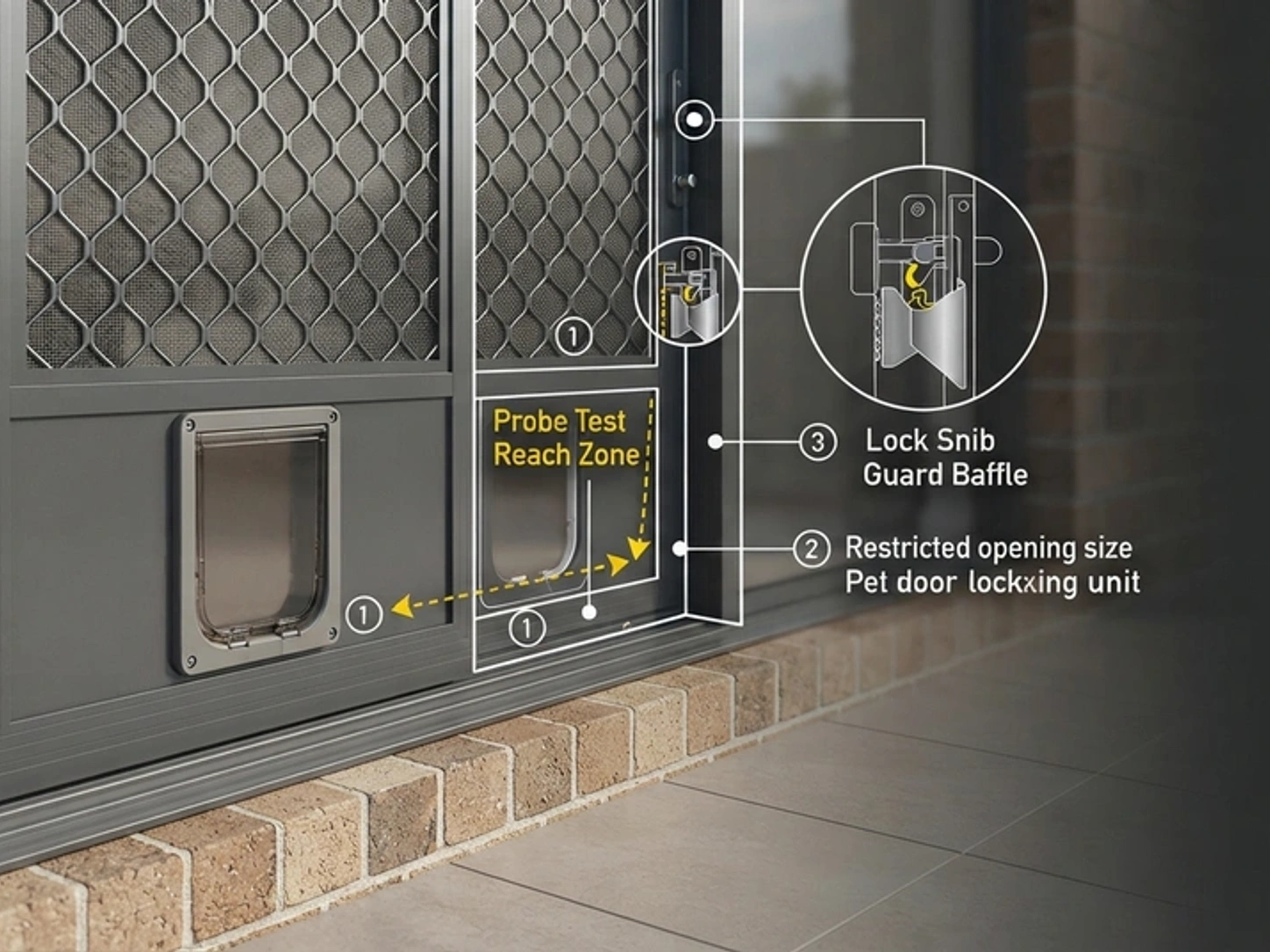
AI-generated illustrative image. Not a product test, certification record or project evidence.
No. Under Australian Standard AS 5039.1:2023 and National Security Screen Association (NSSA) regulations, cutting an opening into the mesh to install a pet door automatically voids the door's formal security certification. The aperture breaches the mandatory AS 5039.3 Probe Test and creates an access point for lock manipulation, reclassifying the product from a certified 'Security Door' to a 'Barrier Door'. However, engineering a pet door within a 316 stainless steel mesh frame with lock shields still provides formidable physical protection compared to standard screens.
Every year, thousands of Australian homeowners order custom security screen doors with an explicit, non-negotiable requirement: they need a pet door so their dog or cat can move freely between the living room and the backyard. In the same breath, they demand that the door carry full certification to Australian Standard AS 5039. To most consumers, combining a heavy-duty stainless steel security screen with a pet flap seems like a straightforward, common-sense engineering request. In the fenestration and security screening industry, however, it represents an absolute regulatory contradiction. Legally and technically, the moment an opening is cut into a security screen for a pet door, the product ceases to be a certified security door.
The Australian Standard verdict: AS 5039.1:2023 and the NSSA ruling
In Australia, the term 'Security Door' is not marketing puffery; it is a legally protected product designation governed by Standards Australia. In November 2023, Standards Australia updated the regulatory framework with the publication of AS 5039.1:2023 (Part 1: Classification and Performance) and AS 5039.3:2023 (Part 3: Methods of Test, superseding the legacy AS 5041 standard).
The official stance of the National Security Screen Association (NSSA)—the peak industry body representing licensed manufacturers—is clear and uncompromising: 'Once a pet door is installed within a security door, it is no longer compliant with Australian Standards, as the opening compromises the security of the door. If it is not labelled with an Australian Standards Compliance Label, it is not a security door.'
By law, reputable Australian fabricators cannot affix an AS 5039 compliance badge to any screen door featuring a pet opening. The product is legally reclassified as a 'Barrier Door' or 'Safety Screen'.
Why pet doors fail AS 5039: the probe test and structural tension
To achieve certification under AS 5039, a security door assembly must pass a battery of six independent laboratory tests: the Dynamic Impact Test, Knife Shear Test, Anti-Jemmy Test, Pull Test, Probe Test, and Shear Test. A pet door fundamentally causes failure across two of these critical hurdles:
1. The Probe Test Failure (Lock Manipulation): The AS 5039.3 Probe Test simulates an intruder attempting to create an opening or insert hands, bent wires, or lever tools through the screen to disengage internal lock snibs, handles, or emergency escape mechanisms. A pet flap—even one with magnetic catches or plastic locking tabs—creates a physical aperture that can easily be pushed inward. An adult intruder can reach an arm through a medium or large dog flap, or slip an angled rod through a cat flap, reaching up to flick the interior lock cylinder into the unlocked position.
2. Structural Mesh Tension Disruption: High-tensile 316 stainless steel woven mesh (0.8mm) relies on uniform perimeter tension across all four edges to withstand the 100-joule sandbag impacts required by the Dynamic Impact Test. Cutting a 250mm x 350mm rectangular opening into the lower half of the mesh severs the structural warp and weft wires. This localized discontinuity creates severe stress concentrations. When subjected to violent kicks, the mesh tears away from the pet door sub-frame, allowing forced entry.
The home insurance dilemma: what policies actually require
This technical reclassification carries tangible legal and financial consequences for homeowners. Major Australian home insurers (including NRMA, AAMI, Allianz, and QBE) frequently ask policyholders during premium calculations whether external doors are fitted with 'deadlocked, Australian Standards compliant security screens'.
If a homeowner declares that their home possesses AS 5039 security screen doors to secure premium discounts, but an intruder gains access by reaching through an unrated pet flap to open the primary entrance, the insurer's forensic assessor can deem the door a non-compliant barrier screen. In worst-case scenarios, claims for burglary can be disputed or reduced due to misrepresentation of physical security measures.
If your home insurance policy relies on security door declarations, always check whether an opening pet door is permissible, or ensure the primary solid timber or double-glazed aluminium entrance door remains deadlocked when the home is unoccupied.
Engineering practical security: how to safely install a pet door
While you cannot achieve a formal AS 5039 compliance certificate with a pet door, you do not have to settle for a flimsy, easily defeated insect screen. Quality architectural window and door manufacturers utilize specific engineering mitigations to preserve maximum physical security:
Structural Aluminium Mid-Rails and Sub-Frames: Rather than simply cutting into raw mesh and screwing flimsy plastic frames onto the wires, professional fabricators build a dedicated extruded aluminium sub-box. Installing an architectural mid-rail or welded corner framework isolates the upper security mesh panel from the lower pet aperture, ensuring the upper two-thirds of the door retains full impact and knife-shear resistance.
Internal Lock Shield Baffles (Anti-Reach Guards): To defeat the Probe Test vulnerability, custom fabricators can install an internal solid sheet baffle or extended aluminium shroud over the interior lock housing. This physical barrier blocks anyone from reaching upward from the pet flap to contact the lock snib, preventing bypass techniques.
Microchip-Activated Electronic Pet Flaps: Upgrading from a free-swinging magnetic flap to an RFID microchip electronic flap prevents stray animals and pests from entering. High-security electronic models feature multi-point motorized deadbolts that lock the rigid acrylic door plate against forced pushing from the exterior.
Removable Security Blocking Panels: Premium pet door systems include heavy-gauge aluminium or steel slide-in security blocking plates. When the family leaves for vacation or goes to sleep at night, the metal plate slides into internal locking channels across the pet opening, converting the door back into a continuous, impenetrable metal barrier.
How SMIRO balances lifestyle convenience and architectural protection
At SMIRO, we believe in radical transparency regarding Australian fenestration standards. When clients with beloved pets consult our team, we clearly explain the regulatory boundary between AS 5039 certified security doors and customized barrier doors.
For properties requiring uncompromised AS 5039 compliance—such as main entrance doors or remote holiday homes—we recommend keeping primary entrance screens completely continuous, outfitting SMIRO Urban Series Hinged Doors with certified 316 stainless steel security screens and 3-point multipoint locks.
For everyday indoor-outdoor living, we design custom pet-integrated sliding screens fitted to our SMIRO Vista Series Sliding Doors and Stacker Doors. By building reinforced sub-frames with heavy-duty 316 marine-grade mesh, heavy-duty rollers, and anti-reach lock shields, we deliver maximum pet freedom without exposing your home to opportunistic intruders.
Frequently Asked Questions
Will a small cat flap breach AS 5039 compliance just like a large dog door?
Yes. Under AS 5039.1:2023, the standard makes no distinction based on the dimensions of the pet flap. Any breach in the continuous infill material violates the Probe Test and invalidates the compliance label. Even a micro cat flap introduces an uncertified joint and potential tool access point that disqualifies the door from carrying the official security compliance badge.
Can an intruder crawl through an extra-large dog door?
Yes, this is a major real-world burglary risk. Extra-large dog doors designed for Great Danes, Mastiffs, or German Shepherds (often measuring 380mm wide by 600mm high) provide ample space for an agile adult or teenage intruder to crawl straight through into the home. For giant breeds, a sliding wall-mounted pet door or a dedicated electronic dog door installed in an enclosed laundry area is significantly safer than installing an opening on an exterior security screen door.
What is the difference in cost between a standard security door and one with a custom pet door?
Adding a professional, factory-installed pet door to a custom stainless steel security door typically adds between $180 and $450 to the total cost. This price covers the specialized pet flap unit (such as a Petway or electronic microchip door), precision factory CNC mesh cutting, structural aluminium perimeter framing, and rubber edge finishing.