
Security & Hardware
What makes high-tensile security screen mesh pet-resistant against dog claws and cat damage?
By Sheng Xu · 18 September 2026
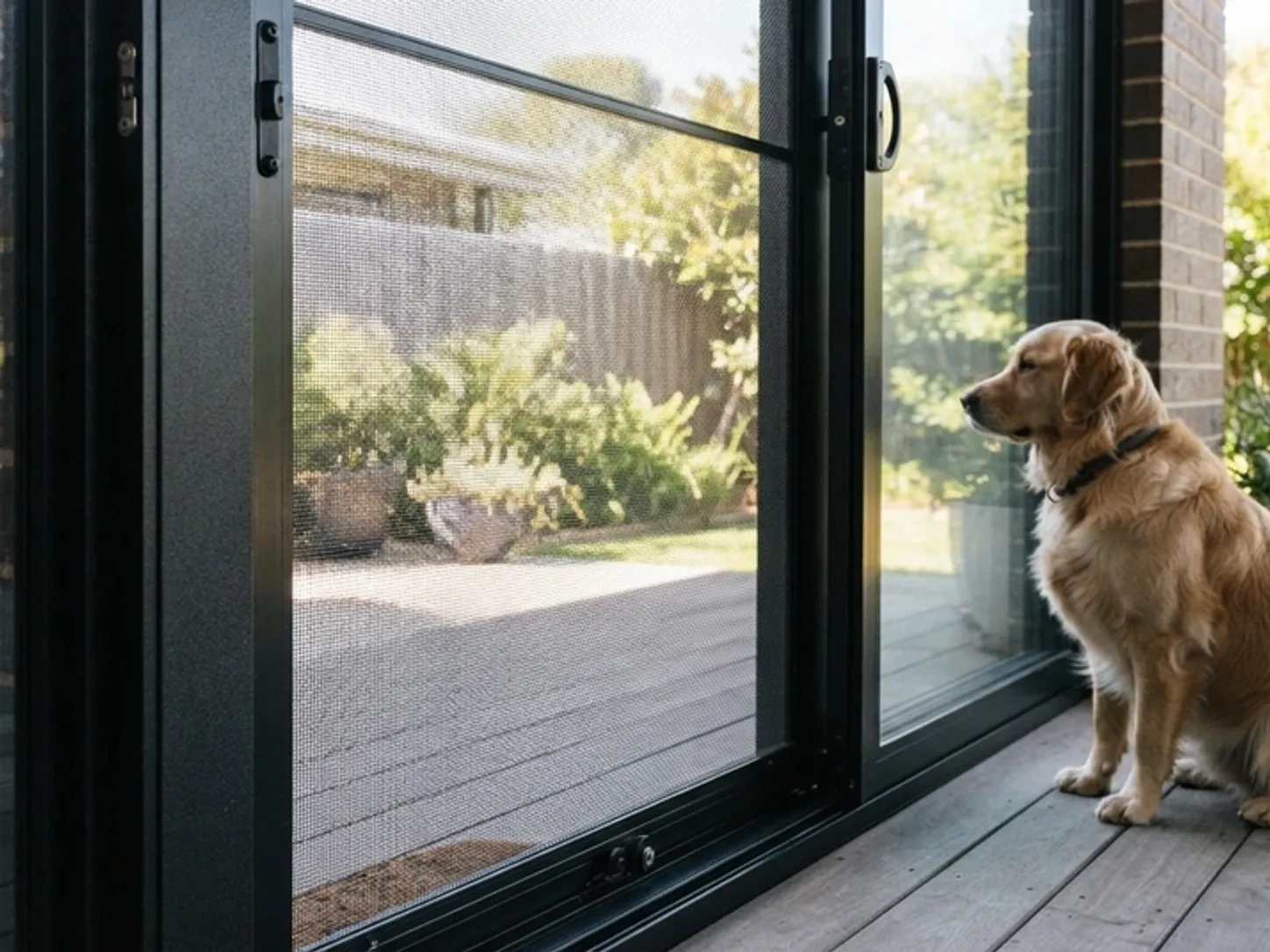
AI-generated illustrative image. Not a product test, certification record or project evidence.
Standard vinyl and fibreglass pet mesh can resist incidental cat scratches, but only high-tensile 316 marine-grade woven stainless steel wire (0.8mm–0.9mm) and structural perforated aluminium sheet provide complete claw-proof, tear-proof, and impact-resistant protection. Unlike conventional screens held by rubber beading that pop under the weight of a running dog, certified security screen mesh is mechanically clamped into heavy-duty architectural aluminium frames, easily withstanding clawing, chewing, and high-energy body impacts.
For Australian pet owners, the battle against shredded insect screens is a perpetual, costly frustration. Traditional fibreglass and aluminium wire flyscreens are exceptionally vulnerable to animal claws: an excited cat climbing a window screen to catch a moth will snag and shred the delicate strands within seconds, while a 25-kilogram dog sprinting towards the garden upon seeing a bird can blow right through a patio door screen. Even products specifically marketed as 'heavy-duty pet mesh' frequently disappoint homeowners after a few months of intense use. Understanding why standard pet meshes fail - and why true high-tensile security screen mesh provides permanent claw immunity - is essential when outfitting modern homes for longevity.
The fundamental flaw of flexible 'pet mesh': why claws and weight destroy it
Hardware store 'pet mesh' (frequently branded as paw-proof or tuff-screen) is manufactured from vinyl-coated polyester or thick PVC-coated fibreglass yarn. While it is undeniably tougher than standard 0.25mm window flyscreen, it remains a flexible textile material that suffers from two insurmountable structural weaknesses:
First, the tensile resistance of polyester and PVC yarns is relatively low under concentrated point loads. A cat's needle-sharp claws exert immense pressure over tiny surface areas (often exceeding 50 megapascals at the tip of the claw). Over repeated scratching cycles, the soft plastic coating frays, the internal fibres stretch, and the woven grid distorts, eventually tearing open into unsightly gaps that allow flies and mosquitoes into the home.
Second, and far more dangerous, is the retention method. Flexible pet mesh is held inside door and window frames using an elastic rubber or vinyl spline cord pressed into a narrow channel. When an active dog—such as an Australian Shepherd, Labrador, or Staffy—jumps against the door, the fabric stretches, creates high lateral tension, and pulls the rubber spline right out of the aluminium extrusion channel. The mesh panel detaches from the frame completely, allowing pets to escape onto the street or into traffic while leaving the door opening completely compromised.
High-tensile 316 marine-grade stainless steel: engineered claw immunity
Genuine architectural security screens solve pet destruction by replacing flexible plastic fabrics with structural metals. The gold standard in Australia is high-tensile 316 marine-grade stainless steel wire mesh, woven with wire diameters between 0.8mm and 0.9mm at a density of approximately 11 by 11 strands per square inch.
The mechanical properties of this material make pet damage physically impossible. High-tensile 316 wire possesses a tensile breaking strength exceeding 900 to 1,000 megapascals. Cat claws simply slip over the smooth, hard black powder-coated wire surface without scratching or catching. Even the most persistent scratching by large dogs cannot bend, dent, or cut the high-tensile wire. In independent laboratory testing governed by Australian Standard AS 5039, this mesh must withstand severe knife-shear cutting tests where heavy surgical steel blades drawn across the surface under high load fail to penetrate the weave.
Furthermore, high-tensile stainless steel wire cannot be chewed. Restless puppies and aggressive chewers that routinely gnaw through plastic flyscreens and wooden door reveals cannot make a dent in rigid 0.8mm marine-grade steel, ensuring the screen maintains its integrity for decades.
Structural mechanical retention: withstanding 100-joule pet impacts
A screen is only as strong as the system that fastens the mesh to the perimeter aluminium frame. True security screen doors discard rubber spline beading entirely in favour of heavy-duty mechanical retention mechanisms.
Under Australian Standard AS 5039 (tested via AS 5039.3 / AS 5041), compliant security screens must survive multiple consecutive dynamic impacts from a 42-kilogram sandbag swung with 100 joules of kinetic energy—simulating an adult intruder attempting to kick through the door. High-end retention systems achieve this through either high-tensile screw-clamp technology or bonded multi-point wedge locking systems that clamp the edges of the stainless steel mesh directly into heavy structural aluminium framing extrusions.
For pet owners, this mechanical anchoring means that when a large dog sprints into the door at full speed, the screen will not blow out of its track. The kinetic energy is safely absorbed across the entire perimeter frame, keeping your pet securely inside the home and preventing expensive screen blowouts.
Alternative options: perforated aluminium sheet (1.6mm - 2.0mm)
For households seeking an alternative to woven wire, structural perforated aluminium sheet mesh (commonly manufactured from 1.6mm to 2.0mm thick architectural 5052-grade marine alloy) provides exceptional pet resistance. Rather than individual woven wires, this system features a solid metal plate punched with 2.2mm circular apertures.
Because it is a single continuous sheet of hardened structural metal, there are no wire intersections for claws to snag. Animals cannot grasp or grip the surface, and the smooth powder-coated finish is impervious to claws, teeth, and weather. While perforated aluminium provides slightly less open airflow area (approximately 38% open area versus 42% for woven stainless steel), it provides robust pet security combined with enhanced daytime privacy.
Optical clarity and ventilation: why black mesh beats grey pet flyscreen
A common misconception among homeowners is that upgrading to heavy stainless steel security mesh will darken living areas or obstruct views into the garden where pets play. In reality, the optical physics of security screen mesh produce superior visual clarity compared to thick polyester pet flyscreen.
Thick vinyl pet mesh uses fat yarn (0.5mm to 0.7mm) with small openings, blocking up to 45% of incoming daylight and scattering light reflections off its grey or charcoal surface. In contrast, 316 stainless security mesh uses thin 0.8mm high-tensile wires coated in an ultra-matte black UV-stabilised powder coat. The human eye easily focuses past the slim black wire grid onto the sunlit outdoors, creating an almost invisible barrier from inside the house while delivering approximately 70% of natural airflow.
SMIRO architectural fenestration and integrated pet-proof screening
At SMIRO, we believe that modern architectural doors and windows should deliver expansive views, effortless indoor-outdoor flow, and total peace of mind for pet-owning families. When designing large-format sliding doors or multi-panel openings, integrating pet-proof security screens during initial factory fabrication eliminates clunky aftermarket retrofits.
Our high-performance architectural door suites—including the SMIRO Vista and Urban Series Sliding Doors and Stacker Doors—feature purpose-engineered sub-tracks designed specifically to carry heavy-duty 316 stainless steel security screen sliding leaves without sagging or jumping the track. For wide entertaining areas featuring SMIRO Living and Comfort Series Bi-Fold Doors, our engineering team supplies coordinated multi-panel security screen systems that fold away cleanly alongside the primary glazed leaves.
Furthermore, for second-storey bedrooms and highlight openings, pairing SMIRO Awning Windows or Sliding Windows with custom AS 5203 fall-prevention security screens protects curious cats and active children from window falls while complying fully with National Construction Code fall-protection mandates.
Frequently Asked Questions
Can a cat climb up 316 stainless steel security mesh without damaging it?
Cats will occasionally attempt to climb woven stainless steel mesh to reach higher vantage points. The mesh itself will suffer zero damage: high-tensile 316 stainless wire will not stretch, bend, or fray under cat claws. However, cat paws can occasionally get wedged between wires if they jump violently. For energetic climbing cats, smooth perforated aluminium mesh (which offers no grip for climbing claws) is often the preferred selection.
Will dog urine cause stainless steel security screen mesh to rust?
Animal urine contains concentrated uric acid and ammonia salts that are aggressive to metal finishes. While 316 marine-grade stainless steel wire and its exterior powder coating are exceptionally corrosion-resistant, pet urine left unwashed at the base of a door can eventually cause tea staining or galvanic bubbling along the bottom aluminium frame rebate. If a dog marks the door, simply rinse the lower section with clean water and a mild car wash shampoo every few weeks to maintain the factory warranty.
Is pet mesh cheaper than 316 stainless steel security mesh?
Yes, vinyl pet mesh in a lightweight safety screen door typically costs between $250 and $450, while a certified 316 stainless steel security screen door costs between $650 and $1,200 supplied and installed. However, because vinyl pet mesh typically stretches, sags, and pops out of its spline within two to three years of aggressive pet use, investing in structural stainless security mesh pays for itself by eliminating repeated rescreening and repair costs over its 20-plus year lifespan.