
Energy & Sustainability
How does security screen mesh act as solar shading to reduce radiant heat and UV transmission?
By Sheng Xu · 18 September 2026
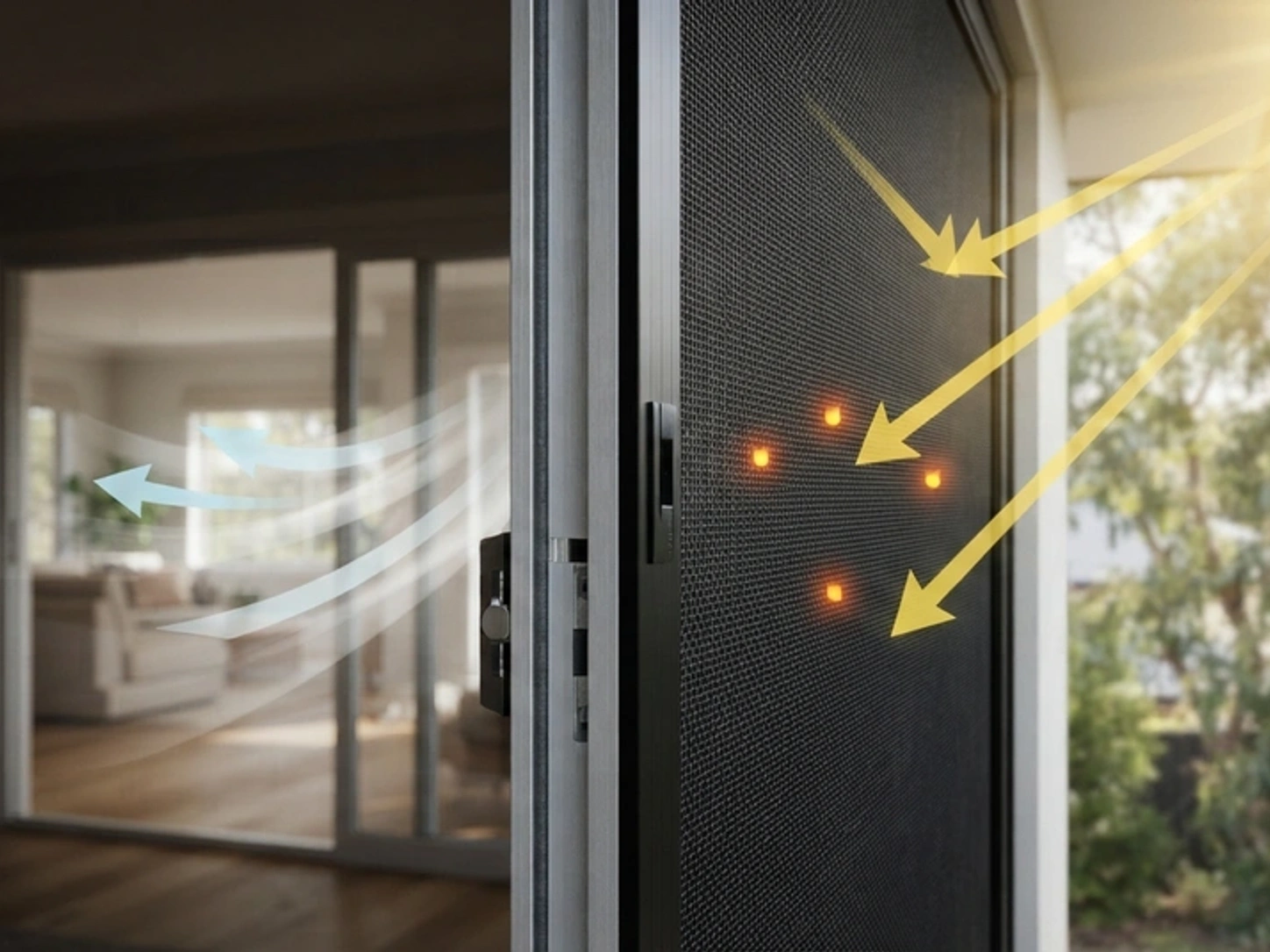
AI-generated illustrative image. Not a product test, certification record or project evidence.
Installed on the exterior of windows and doors, high-tensile 316 stainless steel security mesh intercepts intense solar radiation before it strikes the glass, decreasing total solar heat gain by up to 52% to 53% and reducing radiant heat flux by up to 59% (tested under AS 1530.4). By filtering out up to 60% of damaging UV radiation, external security screens function as permanent, windproof passive shading appliances that achieve up to 4.5 WERS cooling stars and assist homes in meeting NCC 2022 energy caps.
When Australian homeowners invest in security screen doors and window grilles, they almost universally view the purchase through a single functional lens: physical security against home invasion. They expect the screen to stop crowbars, resist kicks, and prevent knife slashing. What few people realise is that modern architectural security screen mesh acts as one of the most effective, maintenance-free passive solar shading appliances available in the building industry. In rigorous independent testing governed by the Window Energy Rating Scheme (WERS) and the Australian Glass and Window Association (AGWA), outfitting glazed windows with external woven stainless steel security mesh cuts solar heat gain by up to 53%, blocks damaging ultraviolet radiation, and dramatically reduces air conditioning operating costs.
The thermodynamics of solar shading: external screening vs internal blinds
To appreciate why security screens are so effective at thermal control, it is essential to understand the physics of solar heat gain through architectural glass. In modern homes, unshaded glazing is responsible for up to 87% of total summer heat gain.
Most homeowners attempt to manage summer heat by drawing internal window treatments—such as roller blinds, curtains, or timber plantation shutters. Thermodynamically, this is an exercise in futility. By the time sunlight hits an internal blind, shortwave solar radiation has already penetrated through the glass pane into the building interior. The internal blind absorbs the light, heats up like an electric radiator, and re-radiates longwave infrared thermal energy directly into the room air. This is the classical greenhouse effect: the heat is already trapped inside the building envelope.
External security screen mesh operates on the fundamental engineering principle of exterior interception. Because the screen is mounted on the outside face of the window frame, it intercepts intense solar radiation before it ever touches the primary glass surface. The tightly woven 0.8mm high-tensile wire grid absorbs and scatters direct radiant energy. As heat warms the exterior metal wires, natural convective airflow across the building façade dissipates the thermal energy straight into the outside atmosphere, keeping the glass cool and stopping conductive transfer dead in its tracks.
Quantifying the numbers: WERS ratings and 53% solar heat reduction
The solar performance of security screens is not anecdotal; it is validated by standardized computer modelling and laboratory test procedures under the Window Energy Rating Scheme (WERS). When an external stainless steel security screen is installed over a standard clear single-glazed aluminium window, the thermal performance improvements are dramatic:
Solar Heat Gain Coefficient (SHGC) Slash: Standard 3mm or 4mm clear float glass exhibits a Solar Heat Gain Coefficient (SHGC) of roughly 0.75 to 0.82, meaning 75% to 82% of all solar heat striking the window transfers directly into the living space. Adding an external woven 316 stainless security screen drops the effective system SHGC by up to 52% to 53%, slashing heat transmission to below 0.38.
WERS Cooling Stars: Under WERS star rating simulations, applying high-performance security screens elevates basic glazed openings to achieve up to 4.5 stars for cooling performance. In hot, sun-drenched regions—including Queensland, Western Australia, and western Sydney—this massive reduction in peak solar load takes substantial pressure off split-system air conditioners, reducing cooling energy consumption and lowering household quarterly electricity bills.
Radiant heat flux reduction under AS 1530.4 (fire attenuation)
The radiant barrier capabilities of security mesh are so potent that they are formally certified for fire protection. Under Australian Standard AS 1530.4 (Methods for fire tests on building materials and structures, Appendix B7), high-tensile stainless steel security screens are subjected to intense radiant heat flux testing simulating bushfires and adjacent building fires.
During laboratory testing, premium woven 316 stainless steel security mesh achieves an extraordinary 59% reduction in incident radiant heat flux between the exterior fire source and the glass envelope behind it. This attenuation prevents building glass from undergoing sudden thermal shock (which causes ordinary annealed and toughened glass to shatter during bushfires) and prevents internal furnishings near windows from spontaneously combusting from extreme infrared radiation.
This radiant heat mitigation is also the scientific foundation for why AS 5039 certified security screens satisfy the stringent Bushfire Attack Level (BAL) 40 requirements of AS 3959, shielding homes from airborne ember attack and intense convective heatwaves.
UV radiation filtration: saving floors, furniture, and artwork
Direct solar heat is not the only destructive force passing through residential windows. Ultraviolet (UV) radiation—specifically UV-A and UV-B wavelengths—is the primary driver of photolytic fading and material degradation inside Australian homes. Harsh UV rays bleach expensive timber floorboards, crack leather sofas, fade vibrant rug dyes, and deteriorate window curtains.
Standard clear float glass only blocks about 20% to 25% of UV radiation. By contrast, the microscopic cross-wire grid of 0.8mm woven black security mesh physically blocks and filters out up to 60% of incoming UV rays. It provides continuous, maintenance-free sun protection for your valuable interior furnishings 365 days a year, without requiring tinted window films that can bubble, peel, or cause glass thermal stress fractures.
Synergy with NCC 2022 7-star NatHERS cooling load limits
Under the National Construction Code 2022 (NCC 2022), Australian home designs must clear strict independent cooling load limits (measured in megajoules per square metre per year) to obtain a building permit. Modern architectural plans featuring expansive west-facing sliding doors frequently fail their cooling load cap because unshaded afternoon sun superheats the living areas.
Specifying factory-integrated external security screens on western and northern elevations serves as an approved, cost-effective passive shading device. Because the screen blocks over 50% of direct solar heat, NatHERS software engines calculate a significantly lower annual cooling demand. For builders and architects struggling to make large alfresco door openings comply with NCC 2022 cooling limits, external security screens provide an elegant design solution that preserves large glass spans without requiring bulky awnings or motorized external louvres.
SMIRO fenestration: combining Low-E thermal breaks with solar security screening
At SMIRO, we design fenestration systems that address both conductive heat transfer and radiant solar heat gain as an integrated whole.
While our thermally broken aluminium frames and argon-filled Low-E double glazing minimize conductive winter heat loss and seal against air infiltration, pairing our large-format SMIRO Vista and Urban Series Sliding Doors with custom 316 stainless security screens provides the ultimate dual-layer climate barrier. The outer security screen deflects 53% of radiant summer heat before it touches the glass, while the inner double-glazed unit locks in internal climate control, delivering year-round acoustic comfort, energy savings, and uncompromising physical protection.
Frequently Asked Questions
Will security screen mesh block useful winter solar heating?
Because security screens are permanently fixed external screens, they do filter some direct solar gain during winter (reducing winter passive solar heating by approximately 30% to 40%). However, in most Australian climate zones—where annual summer cooling costs and heatwave discomfort far outweigh winter heating penalties—the net annual energy benefit remains substantially positive. Furthermore, on winter nights, the mesh acts as a subtle windbreak that reduces cold air velocity against the glass, marginally lowering conductive heat loss.
Does window tinting provide the same heat reduction as security screens?
No. Window tinting films applied to internal glass surfaces absorb solar heat and transfer it into the glass pane, which often increases the risk of thermal stress fractures on double-glazed units. External security screens intercept heat before it strikes the glass, allowing convective air currents to blow the heat away. Additionally, window film offers zero physical break-in resistance, no insect protection, and cannot provide fresh air ventilation.
Can security screens be counted towards NatHERS energy rating calculations?
Yes. If security screens are permanently installed as part of the window and door supply contract, energy assessors utilizing certified NatHERS software (such as FirstRate5, BERS Pro, or HERO) can model external shading devices using verified WERS product data, directly lowering modelled cooling energy loads.