
Cost & Practical Guides
Stacker Doors Price in Australia: What Aluminium Stacker Doors Cost and What to Give a Supplier to Get a Real Quote
By Sheng Xu · 4 October 2026
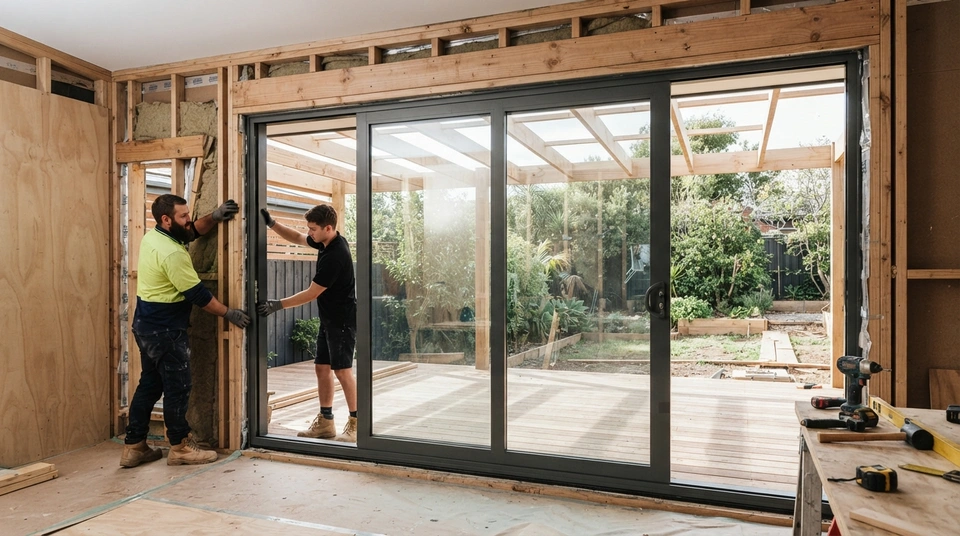
AI-generated illustrative image. Not a product test, certification record or project evidence.
In Australia, supply-only prices for aluminium stacker doors range from $1,565 to $3,500 for standard 3-panel systems (2.4m to 3.6m wide) and from $2,800 to $6,500+ for 6-panel centre-opening systems (4.8m to 7.2m wide). Professional installation adds $800 to $1,800 for direct replacements, or $3,500 to $8,000+ if widening an opening with a new structural steel lintel. Panel count influences price as heavily as width because each extra moving panel adds specialized interlocking extrusions, precision rollers, and certified double glazing. Getting an accurate, binding quote requires supplying 7 essential inputs, including structural opening dimensions, panel handing, frame depth, glazing make-up, and screening specifications.
For Australian homeowners planning an extension, alfresco renovation, or new architectural build, aluminium stacker doors are often at the top of the wish list. Their ability to slide multiple glass panels into a compact stack creates an enviable indoor-outdoor transition. However, navigating the cost of aluminium stacker doors can be challenging. Online estimates vary wildly from generic $1,200 entry-level figures on directory sites to $15,000+ custom architectural quotations.
The wide price variance stems from three fundamental realities: first, stacker doors are multi-track systems where configuration moves cost just as aggressively as physical width; second, the National Construction Code (NCC 2022) 7-star energy mandate makes high-performance double glazing the standard across most Australian climates; and third, structural carpentry or masonry alterations required to create or widen a 3- to 6-metre opening frequently cost more than the door itself. Understanding published industry benchmarks and knowing exactly what information to provide a joinery supplier is essential to securing a realistic, binding quote.
Current Aluminium Stacker Door Prices in Australia (Supply-Only Benchmarks)
Supply-only prices cover the manufactured aluminium door unit—including the outer perimeter frame, moving sashes, fixed panels, standard glazing, stainless steel rollers, and keyed mortise hardware—delivered to site, excluding builder installation labour.
Based on current published Australian stock lists and fabricator price schedules (such as A&D Building Supplies in Queensland, Windows and Doors Sydney in New South Wales, and Stock Windows in Victoria), supply-only prices for standard residential stacker doors fall into predictable tiers:
3-Panel Stacker Doors (Single-Direction Stack, XXO / OXX):
• Size 2124 (2100mm H x 2238mm to 2400mm W): $1,565 to $2,300 in single glazed; $2,500 to $3,200 in double glazed (e.g., 5+9Ar+5 toughened glass).
• Size 2130 (2100mm H x 2688mm to 3138mm W): $1,740 to $2,650 in single glazed; $2,800 to $3,600 in double glazed.
• Size 2436 (2400mm H x 3588mm to 3600mm W): $2,080 to $3,200 in single glazed; $3,500 to $4,500 in double glazed.
• Size 2440 (2400mm H x 4038mm W Architectural Max): $2,240 to $3,600 in single glazed; $3,800 to $4,900 in double glazed.
6-Panel Stacker Doors (Centre-Opening Bi-Parting, OXXXXO):
• Size 2145 (2100mm H x 4446mm to 4500mm W): $2,805 to $3,900 in single glazed; $4,200 to $5,400 in double glazed.
• Size 2154 (2100mm H x 5346mm to 5400mm W): $3,125 to $4,300 in single glazed; $4,800 to $6,200 in double glazed.
• Size 2460 (2400mm H x 6000mm to 6246mm W): $3,425 to $4,800 in single glazed; $5,400 to $7,200 in double glazed.
• Size 2472 (2400mm H x 7200mm W Architectural Span): $4,200 to $5,800 in single glazed; $6,500 to $8,800+ in custom commercial double glazed.
The Panel Count Paradox: Why 6-Panel Doors Cost More than Wide 3-Panel Doors
A common point of confusion for buyers is why door prices do not scale purely on physical width. Sourcing directly from published stock schedules reveals a clear pricing anomaly: a 4.4m wide 6-panel centre-opening stacker costs $2,805 (A&D Brisbane), whereas a 4.0m wide 3-panel stacker costs only $2,240—a 25% price increase for just 40cm of additional width.
The explanation lies in mechanical complexity. A 3-panel stacker has only one fixed panel and two moving sashes on a 3-track sill. A 6-panel bi-parting stacker incorporates two fixed panels and four moving sashes. It requires twice as many glass cutting and toughening steps, four sets of structural interlocking stiles instead of two, double the number of stainless steel roller carriages (8 rollers vs 4), dual-point centre meeting stile locksets, and twice the factory assembly labour.
When budgeting wide openings, panel count is just as significant a cost multiplier as total width. If your structural span is 4.0 to 4.5 metres, choosing a 3-panel configuration with wider panels (~1.3m each) will almost always save $800 to $1,500 compared to a 6-panel configuration of identical overall dimensions.
Supply-Only vs. Fully Installed: Understanding Labour and Site Costs
Installing an aluminium stacker door is not a standard handyman job. Because stacker frames span up to 6 or 7 metres and carry hundreds of kilograms of double-glazed glass, proper installation requires a licensed builder, carpenter, or qualified glazier.
In Australia, installation labour for stacker doors is typically quoted in two ways:
Direct Replacement Installation ($800 to $1,800): Applies when the stacker door is being fitted into a pre-existing opening of identical dimensions (e.g., replacing an old timber slider with a new aluminium stacker). This includes removing and disposing of the old door, checking and packing the sub-floor, fitting continuous sill flashing, plumbing and squaring the aluminium frame, installing pre-primed timber reveals (138mm to 160mm), inserting and adjusting glazed sashes, and applying external silicone weather-seals.
Complex Architectural Installation ($1,800 to $3,500+): Applies to upper-storey installations, sites with restricted crane or carry access, zero-threshold flush drain integrations, or commercial sub-sill installations requiring extensive perimeter waterproofing under AS 2047.
Hourly rates for licensed glaziers and carpentry contractors currently sit between $80 and $120 per hour across metropolitan Sydney, Melbourne, Brisbane, and Perth. A standard 3-panel replacement typically requires two tradespeople for roughly 4 to 6 hours.
The Hidden Structural Cost: Replacing vs. Widening an Opening
The single largest financial surprise for renovating homeowners occurs when a project requires widening an existing 1.8m or 2.4m sliding door opening to accommodate an expansive 3.6m or 6.0m stacker door. In an existing home, exterior walls are load-bearing, carrying roof trusses, ceiling joists, and upper-storey loads.
You cannot simply cut a wider hole in the wall. Widening an opening requires major structural engineering and carpentry works, which fall entirely outside the door joinery supplier's quotation:
1. Structural Engineering Certification ($600 to $1,200): A certified structural engineer must inspect the site, calculate roof and wall dead/live loads, and produce certified computation sheets and lintel beam specifications for council approval.
2. Temporary Propping & Demolition ($600 to $1,200): The builder must install Acrow props and needle beams inside the room to physically support the roof trusses while the existing wall framing, lintel, and brickwork are cut away.
3. Structural Lintel Installation ($1,500 to $3,500): For spans over 3.6m, standard timber headers are insufficient. Builders must supply and crane-lift a heavy steel Parallel Flange Channel (PFC) beam, Universal Beam (UB), or deep engineered Laminated Veneer Lumber (LVL) beam, supported on new structural steel posts or laminated timber stud columns.
4. Masonry, Flashing & Plaster Making-Good ($1,200 to $2,500): Brick cut-backs, cavity closers, damp-proof course (DPC) installation, internal plasterboard patching, cornicing, and exterior cladding returns.
In total, widening an opening or creating a new opening from scratch typically adds $3,500 to $8,000+ in structural builder costs on top of the door's purchase and installation price.
Key Specification Cost Drivers: Glazing, Screens, BAL Ratings & Finishes
When comparing quotes, small differences in specification can alter the invoice by thousands of dollars:
Glazing Make-Up: Standard single toughened glass (4mm–6mm) is the cheapest option but cannot pass NCC 2022 7-star NatHERS energy caps in southern and temperate Australian climates. Upgrading to an insulated glass unit (IGU) with argon gas (e.g., 5mm Clear Toughened + 9/12mm Argon + 5mm Toughened) adds $800 to $2,500. Upgrading to acoustic laminated glass (such as 6.38mm or 8.38mm laminate) to block traffic noise along major urban corridors adds 25% to 40% to the glazing cost.
Integrated Insect and Security Screens: Because stacker doors utilize wide multi-track extrusions (such as the SMIRO Urban Reinforced 240mm series), dedicated stacking screen tracks must be factored in. Basic fibreglass mesh stacking flyscreens add $400 to $800. If physical security is required, upgrading to AS 5039 certified security screen doors featuring 0.8mm 316 marine-grade stainless steel mesh and three-point keyed locks adds $1,200 to $2,400 for a 3-panel set.
Bushfire Attack Level (BAL) Compliance: Homes located in designated bushfire prone areas must comply with AS 3959. Upgrading a stacker door from standard residential construction to BAL-29 or BAL-40 requires upgrading glass to a minimum 5mm or 6mm toughened safety glass, fitting metal hardware and all-metal bug strips, and installing bronze or stainless steel screen mesh, adding 15% to 25% to the product price.
Powder-Coat Finishes: Standard architectural powder-coat colours (such as Monument, Black, Pearl White, and Surfmist) carry no price premium. Specifying custom Dulux Electro or premium anodised coastal finishes (25-micron marine grade) adds 15% to 25% to the aluminium extrusion cost.
The 7 Things to Give Your Supplier to Get an Accurate, Binding Quote
Joinery fabricators frequently quote high or add substantial contingency buffers when customer requests lack crucial technical specifications. To receive a fast, accurate, and binding quote, provide your supplier with this 7-point checklist:
1. Exact Structural Opening Dimensions: Measure stud-to-stud width and subfloor-to-lintel height. Deduct 20mm clearance (10mm per side for packing) to state your desired overall outer frame size (e.g. '2100mm H x 3000mm W outer frame'). Never measure the old door panel alone.
2. Panel Count and Stacking Direction (Handing): Specify whether you want a 3-panel (XXO / OXX) or 6-panel (OXXXXO) system, and state the opening direction viewed strictly from the outside looking in (e.g., '3-panel stacking to the left when viewed from outside').
3. System Series and Frame Depth: Specify whether you require a standard 3-track architectural frame (such as SMIRO Vista 187mm) or a heavy-duty frame with integrated screen tracks (such as SMIRO Urban Reinforced 240mm).
4. Glazing and Energy Performance: State the required glass make-up (e.g. 'Double glazed 5mm Toughened + 12mm Argon + 5mm Low-E Toughened') or your NatHERS target whole-window values (Uw and SHGCw).
5. Screening Requirements: Clearly declare whether screens are required at fabrication stage (e.g., 'Matching 3-track sliding flyscreens' or 'AS 5039 certified 0.8mm stainless security screens').
6. Installation Fixing and Site Exposure: Specify fixing method (pre-fitted timber reveals—e.g. 138mm primed pine—or aluminium fin fixing), local wind classification (N1, N2, N3, or N4 under AS 4055), and Bushfire Attack Level (BAL).
7. Delivery Location and Site Access: Provide delivery address, whether offloading requires a hiab crane truck, and whether panels must be carried to ground-floor or upper-storey living zones.
Frequently Asked Questions
How much does a standard 3-panel aluminium stacker door cost in Australia?
For a standard residential 3-panel aluminium stacker door measuring 2.1m high by 3.0m wide, supply-only prices typically range from $1,885 to $2,650 for single glazing, and $2,800 to $3,600 for high-performance double glazing. Fully installed into an existing opening, expect to pay between $3,500 and $5,500 total.
Why is a 6-panel stacker door so much more expensive than a 3-panel door?
A 6-panel centre-opening stacker has four moving sliding panels and two fixed panels. This requires twice as many glass units, four interlocking stile sets, two separate mortise lock mechanisms, eight heavy-duty roller carriages, and significantly more fabrication time than a 3-panel system, pushing supply-only prices to between $3,500 and $7,200+.
Is double glazing required on stacker doors under NCC 2022?
Under NCC 2022 7-star NatHERS energy efficiency provisions, expansive glazed openings like stacker doors almost universally require double glazing in climate zones 4, 5, 6, 7, and 8 (Sydney, Canberra, Melbourne, Adelaide, Hobart, and Perth) to satisfy stringent heating and cooling load caps and prevent winter condensation.
How much does it cost to install a stacker door where a window currently sits?
Replacing a standard window with a stacker door requires removing the sub-sill brickwork or wall framing down to floor level. If the opening width is unchanged, this conversion typically costs $1,500 to $2,500 in builder labour. If the opening must also be widened horizontally, structural steel lintel installation and masonry demolition will add $3,500 to $8,000+ in structural costs.
Plan Your Stacker Door Budget with SMIRO
Investing in an aluminium stacker door delivers unmatched lifestyle appeal and long-term property value when specified with precision. By selecting the right panel configuration, ensuring double-glazed compliance with NCC 2022, and budgeting realistically for structural framing, you can transform your living space without unexpected cost blowouts.
To receive an exact, factory-direct quotation tailored to your architectural plans, visit our SMIRO Stacker Door System Page, explore our custom quoting service, or consult our technical guides on stacker door sizes & dimensions and stacker doors vs bifold doors to find the perfect fenestration solution for your build.
Our Products
Stacker Doors
View system
Bi-folding Doors
View system
Sliding Doors
View system
Fixed Windows
View system
Sliding Windows
View system