
Cost & Practical Guides
Changing Window Frames: What Replacing Old Aluminium Windows Involves
By Sheng Xu · 23 November 2026
AI-generated illustrative image. Not a product test, certification record or project evidence.
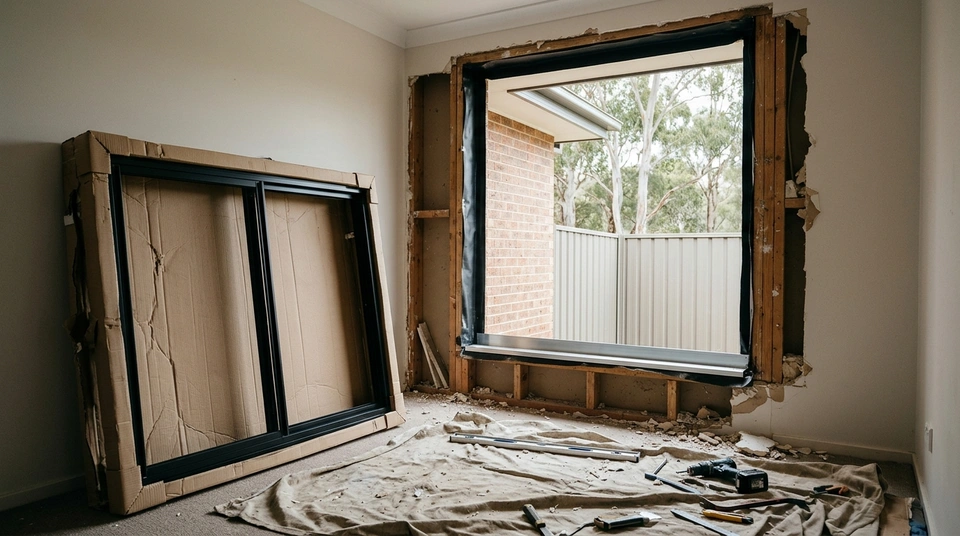
Changing window frames means taking the old aluminium frame out of the wall opening and deciding what goes back: a complete new assembly fixed into the structural opening, or a new unit fitted inside the existing frame. A frame alone cannot usually be swapped around the glass it held, because in an aluminium window the frame is the window. Plan on four to eight weeks of manufacturing, one to three days on site for a typical house, then flashing, sealing and internal making good.
Changing window frames on a house built in the 1970s or 1980s is a sequence of decisions rather than one job. What comes out depends on the wall type, the timber behind the old frame, and whether the new window keeps the same size. What follows is the order a crew works in: survey and order, removal, inspecting the opening, flashing, fixing, sealing and finishing. Measuring is covered separately, so this starts once the order is placed.
What changing window frames actually involves
A window has four parts, and buyers often mean different ones. The frame is the outer aluminium extrusion fixed to the wall. The sash or panel is the part that opens. The reveal is the lining around the depth of the opening, usually timber. The architrave is the trim covering the joint between reveal and wall lining. In an aluminium window the frame and its sashes are one system, so the frame cannot be swapped while the original glass and hardware stay. Some sliding systems allow a new panel and rollers into a sound frame, and Meichen Windows and Doors (June 2026) treats that sash-only swap as reasonable only where the frame is square, runs smoothly and shows no corrosion or failed seals. Where the frame is the failing part, the frame is what gets replaced.
Full frame replacement versus an insert into the old frame
Full-frame replacement takes the old frame out and fixes a complete new assembly into the structural opening. An insert, also called a pocket or retrofit unit, fixes the new window inside the old frame and leaves plaster, cladding and reveals untouched. The insert is quicker: Hans Aluminium (August 2026) puts it at about an hour per window against four to six hours for full-frame work. The trade-off is glass area, plus the risk that an out-of-square or damp retained frame keeps failing around a sound new unit. Aurenoo (September 2026) is blunt that an insert is poor value if it leaves decay or water entry unresolved, and advises asking for a section drawing showing old frame, new frame, seals and drainage path. Only full-frame work changes window size or style and renews flashings.
Removing frames from brick veneer, weatherboard and double brick
Removal is where damage happens, and the method changes with the wall. In brick veneer the brick skin carries no structural load, so the new window is fixed to the structural timber or steel reveal and never to the veneer itself (Simply Doors and Windows, October 2026). The crew strips architraves and internal linings, then cuts or unscrews the old frame free instead of levering it out, because levering cracks the brick courses beside the opening. Many older units sat straight against the brick with no cavity flashing, so expect a deteriorated timber reveal and allow time to fix it before the new frame goes in.
Weatherboard is the most forgiving wall. The window sits in a timber frame inside the cavity, so the crew lifts the cladding, cuts the old fixings, slides the new unit in and refixes, with the flashing deciding whether the joint lasts (Weatherall, April 2026). Double brick is the least forgiving. Both skins are load bearing around the opening, old frames may be tied into the brickwork or held with masonry anchors, and cutting them free leaves fixings and render to patch. Weatherall notes that century-old double brick in Brunswick and Northcote can hide rot behind the frame and openings shifted out of square.
Timber reveals and architraves: structural and cosmetic
Two pieces of timber get confused here. The reveal lines the depth of the opening and belongs to the structural interface: the AGWA Guide to Residential Installation, version 4 (July 2020), secures aluminium frames in brick veneer by screwing through the reveal into stud work, and fixes the reveal itself to stud frame and lintel. The architrave is decoration over the joint between reveal and wall lining, and period homes often have a profile worth matching before anyone orders. A replacement disturbs both, and a frame of different profile depth may not meet the old architrave line. Clearfox (November 2026) advises walking each opening with the installer and asking whether making good of the reveal and architrave is in scope, who repairs the plaster, and whether painting is included.
Flashing, head gaps and the NCC 2022 rules
NCC 2022 Housing Provisions Part 8.2 sets the installation rules, and they apply to replacement work as much as to new builds. Structural building loads must not be transferred to the window assembly. A minimum 10 mm gap is required between the top of the assembly and any loadbearing framing or masonry wall element, and it may need to be larger over wide openings to allow for frame settlement. Packing, where used, must sit along each side and bottom, must be fixed so the sides and bottom stay straight, and must stay clear of flashing. Where aluminium sills may contact masonry, an isolating material such as a bituminous membrane is used.
Flashing is the other half of the weatherproof detail. Simply Doors and Windows (October 2026) describes brick veneer flashings that run at least 150 mm past each side of the reveal, turn up at least 150 mm into the cavity and embed at least 30 mm into brick, lapped so sarking sits over the head flashing, head over jamb, jamb over sill, with weepholes clear. The AGWA installation guide is direct that installation problems are the prime cause of window leaks, through omitted or incorrect flashing, smothered weepholes or a break in the water barrier. Building Commission NSW (July 2025) notes that AS 2047 requires flashing to comply with AS 4773.2. The gap rule is worked through in SMIRO's NCC 2022 window installation guide.
Making good after the frames are out
Making good is the part homeowners assume is included and often is not. Internally it can mean plaster repair, new corner beads, filler, new architrave and a paint touch-up, because careful removal still leaves nail holes and a paint line. Externally it can mean a render patch, repointing where the opening changed, or a new sealant bead. Haines Glass (November 2025) lists finishing, plaster repair, cladding touch-ups and painting among the lines most often left out of a window quote, and advises getting the answer in writing.
How long a house takes
A single window is out and replaced in an hour or two, and an insert is faster than a full-frame swap. Hans Aluminium (August 2026) puts a standard window at one to two hours and a house of 10 to 15 windows at one to three days of installation, with manufacturing at four to eight weeks and 60 to 80 per cent of elapsed time, so a project usually runs six to twelve weeks from contract to handover. Weatherall (April 2026) puts a three-bedroom Melbourne house of eight to twelve windows at a two-day install and four to six weeks of manufacturing. Access breaks schedules: first-floor openings, scaffolding and narrow side paths slow the crew.
What a frame replacement costs, and where the figure comes from
Cost is the last question and the widest range, because window count, glazing, wall type, access and the amount of making good all move it. Publisher-dated market ranges and the lines they do and do not cover are set out in the window replacement cost guide. SMIRO does not publish a price list: it quotes from drawings, elevations or a window schedule, and standard quotes are supply only, so ask for supply and installation if you want both. Send your sizes or elevations through the quote request page for a figure for your house.
Frequently asked questions
Can you replace just the frame of a window?
Not while keeping the glass. The frame is the window: the glass is cut to it, the sashes are made for it, and the fixing and drainage details run through it. The real choices are full-frame replacement, an insert inside a sound existing frame, or reglazing the existing frame. If the frame is corroded, warped or leaking, the new frame is the whole job, not a spare part.
Is it better to replace just the insert or the whole window frame?
It depends on the frame, not on budget alone. An insert suits a frame that is square, sound and draining properly, and it keeps internal finishes intact. Full-frame replacement is the better spend where the frame is corroded, the reveal is soft, the flashing has failed, or the window size and style need to change, because an insert fixes none of those.
Can a rotted or corroded window frame be repaired?
Timber reveals and architraves can usually be repaired or replaced piece by piece, and that work is routine during a replacement. An aluminium frame that has corroded through, lost its shape or no longer holds a panel straight is a different case. Patching does not restore the profile or the drainage path, so a new window is normally the only way to get a weathertight result.
Does removing old frames damage the brickwork?
It can, which is why frames are cut free from their fixings rather than levered out. Brick veneer is the more forgiving case because the brick skin is non-structural. Double brick carries load in both skins and old frames may be tied into the brickwork, so expect some patching, repointing or render repair around the opening. Any cracking that predates the job should be assessed before the new window is ordered.
How long is a window opening left open?
A crew aims to have each window out and replaced the same day, so the house is not open overnight. Where rot or a sizing problem stops that, the opening is boarded and sealed until work resumes (Weatherall, April 2026). A whole-house job of eight to twelve windows usually runs across one to two days, one room at a time.
Key takeaways: changing window frames comes down to full-frame replacement, an insert into a sound existing frame, or reglazing, and the honest answer to a frame-only swap is that the frame is the window. Wall type decides the removal method, and brick veneer, weatherboard and double brick each fail differently. The 10 mm head gap and continuous flashing under NCC 2022 Part 8.2 decide whether the new window stays watertight, and making good is the line most often missing from a quote. Allow one to three days on site and six to twelve weeks end to end.
Our Products
Fixed Windows
View system
Sliding Windows
View system
Sliding Doors
View system
Stacker Doors
View system
Awning Windows
View system