
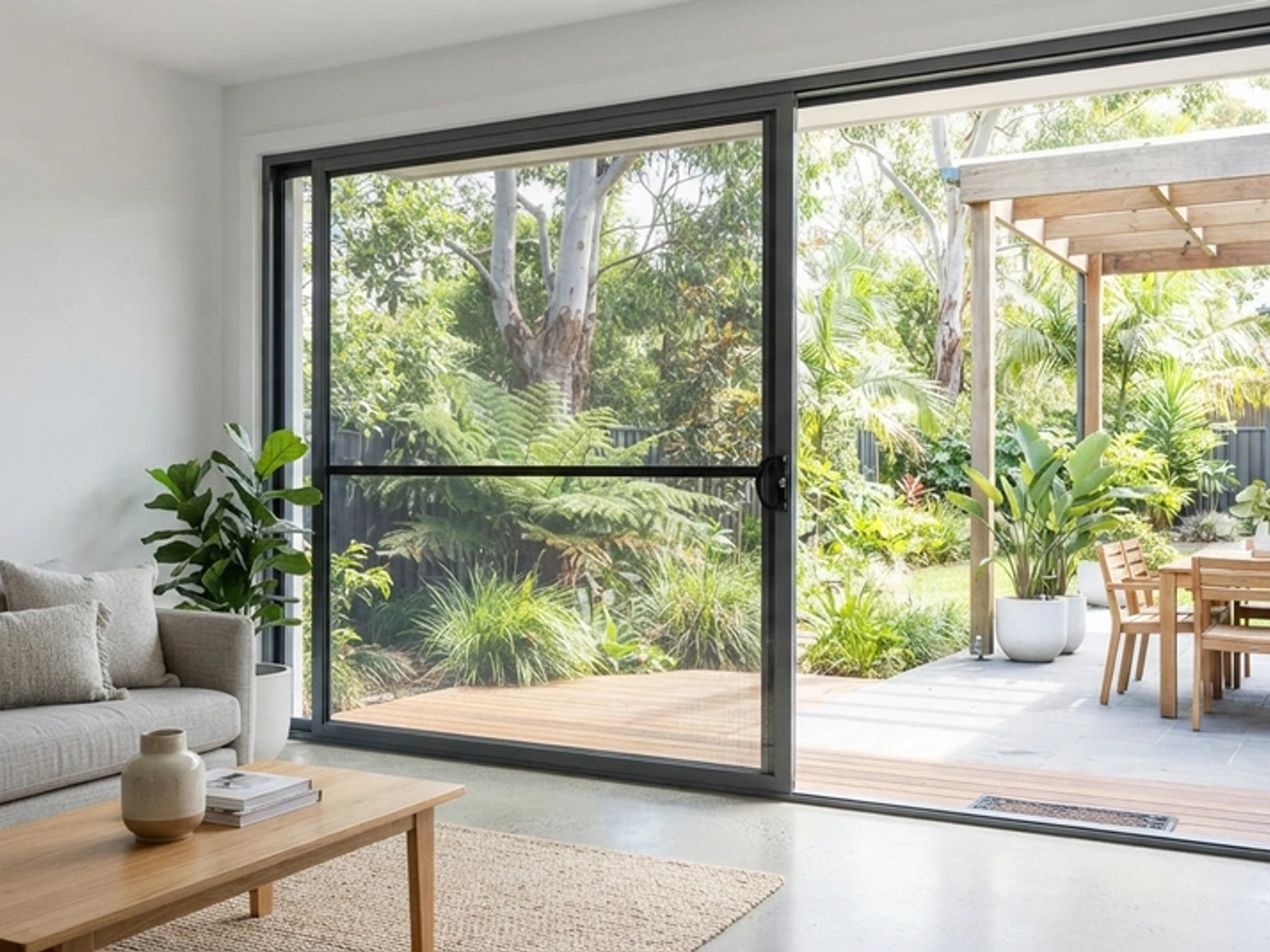
Science & Design
Does security screen mesh block airflow and natural light? The optical physics explained
By Sheng Xu · 18 September 2026
AI-generated illustrative image. Not a product test, certification record or project evidence.
No, it does not make rooms dark or stifle ventilation. High-tensile 316 woven stainless steel security mesh features an open area ratio of approximately 41% to 44%, preserving 65% to 75% of natural cross-ventilation in residential rooms. Optically, while light-coloured flyscreens scatter glare and create a cloudy 'veiling effect', ultra-matte black security mesh absorbs light reflections, allowing the human eye to focus past the thin 0.8mm wires onto the sunlit landscape beyond, creating an almost invisible barrier from indoors.
When Australian homeowners and architects consider upgrading to whole-home security screens, two persistent anxieties frequently surface during design consultations: 'Will installing dark metal mesh across my windows make my living room gloomy and dark?' and 'Will it choke off the cooling summer breeze and trap stale heat inside?' These fears are understandable. Legacy security measures—such as cast iron burglar bars, bulky colonial diamond grilles, and heavy metal shutters—frequently turned bright, airy rooms into oppressive, dim enclosures that felt like prison cells. However, modern high-tensile 316 stainless steel security mesh operates on entirely different principles of fluid dynamics and optical physics. Far from plunging homes into darkness, high-performance security mesh delivers clean, glare-free daylight and robust natural cross-ventilation.
The optical physics: why matte black mesh is more transparent than silver or white
Almost all premium security screen doors and window screens in Australia are powder-coated in an ultra-matte black finish. To the uninitiated, painting a screen black sounds counter-intuitive if the goal is to let in maximum light. However, optical physics and the biomechanics of the human eye explain why black is the most transparent colour for fenestration mesh.
The phenomenon comes down to optical reflectance versus optical absorption, and how the human visual cortex processes focal contrast:
1. The Veiling Glare Problem of Light Meshes: Light-coloured screens (such as untreated silver aluminium wire, white mesh, or grey fibreglass flyscreen) reflect ambient indoor and outdoor light directly into the viewer's eyes. When sunlight strikes light-coloured threads, each wire becomes a miniature secondary light source. This scattered light creates a glowing 'veil' of foreground glare. The human pupil naturally reacts to this bright foreground reflection by contracting, forcing your eye muscles to focus on the surface of the screen rather than looking through it. The result is a hazy, cloudy, obstructed view of the outdoors.
2. Matte Black Light Absorption: Architectural 316 stainless steel security mesh is coated with an ultra-matte, high-durability black polyester powder coat. Black pigments absorb approximately 95% to 98% of visible light striking the wire surface, generating virtually zero specular reflection or veiling glare. When an occupant stands inside a shaded room and looks out towards a sunlit patio or garden, the dark wires produce no foreground glare signal.
3. Visual Accommodation (The Disappearing Grid): Because the foreground wires are dark and non-reflective, the visual cortex automatically ignores the thin 0.8mm geometric grid and accommodates (focuses) on the high-luminance, rich-contrast outdoor landscape beyond. The black mesh effectively 'melts away' to the human eye, providing clear optical transparency that is markedly superior to traditional grey flyscreens.
Natural daylighting without squinting: diffuse light transmission vs harsh glare
Standard woven 316 stainless steel security mesh (with 0.8mm wire diameter and 11 strands per inch) possesses a physical Open Area Ratio of approximately 41% to 44%. This means that roughly 42% of the window aperture is completely unobstructed open air, while 58% is solid metal wire.
In terms of ambient daylighting, this 42% open area is more than sufficient to fully illuminate interior spaces with natural diffuse daylight. Rather than turning rooms dark, the wire grid acts as a micro-louvre system. It scatters and softens intense direct solar radiation, eliminating the harsh, squint-inducing hotspots that cause eye strain on computer screens and televisions. Interior light levels remain bright, soft, and balanced, reducing the need for daytime artificial lighting while significantly improving visual comfort.
Fluid dynamics and airflow: open area percentage vs real-world breeze
The impact of security screen mesh on ventilation is governed by fluid mechanics—specifically, air pressure drop across porous planar media. A common mistake is assuming that because a screen has a 42% open area, it must cut 58% of incoming airflow. In aerodynamic testing, this is demonstrably false.
When ambient breezes approach a window, air does not travel as rigid parallel sticks; it acts as a fluid medium. Air molecules funnel through the smooth, rounded 1.57mm apertures between the woven wires, creating minor boundary layer friction and micro-turbulence. Empirical air velocity measurements conducted by Australian building science laboratories show that:
Woven Stainless Steel Mesh: Delivers between 65% and 75% of unrestricted natural airflow under typical residential breeze velocities (1 to 4 metres per second). In cross-ventilated homes with open doors and windows on opposite elevations, the reduction in air exchange rate is almost imperceptible to human occupants.
Perforated Aluminium Sheet Mesh: Because perforated sheet consists of 1.6mm to 2.0mm thick metal plates with punched circular holes, it presents flat, blunt edges rather than aerodynamic rounded wires. It creates slightly higher pressure drops, delivering roughly 55% to 65% of natural airflow. However, this is counterbalanced by enhanced one-way daytime privacy.
Psychological safety: why security screens actually increase ventilation
There is a profound difference between the theoretical airflow of an open glass door and the real-world airflow of a lived-in home. In reality, security screen mesh dramatically increases overall annual household ventilation by eliminating fear.
In hot Australian summers, many homeowners keep their large glass sliding patio doors and ground-floor bedroom windows locked shut overnight or while relaxing in another room because they fear opportunistic break-ins or wandering wildlife. As a result, the home receives 0% natural ventilation, forcing families to run expensive split-system air conditioning all night long.
Installing AS 5039 certified security screen doors allows homeowners to slide open massive glazed leaves, deadlock the security screens with 3-point multipoint locks, and leave the house open to cooling nighttime breezes in complete safety. A screen delivering 70% airflow on an open door will always provide infinitely more fresh air than a 100% open-capable glass door that remains locked shut out of security concerns.
How SMIRO maximizes natural light and ventilation in modern builds
At SMIRO, our architectural engineering philosophy centres on biophilic design: connecting indoor spaces with natural light, fresh air, and surrounding landscapes without compromising on structural security or thermal envelope performance.
When pairing security screens with our fenestration systems, we ensure minimal sightline disruption and maximum air passage:
Expansive Sliding Systems: Our SMIRO Vista and Urban Series Sliding Doors feature ultra-slim aluminium profile sightlines that maximize glass area. When matched with our factory-integrated 316 stainless steel security sliding screens, the black mesh aligns seamlessly with the structural mullions, preserving broad panoramic views across your backyard or swimming pool.
Acoustic and Ventilation Integration: For bedrooms and study spaces, SMIRO Awning Windows provide controlled top-hinged ventilation. By integrating internal stainless security screens with perimeter compression seals, you can leave awning windows open during gentle rainstorms to capture fresh night air without compromising security or allowing moisture ingress.
Frequently Asked Questions
Can people outside see into my home through black security screen mesh?
During daylight hours, no. The optical physics works in reverse for someone standing outside in the sun looking into a darker room: the human eye adjusts to the high outdoor daylight, and the interior appears deep in shadow behind the dark mesh. However, at night, when interior lights are switched on and it is dark outside, the contrast ratio flips: anyone standing in the darkness outside can see clearly into your illuminated living room. Curtains or blinds should always be drawn at night for privacy.
Does perforated aluminium sheet block more breeze than woven stainless wire?
Yes. Perforated aluminium sheet (such as 1.6mm punched panels) has a slightly lower open area ratio (typically 38% compared to 42% for woven wire) and presents flat plate surfaces that generate more aerodynamic turbulence. Under light breeze conditions, woven 316 stainless steel mesh allows approximately 10% to 15% more airflow through the opening than perforated aluminium sheet.
Will security screen mesh catch dust and impede airflow over time?
Yes. Airborne dust, pollen, and microscopic salt crystals will naturally collect on the cross-wires over 6 to 12 months, gradually reducing open area and restricting airflow. Regular cleaning with warm water, a soft cloth, and a gentle car wash shampoo every few months restores full 100% open area, ensures effortless cross-ventilation, and protects the powder coat finish against long-term corrosion.