Glass & Glazing
Glass Louvre Windows: Blades, Glazing & Security
By Sheng Xu · 15 October 2026
AI-generated illustrative image. Not a product test, certification record or project evidence.
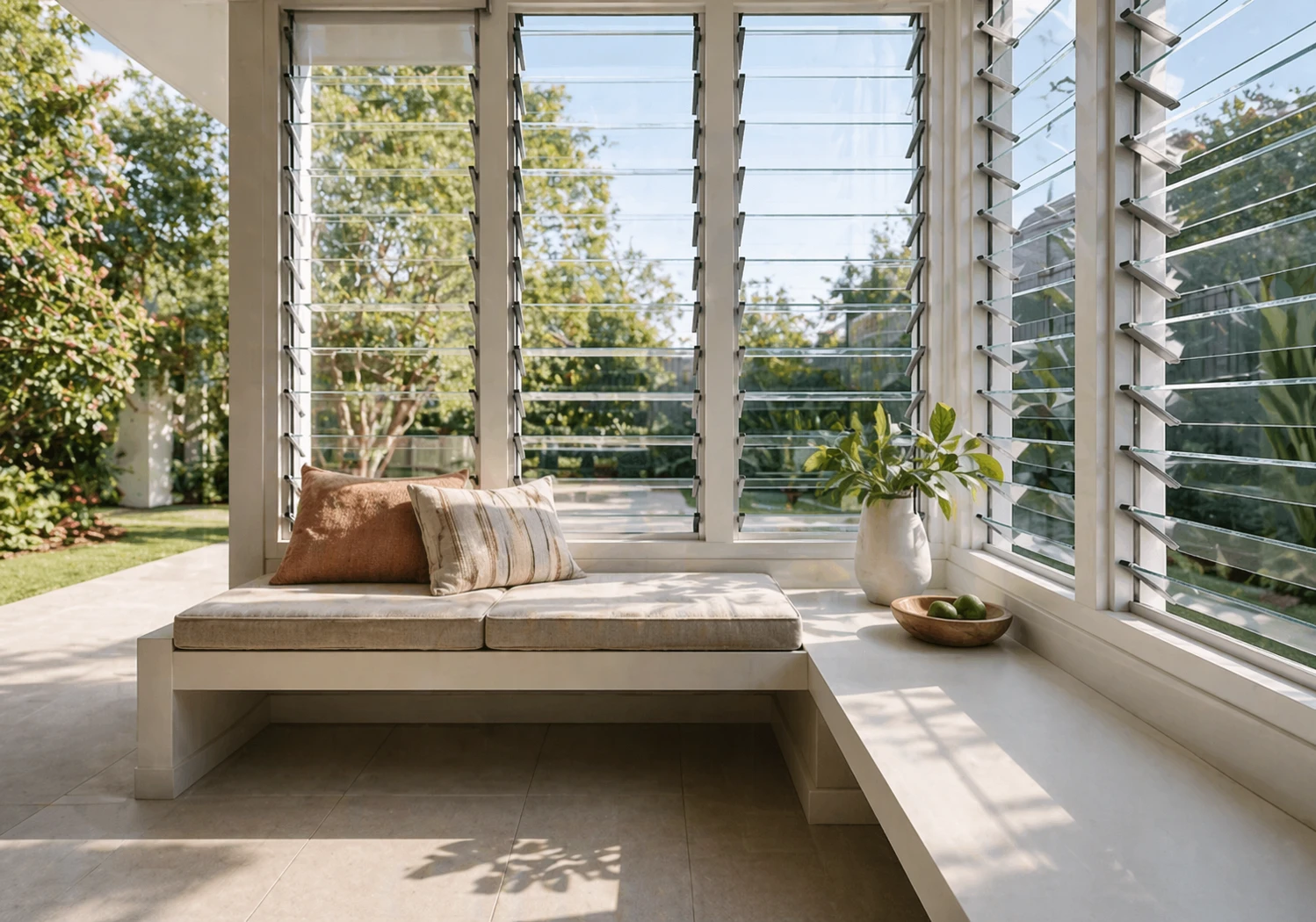
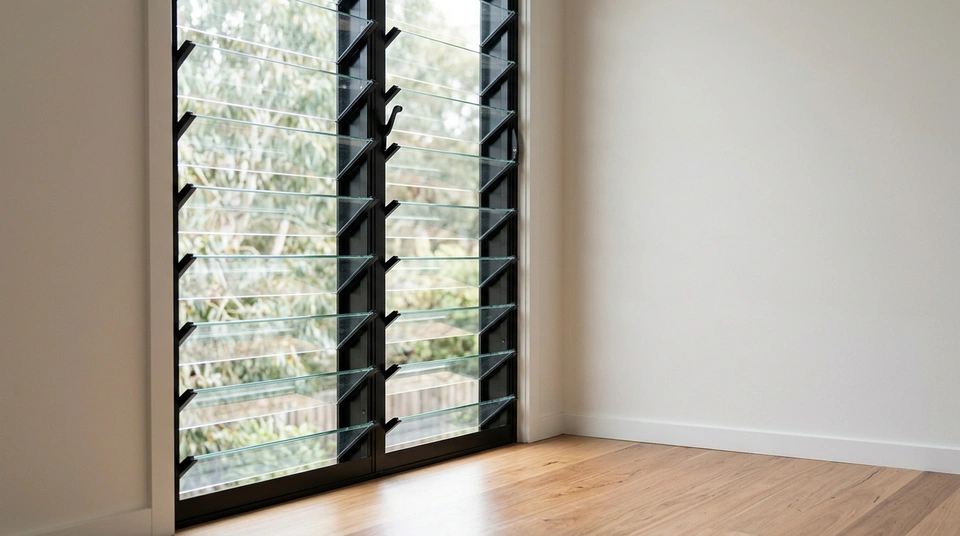
A glass louvre window is a gallery of horizontal blades held in clips that pivot together on a single lever. Each blade is a separate specification decision covering four things: the material it is made from, the glass inside it, its height, and the clip that holds it. Blade material and blade retention are what decide daylight, privacy and security; none of them change how much air the window moves.
Four points decide a blade specification. Blade material decides light and privacy rather than airflow: glass admits daylight, aluminium blocks it, and both fit the same clip. Blade thickness is a system standard rather than a preference, because Australian louvre ranges are built around 6 mm blades and an off-spec blade will not seat in the clip. Laminated glass is the option to avoid, since the laminate edge sits exposed to weather and the manufacturers who publish on it decline to warrant it. Finally, a screen and a lock do different jobs: the lock stops the blades being wound open, and the retention system stops them being slid out.
Most buyers arrive with two decisions already made, a blade height and a frame colour, and never get asked about the other two. The result is a window that looks right and behaves badly: clear blades where the bathroom wanted privacy, or a glass blade where a louvre above a doorway needed to block light. The four decisions are cheap to make at specification and expensive to correct afterwards, because changing the material or the glazing on a finished window means new blades rather than a new coat of paint.
Glass blades and aluminium blades do different jobs
Glass blades are for daylight and view, and they are the default on a louvre window. They come in clear, tinted and obscure forms, and can be toughened, which matters because Australian building rules require Grade A safety glass in some louvre locations.
Aluminium blades are for privacy and block-out. They are solid, so a closed aluminium louvre lets nothing through and blocks almost all solar radiation. The same clip takes either material, so a re-blade can change material without changing the gallery. Timber is the third option and the one with a catch: 13mm thick, needing a 6mm adapter, and the blade most likely to move over time.
Clear, frosted, laminated and double-glazed blades
Clear glass is the default and the best choice for view and daylight. Tinted grey or green glass is the same blade with less solar heat gain through it, the standard response to a hot western elevation.
Frosted and obscure glass is the answer to the bathroom problem, because a louvre is the only window that gives you ventilation and privacy at once. The modern forms are surface-etched glass and glass with a white interlayer. Because the blade sits at an angle, an obscure blade reads as frosted from outside and stays bright from inside.
Laminated glass is the one blade option worth actively avoiding, for mechanical rather than thermal reasons. A louvre blade has an exposed edge on all four sides, and a laminate edge is where the interlayer meets the weather. Manufacturers who publish on this are blunt: UV and sunlight deteriorate laminate edges, the extra thickness puts excess force on the handle, and galleries fitted with laminate are not warranted.
Double glazing on a louvre is now real, in one of two forms. The first makes the blade itself a slim insulated glass unit: two panes of low-e glass around a narrow argon-filled spacer, stepped so the inner pane is retained inside the clip. The second frames a conventional unit in a thermally broken blade holder, the heavier approach used on commercial louvres. The slim blade form is the one that fits a domestic louvre window. SMIRO's Urban louvre window lists 6mm single glazed or 5mm + 6Ar + 5mm double glazed, confirmed against the series configuration at quotation.
Blade depth: what the 100 and 150 series actually measure
Three dimensions get called the blade size, and untangling them is worth doing before you compare quotes. Frame depth is the depth of the perimeter frame, and it is the number carried in a series name. Blade height is the vertical face of a blade, quoted as 102mm or 152mm in general Australian ranges. Blade thickness is 6mm across every domestic system.
SMIRO's Urban louvre window is offered as a 100 series and a 150 series, each with its own configuration PDF. Those names refer to the frame depth, and the depth figure for each series is stated in that series configuration sheet rather than in the marketing copy. Frame depth and blade height together decide whether a screen can sit inside the frame line or needs a build-out.
Screens and locks: two jobs that get treated as one
A fly screen excludes insects. A security screen excludes people, and it is a different product: high-tensile stainless steel mesh in a rigid aluminium frame, tested to AS 5039 for impact, jemmy, pull and knife-shear resistance. On a louvre the screen covers the whole opening, because a louvre never seals flat against anything.
That is also the practical problem with screening a louvre. Fit a screen flat against the opening and the blades foul it as they turn, because they sweep out past the face of the frame. The fixes are to box the screen out on a deeper frame, or to use a frame deep enough to take the screen within the frame line.
The lock and the clip do two separate things as well. A keyed handle lock secures the blades closed so nobody can wind them open from outside. A blade retention system locks each blade into its clip so they cannot be pushed or slid out. The second fixes the oldest complaint about louvres, true of older galleries and false of a modern one: on a gallery with no retainer the panes slide out of their clips.
Louvres also solve a compliance problem other window types struggle with. Australian rules cap openable windows in upper-storey bedrooms so a 125mm sphere cannot pass through, which costs a casement most of its ventilation. A louvre's blades turn within that limit while the window still moves air, which is why louvres appear in upper-floor bedrooms and schools. Compliance still depends on the specific opening: a louvre needs either a restrictor or a tested fall-prevention screen so that no gap exceeds the limit, and the installed configuration, not the window type, is what the certifier signs off.
Blade replacement or whole-window replacement?
One cracked blade is a glazing job. A single blade replacement is routine for a glazier: the blade comes out of the clip, the new one goes in at the same height and the same 6mm thickness, and the glass is selected for its location. Blades near a floor, in a bathroom or in a side panel generally have to be Grade A toughened safety glass.
A window that will not close evenly is a gallery job, and the blade is often not what failed. The named failure modes in older homes are corroded clips that stop gripping, worn operators so the blades no longer close evenly, and frames that have moved out of square. Older systems also often use blade sizes that no longer match modern replacements, so if more than one blade is loose or hard to close, assume a system fault.
A replacement window earns its price by adding what a repair cannot: clips that meet the present standard, a blade retention system, a keyed handle lock, and a tested configuration under the Australian window standard. If the existing frame can be re-glazed and the geometry is sound, keep it.
Choosing a blade by climate
The blade you want depends on which problem your climate hands you. In the hot humid north, louvres are named as a recommended high-opening window type because cooling ventilation is the design objective and sealing is not. Solid aluminium blades block solar gain while the window stays open; tinted glass keeps the view. There the solar heat gain coefficient matters far more than the U-value, and coastal sites add corrosion-resistant finishes and marine-grade screen mesh to the order.
In temperate and cool climates the balance flips. Heating dominates, so the U-value becomes the number that matters and the blade becomes a heat-loss problem rather than a cooling asset, which is the case for double-glazed or low-e blades. A louvre still seals less tightly than a compression-sealed casement, so choose it for airflow and control. SMIRO's Urban louvre window publishes a U-value of 3.5 to 5.5 W/m2K, an SHGC range of 0.45 to 0.76, 150 Pa design water resistance, and sound under 29 dB.
Frequently Asked Questions
Can you put a security screen on a louvre window?
Yes. A security screen for a louvre is stainless steel mesh in a rigid frame, fitted to the opening rather than to the glass, and on most domestic frames it is built out so the blades can still rotate past it. The window can stay open and still be secure, which is the point of a louvre.
Can you get frosted glass louvre blades?
Yes, and on a bathroom louvre they are the standard answer, giving privacy while the blades are open. Avoid applying frosted film to a louvre blade instead: a film wrap on a pivoting blade with exposed edges is not the same job as film on a fixed pane.
Can a louvre window blade be replaced on its own?
Usually yes, provided the blade height and 6mm thickness still match the clip, and a single blade is far cheaper than a whole unit. The exception is an older gallery where the clips or operator have failed, or where the blade size no longer matches modern standard sizes.
Choosing a louvre blade in one pass
Work through the decisions in order. Material first, because it decides daylight and privacy; glass second, because it decides solar gain and whether safety glass is required; blade height third, because it decides how many blades the gallery carries; and screens and locks as a pair, because a screen stops access through the opening while a lock and a blade retainer stop the blades being worked open.
The two things worth confirming in writing before you order are the frame depth your series delivers, because it decides whether the screen fits in the frame line, and the blade retention and locking hardware that ships with the gallery. Everything else is a finish choice. Those two are the security.