
Design & Energy Rating
Does window frame colour affect a NatHERS rating?
By Sheng Xu · 8 September 2026
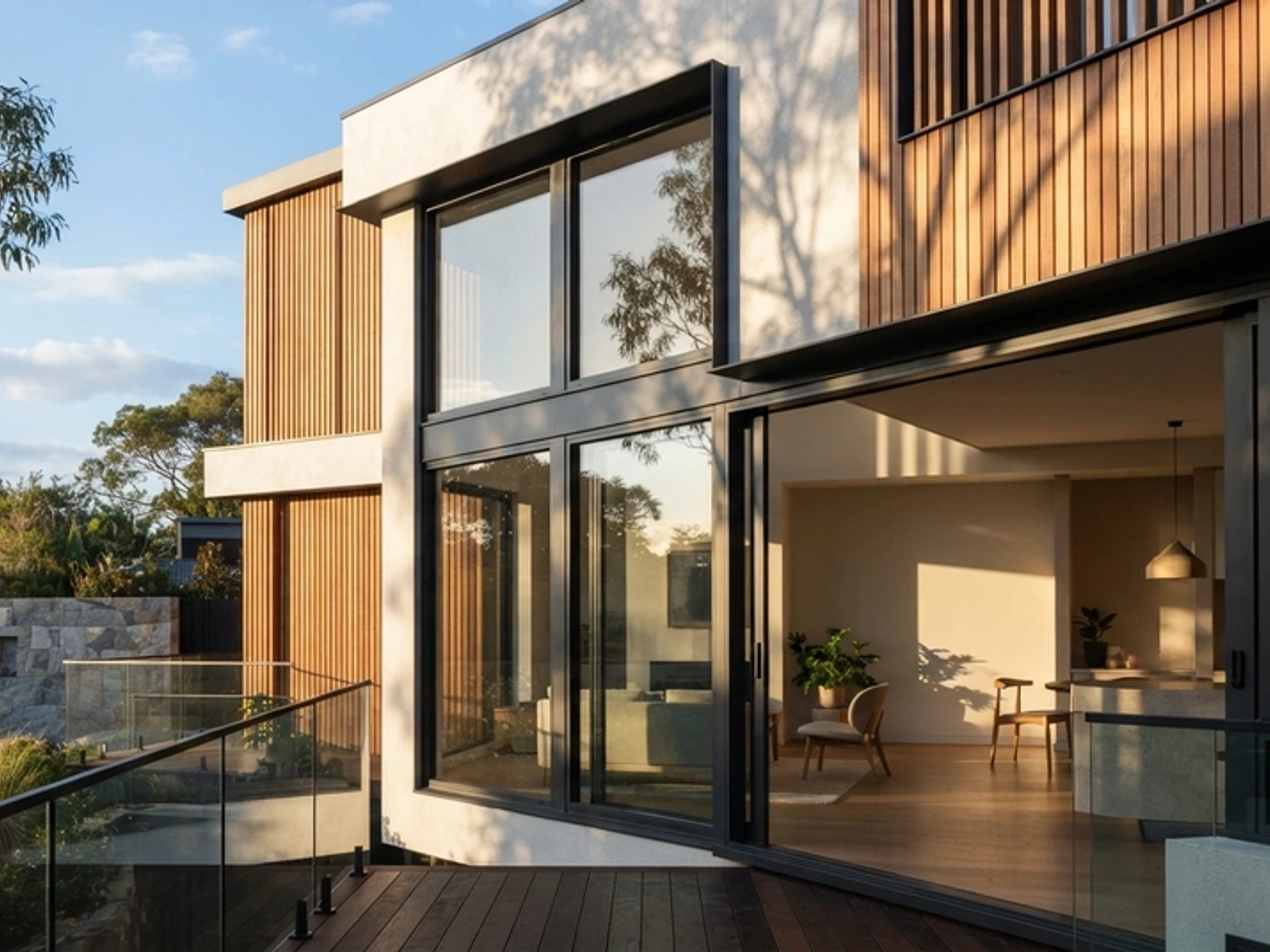
AI-generated illustrative image. Not a product test, certification record or project evidence.
Yes. In NatHERS energy software, window frame colour is modeled as a thermal parameter called solar absorptance across three categories: Light (≤0.40), Medium (0.41–0.60), and Dark (>0.60). Changing frame colours typically shifts a home's overall rating by 0.1 to 0.3 stars. Dark frames (like Monument or Black) absorb solar heat, which can marginally benefit heating-dominated southern climates like Melbourne, but penalizes cooling-dominated climates like Brisbane by increasing summer cooling loads.
For the vast majority of Australian homeowners and designers, selecting a window frame colour is treated as a purely aesthetic decision. You choose charcoal Monument or Matt Black to complement industrial brickwork and modern dark cladding, or you specify crisp White or Surfmist for a relaxed coastal or Hamptons elevation. However, inside the calculation engines of the Nationwide House Energy Rating Scheme (NatHERS), window frame colour is not a cosmetic choice. It is treated as an active thermodynamic variable defined by solar absorptance. Under the National Construction Code 2022 (NCC 2022), changing your window frame colour between light, medium, and dark can shift a home's NatHERS rating by 0.1 to 0.3 stars - an increment that often determines whether a marginal design achieves mandatory 7-star compliance or triggers a permit-blocking cooling load failure.
The physics of solar absorptance: how NatHERS models colour
Every solid surface absorbs a portion of the solar radiation that strikes it and reflects the rest. In Australian building science, this characteristic is measured as Solar Absorptance (SA), expressed as a decimal value from 0.0 (reflects 100% of solar energy) to 1.0 (absorbs 100% of solar energy).
Under NatHERS Technical Note guidelines (specifically clause 8.9), energy assessors are legally required to input the actual specified window frame colour into accredited software platforms such as FirstRate5, HERO, BERS Pro, and AccuRate. If the frame colour is not specified on the architectural plans, the software mandates a default classification of 'Medium' (with an assigned solar absorptance of 0.50).
NatHERS groups window frame powdercoat and anodised finishes into three standardized categories:
Light (Solar Absorptance ≤ 0.40): Highly reflective finishes that bounce away solar radiation. Popular Australian examples include Pearl White, Off-White, Surfmist (SA ~0.32), and Classic Cream (SA ~0.39).
Medium (Solar Absorptance 0.41 to 0.60): Mid-tone neutral colours that balance reflection and absorption. Common examples include Shale Grey (SA ~0.43), Dune (SA ~0.47), Paperbark (SA ~0.42), Evening Haze, and clear anodised aluminium.
Dark (Solar Absorptance > 0.60): Heat-absorbing finishes. Widespread architectural favourites fall into this tier, including Monument (SA ~0.73), Woodland Grey (SA ~0.71), Basalt (SA ~0.69), Ironstone, Deep Ocean, and Night Sky / Matt Black (with BlueScope ASTM test data showing Night Sky at SA ~0.95, and commercial black powdercoats typically between 0.86 and 0.95). Note that while national NatHERS uses the ≤0.40 / 0.41–0.60 / >0.60 bands, NSW BASIX specifies slightly different boundary thresholds (Light < 0.475, Medium 0.475–0.70, Dark > 0.70).
Climate zone polarity: why dark frames help in Melbourne but hurt in Brisbane
Whether a dark or light window frame colour improves your energy rating depends entirely on your local climate zone and whether heating or cooling dominates your annual energy consumption.
In heating-dominated climates - such as Melbourne (Climate Zones 21 and 60), Ballarat (Zone 66), Canberra (Zone 24), and Hobart (Zone 22) - keeping the house warm through cold, overcast winters is the primary energy hurdle. In these southern locations, dark window frames (like Monument or Black) absorb solar radiation on sunny winter days. The external metal heats up and gently conducts warmth into the window reveal and living spaces. In NatHERS thermal modeling, this minor passive heat harvest subtly lowers winter heating loads, frequently adding 0.1 to 0.2 stars to the overall rating.
In cooling-dominated climates - including Brisbane (Climate Zones 9 and 10), the Sunshine Coast, Darwin (Zone 1), Townsville, and Cairns - the exact opposite occurs. Winter heating is virtually non-existent, but summer solar radiation is intense and prolonged. Dark window frames absorb immense heat, with surface temperatures on unshaded aluminium extrusions regularly exceeding 65°C on a 35°C summer afternoon.
That absorbed heat conducts directly into the air-conditioned interior, forcing the cooling system to work harder. In Queensland, specifying dark window frames elevates the annual cooling load. In homes hovering near the statutory NCC 2022 cooling load cap, choosing dark frames over light frames can directly cause the project to breach the cooling limit and fail certification.
Standard aluminium vs thermally broken frames: the conduction barrier
The severity of the thermal impact caused by frame colour is governed by the structural design of the aluminium frame itself.
In standard, non-thermally broken aluminium windows, the frame is an unbroken, continuous piece of extruded metal. Aluminium has an extremely high thermal conductivity (approximately 160 W/mK). When the sun bakes a dark exterior frame, heat conducts instantly and unhindered through the metal profile to the interior room. In hot summer climates, standard aluminium frames painted in dark colours act as miniature radiators inside your living room.
Thermally broken aluminium frames fundamentally break this conduction path. A thermally broken profile inserts an engineered, low-conductivity polyamide barrier (typically PA66-GF25, with a thermal conductivity of around 0.3 W/mK) between the exterior and interior aluminium extrusions. This represents a 500-fold reduction in thermal conduction.
Because the external and internal metal profiles are physically isolated, the heat absorbed by a dark Monument exterior profile cannot easily travel into the home. For homeowners and architects who love the bold architectural look of dark frames in warmer climates, specifying thermally broken aluminium provides the freedom to enjoy dark external aesthetics without paying the indoor thermal penalty.
Orientation dynamics: the west-facing overheating danger
The thermal effect of window frame colour varies significantly depending on which compass direction the window faces:
North-facing windows: In Australian latitudes, northern facades receive high-angle summer sun (which is easily blocked by 450mm–600mm eaves) and low-angle winter sun. Dark frames on northern elevations absorb beneficial winter warmth while remaining protected under summer roof shading, making dark finishes thermally advantageous in temperate zones.
West-facing windows: Western facades catch low-angle, intense afternoon summer sun that shines straight under standard eaves. A dark Monument or Black window on an unshaded west wall absorbs maximum radiant heat during the hottest hours of the day (between 2:00 PM and 6:00 PM), creating severe local overheating.
South-facing windows: Southern elevations receive zero direct sunlight throughout the year. The solar absorptance of south-facing frames has almost zero thermal impact on NatHERS ratings because there is no direct solar radiation to absorb or reflect.
The 'Model vs Build' audit trap: avoiding site non-conformance
One of the most frequent compliance headaches encountered by builders in 2026 arises from administrative tweaks made during the energy rating stage that are subsequently contradicted on site.
Imagine a typical project in western Sydney or Brisbane where the preliminary architectural plan scores 6.9 stars with Monument window frames. Needing a 7.0-star certificate for council building approval, the energy assessor switches the window frame colour in the FirstRate5 software from 'Dark' to 'Light' (such as Surfmist). The software recalculates with lower solar absorptance, the cooling load drops, and the certificate passes at 7.0 stars. The permit is issued.
Six months later, the builder or client - completely unaware of the software tweak - orders trendy Matt Black or Monument aluminium windows from the fabricator to match the architectural renders. When the private certifier conducts the pre-plaster or final inspection, they cross-examine the installed windows against the stamped NatHERS specification.
The stamped energy schedule explicitly calls for 'Light' window frames, but black windows are installed. The certifier cannot sign off on the discrepancy and issues a non-conformance notice. The energy assessor must re-run the rating with dark frames, which immediately drops the score back to 6.9 stars. To regain compliance, the builder is forced to carry out expensive on-site rectifications, such as adding external window awnings or upgrading ceiling insulation. Never change window frame colours between the energy rating model and the factory purchase order.
Balancing aesthetics and performance with SMIRO
Achieving an exceptional 7-star NatHERS energy rating should never require you to sacrifice the architectural style and colour palette you envision for your home.
At SMIRO, our aluminium window and door systems are available in an extensive range of premium architectural powdercoat finishes - including popular Colorbond-matched shades like Surfmist, Dune, Shale Grey, Monument, and Matt Black - applied to meet stringent Australian durability and marine-grade standards. For projects in cooling-dominated regions or designs featuring expansive western glazing, our thermally broken aluminium systems allow you to specify deep architectural dark frames while maintaining ultra-low whole-window U-values and superior interior comfort.
Our technical team can review your NatHERS report alongside your architectural colour schedule, ensuring your window package delivers flawless compliance on paper and stunning visual impact on site.
Frequently Asked Questions
How many stars can changing window frame colour add to a NatHERS rating?
Changing window frame colour typically shifts an overall NatHERS rating by 0.1 to 0.3 stars, depending on window-to-floor area ratios, facade orientation, and climate zone. In a home with large glazed areas hovering at 6.9 stars, switching from dark to light frames in a cooling climate (or from light to dark in a cold heating climate) can be the exact margin that pushes the design across the 7.0-star threshold.
Are black or Monument window frames bad for energy efficiency in Australia?
Not necessarily. In cool and cold climates (such as Victoria, Tasmania, and the ACT), dark frames absorb winter solar heat, which can marginally reduce heating energy requirements. However, in hot, cooling-dominated climates (like Queensland and the Northern Territory), dark frames absorb intense summer heat and increase cooling loads. Using thermally broken aluminium frames mitigates this issue by preventing exterior frame heat from conducting indoors.
What is the default window frame colour in NatHERS software?
Under NatHERS Technical Note clause 8.9, if the window frame colour is not explicitly stated on the architectural drawings, accredited rating software defaults to 'Medium' with an assigned solar absorptance of 0.50 (equivalent to mid-tones like Shale Grey or Dune).
Can I have a dark window frame outside and a light frame inside?
Yes. Thermally broken aluminium systems can be manufactured with dual-colour powdercoating - for example, a dark Monument finish on the exterior to suit modern external cladding, and a clean White or light finish on the interior to match interior decor. In NatHERS software, solar absorptance calculations are based strictly on the exterior frame surface.
Will a building certifier fail my home if I change window frame colours after approval?
Yes, if the colour change causes the home to fail its energy compliance. Building certifiers cross-check window specifications on site against the stamped NatHERS energy certificate. If your certificate specifies 'Light' frames to achieve 7.0 stars and you install 'Dark' frames, the certifier will require an amended energy report. If the recalculated score drops below 7.0 stars or breaches a cooling limit, rectification work will be required before final approval.