
Engineering & Fabrication
How is security mesh attached to aluminium frames? Screw-clamp vs wedge vs spline beading explained
By Sheng Xu · 18 September 2026
AI-generated illustrative image. Not a product test, certification record or project evidence.
A security screen's strength depends entirely on its mesh retention system. While standard flyscreens rely on flexible rubber spline beading that easily pops under 15 joules of force, certified AS 5039 security screens use heavy-duty mechanical clamping: either patented screw-clamp systems (which mechanically sandwich the mesh with tamper-resistant screws) or high-pressure polymer wedge systems (which lock the folded mesh into a reverse hook channel without screws or rivets). High-performance wedge systems also provide 100% dielectric isolation, eliminating galvanic corrosion between stainless steel mesh and aluminium frames.
When consumers and specifiers evaluate security screen doors and window grilles, their attention is almost universally drawn to the wire mesh itself. They inspect the wire diameter, ask whether the alloy is 304 or 316 marine-grade stainless steel, and test the stiffness of the woven grid with their fingers. While the quality of the wire mesh is undeniably critical, forensic laboratory testing under Australian Standard AS 5039 reveals an inconvenient truth: when a security screen fails during a forced-entry attack, the woven wire itself almost never breaks. In over 90% of structural failures, the door fails because the mesh is ripped, popped, or levered out of the perimeter aluminium frame. The retention system—the engineering mechanism that anchors the metal mesh inside the hollow aluminium extrusion—is the true linchpin of physical security.
Method 1: The rubber spline beading system (the flyscreen trap)
To understand why genuine security screens require sophisticated mechanical clamping, one must first understand how traditional flyscreens and cheap barrier doors are assembled. In conventional screening, the mesh is laid across an extruded aluminium frame and forced into a narrow 4mm groove using an elastic rubber or vinyl cord (known as a spline) rolled in under friction with a hand-held plastic wheel.
Friction-based spline beading is an excellent, cost-effective system for keeping flies and mosquitoes out of a bedroom. As a security system, however, it is completely useless:
Under dynamic impact testing (governed by AS 5039.3 / AS 5041), a rubber spline system fails under less than 15 to 20 joules of kinetic force. A single kick from an adult intruder—or even a 25-kilogram family dog charging at the door—generates enough lateral membrane tension to stretch the rubber cord, pulling the spline straight out of the receiver channel. The mesh sheet detaches in one piece, allowing the intruder to step straight through the opening. If a manufacturer attempts to sell a 'security screen' held together with rubber spline beading, it is not a security product; it is an unrated barrier screen.
Method 2: The patented screw-clamp system (mechanical compression)
The screw-clamp method (most famously pioneered by Crimsafe and utilized by several high-security fabricators) represents a heavy-duty mechanical approach to mesh retention. Rather than relying on friction or glue, the perimeter of the woven stainless steel mesh is physically sandwiched between two heavy aluminium extrusions: the main outer frame profile and a specialized interior clamping bead.
High-tensile, tamper-resistant stainless steel screws are driven directly through the aluminium clamping bead, through the wire mesh weave, and into the solid aluminium frame profile at tight, regular intervals (typically every 25mm to 30mm around the entire perimeter).
The Engineering Advantages: Screw-clamp systems provide immense resistance to localized impact. When a burglar kicks or strikes the centre of the screen, the clamping plate acts like a continuous mechanical vice. The kinetic energy is immediately transferred away from the point of impact and distributed evenly across thousands of perimeter screws and into the building structure, withstanding massive impact energies exceeding 500 joules.
The Architectural Trade-Offs: Driving hundreds of screws through metal creates visible rows of screw heads along the interior perimeter of the frame, creating an industrial, commercial aesthetic that some modern residential architects find visually busy. Additionally, driving screws through stainless wire creates localized stress concentrations and micro-tears in the wire's powder-coat finish, necessitating meticulous galvanic isolation.
Method 3: The high-pressure polymer wedge system (screwless keyway)
The primary modern engineering rival to the screw-clamp is the high-pressure polymer wedge retention system (utilised by premium architectural brands such as Invisi-Gard, Commandex Keyway, and Amplimesh SupaScreen's pressure-fit range). This system was developed specifically to deliver certified AS 5039 impact strength while achieving a clean, screwless, minimalist architectural finish.
How it Works: The edge of the woven stainless steel mesh is bent into a precise hook profile and inserted into a specially shaped internal keyway channel within the heavy-duty aluminium extrusion. A continuous, rigid co-extruded polymer wedge (manufactured from UV-stabilised engineering-grade UPVC or vulcanised Santoprene elastomer) is then pressed into the channel under high pneumatic or hydraulic force.
The wedge drives the folded mesh into a reverse-barb locking geometry. The harder an intruder kicks the mesh from the outside, the tighter the hooked wire pulls against the structural wedge, wedging itself deeper into the aluminium frame's internal locking lip. Wedge systems comfortably withstand 450 to 500 joules of dynamic impact—more than four times the legal requirement of Australian Standard AS 5039.
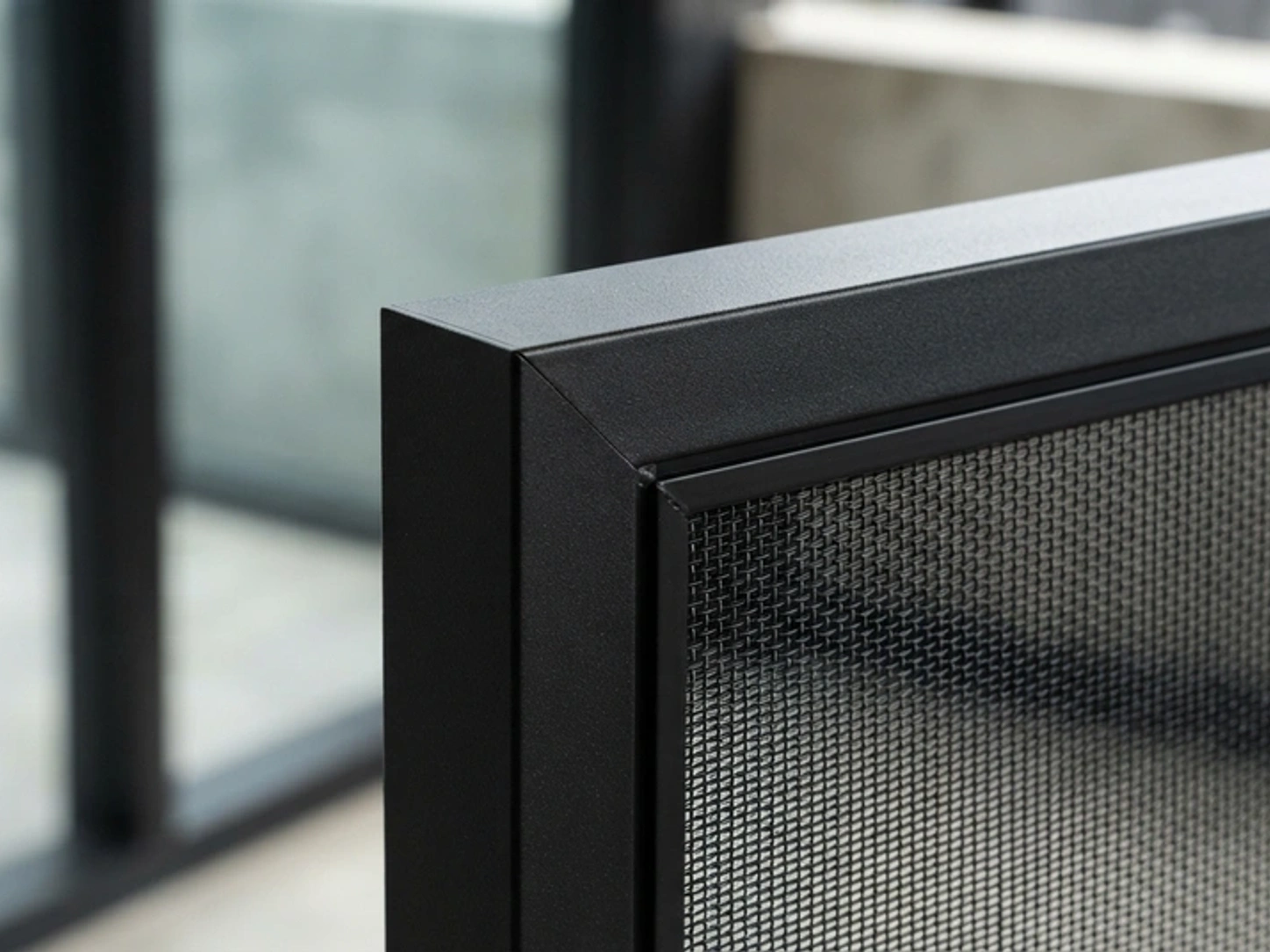
The Architectural Advantages: The visible face of the frame is completely smooth, seamless, and free of screws, rivets, or visible fixings. It integrates flawlessly with modern contemporary homes and high-end architectural sliding door suites.
The hidden engineering battlefield: galvanic corrosion isolation
Beyond resisting crowbars and sledgehammers, the mesh retention system performs a second, equally critical scientific duty: preventing galvanic corrosion. In the marine environment of coastal Australia (where airborne salt spray travels several kilometres inland), joining two dissimilar metals together creates a severe chemical corrosion hazard.
On the galvanic nobility scale, stainless steel (an active cathode) and aluminium (an active anode) possess an electrical potential difference of approximately 0.80 volts. If 316 stainless steel wire touches bare aluminium in the presence of an electrolyte (such as humid, salty coastal air), an electrolytic galvanic cell is established. The aluminium extrusion will act as a sacrificial anode, corroding rapidly into a white, chalky powder. Over two to four years, galvanic corrosion destroys the aluminium screw threads and receiver channels, causing the frame to crack, blister its powder-coat paint, and completely drop its mechanical clamping pressure.
This is where retention engineering proves its worth:
In screw-clamp systems, fabricators must insert continuous Santoprene rubber isolating gaskets between the clamp plate, mesh, and frame, and coat every screw in insulating anti-corrosive paste. If an inexperienced installer overtightens a screw and pinches through the rubber gasket, metal-to-metal contact occurs, initiating localized galvanic pitting.
In polymer wedge systems, the non-conductive UPVC or Santoprene locking wedge wraps completely around the perimeter of the mesh. It provides a permanent, continuous 100% dielectric barrier that physically prevents the stainless steel wire from ever touching the aluminium frame. In independent salt-spray chamber testing (AS 2331.3.1), high-end wedge systems endure over 2,000 to 10,000 hours of continuous salt fog exposure with zero galvanic corrosion.
How SMIRO integrates structural retention into architectural systems
At SMIRO, our fenestration manufacturing standards reject flimsy spline-retained screens in favour of heavy-duty structural screening engineered to complement our high-performance aluminium window and door suites.
All SMIRO security screens are constructed from primary architectural 6063-T5 aluminium extrusions with heavy internal corner stakes that prevent corner joint twisting under load. By utilizing advanced dielectric isolation barriers and precision mechanical clamping, our integrated security screens provide uncompromising physical protection for our SMIRO Vista and Urban Series Sliding Doors, Living Series Bi-Fold Doors, and Awning Windows without sacrificing sleek, modern architectural aesthetics.
Frequently Asked Questions
Can a screw-clamp security screen be repaired if the mesh is dented?
Yes. One of the practical maintenance benefits of a screw-clamp system is disassembly. Because the clamping bead is secured with mechanical screws, a licensed technician with the matching tamper-resistant driver bit can unfasten the clamp plate, remove the damaged stainless steel mesh panel, and clamp a brand-new factory-cut mesh sheet into the existing aluminium frame on-site.
Can a DIY homeowner rescreen a wedge-retention security door?
No. High-pressure polymer wedge systems require specialized factory hydraulic pressing equipment or proprietary pneumatic insertion tools to drive the high-density wedge into the receiver keyway under controlled pressure. Attempting to force the wedge in with hand tools or screwdrivers will deform the aluminium extrusion and tear the polymer isolator, compromising both the door's impact resistance and its corrosion warranty.
Are pop-riveted security screens compliant with Australian Standards?
Some older or budget barrier screens use aluminium pop-rivets to secure internal mesh plates. However, under the updated AS 5039.1:2023 testing, standard pop-rivets frequently fail dynamic impact and anti-jemmy tests because the soft aluminium rivet stems shear off under sudden lateral shock. Certified security screens require heavy-duty high-tensile fasteners or continuous polymer wedge locking channels.