
Window Types
Are Aluminium Awning Windows Worth It? The Honest Answer
By Sheng Xu · 14 August 2026
Aluminium awning windows are top-hinged sashes that open outward from the bottom on a chain winder, and the open sash deflects rain away from the opening. That makes them the one window you can leave open through a shower - the standard pick for bathrooms, kitchens and high walls - in exchange for airflow: the sash opens only to around 45 degrees and blocks much of its own opening.
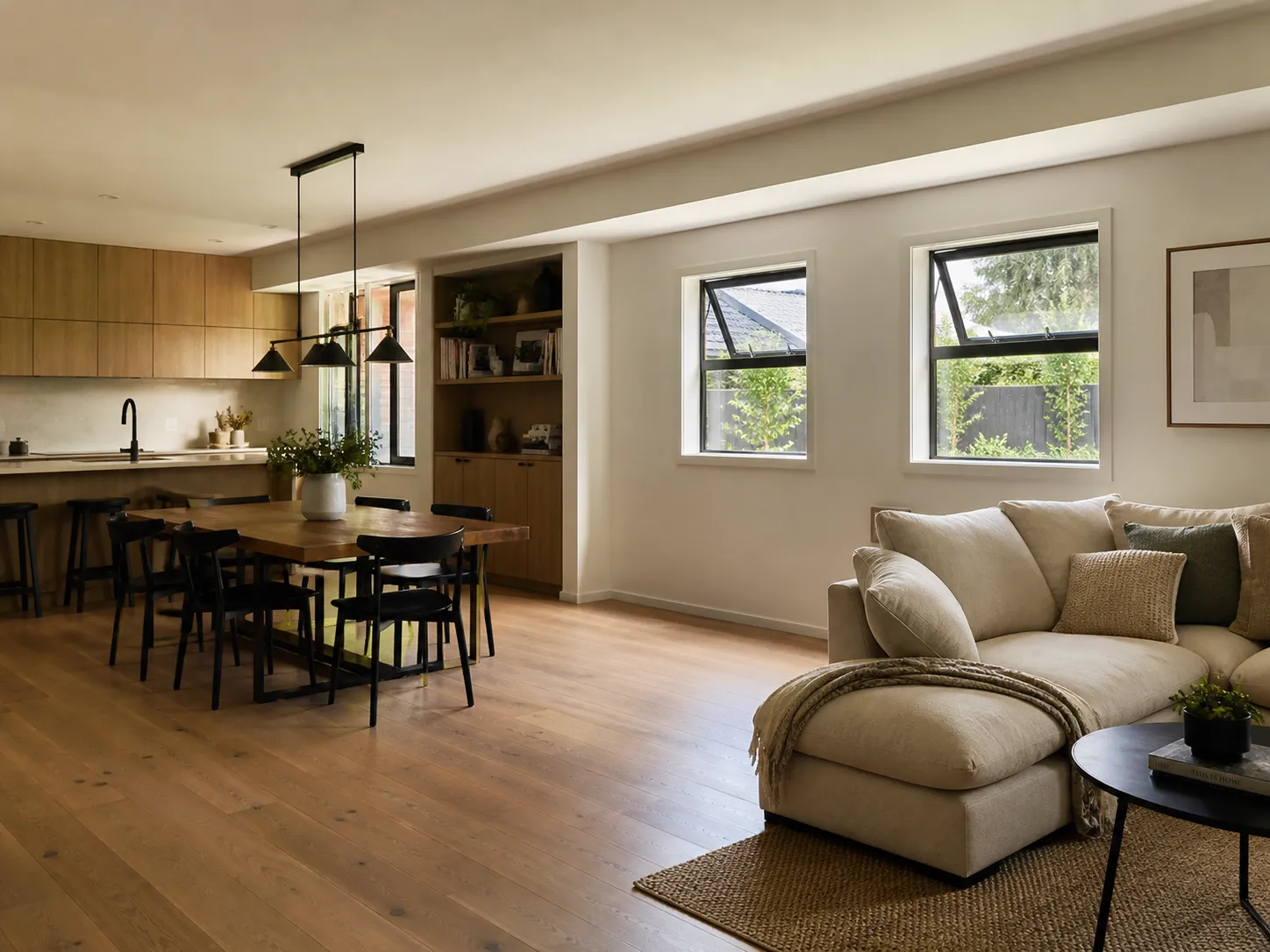
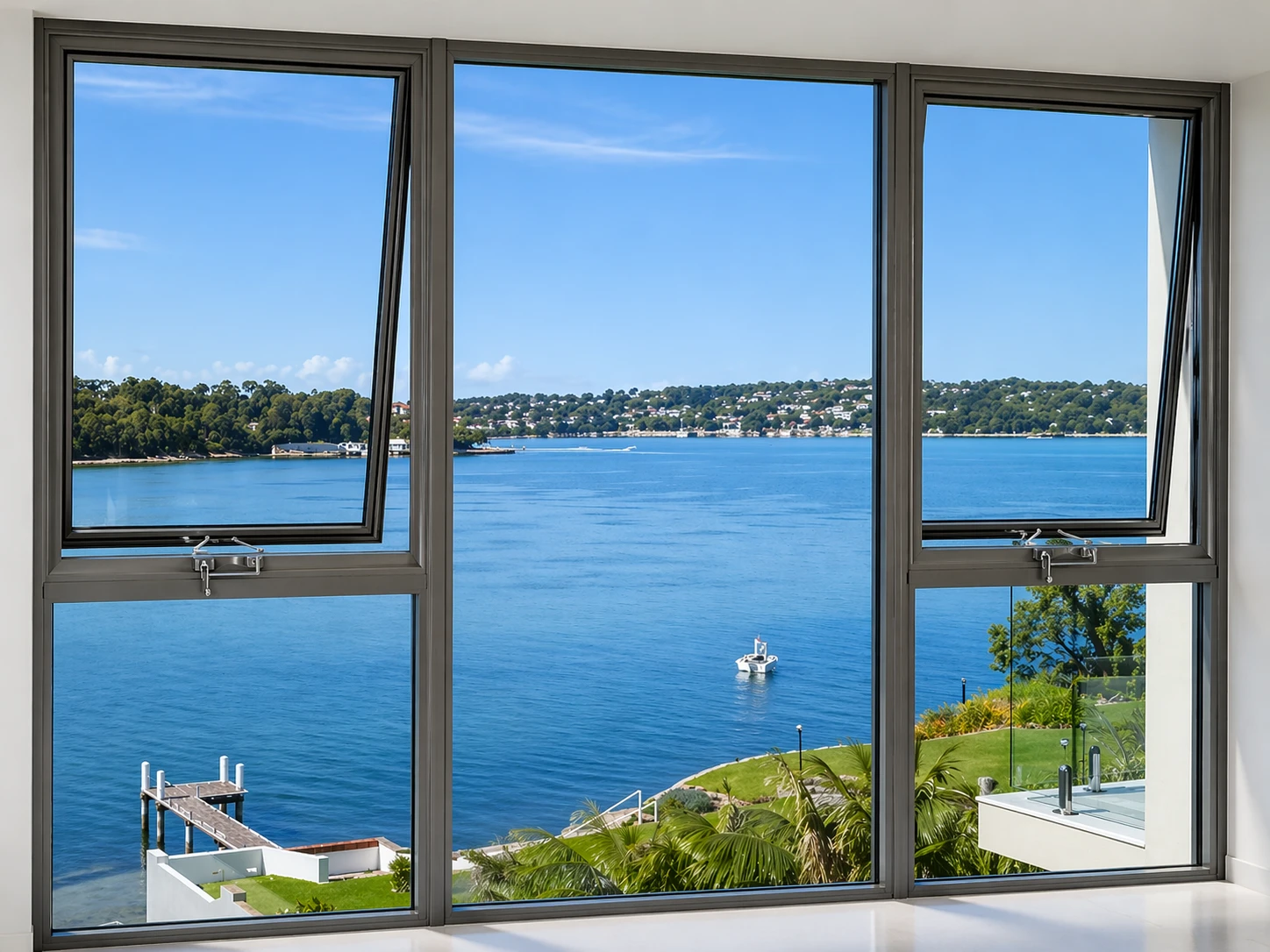
Aluminium awning windows are the rain-proof corner of the window range. A single sash is hinged along its top edge and opens outward from the bottom on a chain winder, so when it is open the glass forms a small canopy over the opening. Rain hits the glass and runs off the outer face, which is why awning windows are the one openable type you can leave open through a typical Australian shower - and why they own the bathrooms, kitchens and high walls of the country.
What are aluminium awning windows?
Aluminium awning windows are built around a single sash hinged along the top that pushes outward from the bottom, operated by a chain winder or a friction stay and opening to roughly 45 degrees. They come as a single unit, a double unit, or stacked awning-over-fixed configurations for tall, narrow openings, and the frames are the standard aluminium sections found across Australian homes, 50 to 56 millimetres deep on typical thermally broken systems.
One honest limit is built into the design. Because a single top hinge carries the whole sash, awning panels are normally kept to roughly 1.9 to 2.3 square metres per sash - enough for a bathroom or kitchen window, not for a feature wall, which is why tall openings are split into stacked banks rather than one huge sash.
The design exists for one reason: rain. When the sash opens it angles outward and downward like a small awning, and the glass sheds rain away from the opening. Every strength of an awning window, and every weakness, flows from that geometry.
Can awning windows stay open in the rain?
Yes, in most typical Australian rainfall. The top-hinged sash deflects water away from the opening, so you can leave an awning window open through a shower and still get ventilation without water inside. No other common openable window type achieves that as reliably - a casement, sliding or louvre window has to be closed when the rain comes.
Practitioners lean on exactly this. One Whirlpool thread on window replacement chose awning with winder for the whole house specifically because the chance of a rain shower getting under and in is pretty much zero, and the same poster notes awnings are perfect for evaporative cooling homes, since there is no running around closing windows when it rains.
The protection has a limit. Heavy, wind-driven rain can find its way past the sash, so in a severe storm every window type gets closed. In ordinary weather, that rain-safe ventilation is why awnings dominate bathrooms and laundries venting steam, kitchens venting cooking air, and clerestory windows near the ceiling line, where the stack effect exhausts warm air rising out of the room.
The honest trade-off: why awnings ventilate less than casements and louvres
The cost of rain-proof ventilation is airflow. An awning sash opens only to about 45 degrees, and because it does not clear the frame, the sash itself covers a significant part of its own opening, so awning windows deliver steady background ventilation rather than a strong cross-breeze.
The measured gap is worth stating. A technical bulletin from louvre manufacturer Breezway models a chain-winder awning at roughly 10 per cent of the window as open airflow at a standard model size, falling to around 1 per cent on large windows, against about 80 per cent for a casement. Treat the exact figures as manufacturer directional data, but the pattern holds in the field.
Practitioners confirm the pattern in everyday terms. In a 7-star build thread on the homeone forum, one owner with awning windows across the house says plainly that it cools down a lot slower than if you had casements. What awning windows do instead is maintain low-level, consistent air movement - keeping a bathroom fresh, cycling moisture out of a kitchen, letting a bedroom breathe overnight - and they do it with the window partly open and locked, which is a genuinely secure night-ventilation position.
Do awning windows seal well? Energy and weather reality
Yes - awnings seal by compression. The winder pulls the sash tight against the frame, the same mechanism as a casement, which practitioners rank well above the brush-pile seal of a sliding window and one manufacturer ranks awnings among the tightest sealing of all openable windows.
The energy story now depends entirely on the frame. Thermally broken awning systems publish whole-window U-values around 2.6 to 3.5 - Capral's Urban Comfort, Alspec's ThermAFrame and Stegbar's eX Hybrid all land in that band, putting awnings in casement territory and marketed around 7-star NatHERS compliance. A plain single-glazed, non-thermally-broken awning sits far higher, around 5.8 to 7.2, which is why the thermal break is the whole energy decision for awnings. Treat these as indicative industry data from published spec sheets.
The weather ratings are strong. Awning systems list water resistance at 600 pascals and, on some commercial ranges, up to 900, which suits exposed and coastal elevations. As with any window, a pass on one glazing configuration does not transfer to another, so the practical ask is for the tested AS 2047 configuration for your exact build-up rather than a generic compliant label.
Are awning windows secure? And the winder-restrictor rule
Yes, with the winder locked and, on upper floors, restricted. The lockable winder pulls the sash flush when closed and holds a partially open position, which is why awnings give a secure night-ventilation setting that sliding and casement windows cannot match.
The restriction is a genuine rule, not a product detail. Australian building rules require openable windows in upper-storey bedrooms to restrict a 125 millimetre sphere passing through and to resist a 250 newton outward force, to stop a young child falling through. An unrestricted winder can open an awning wide enough to fail that test, which is why the compliance path is a short chain winder with a keyed restrictor, or a barrier screen. A key-operated restrictor still allows full opening with a child-resistant release.
One regulation wrinkle is worth knowing before you spec winder hardware: recent minimum standards for rented rooming houses in Victoria require external windows to open and close without a key, which a push-button winder lock fails. And on the maintenance side, awning winders are sealed units - the chain is integral, the gears wear, and the standard advice is to replace rather than repair, at around $25 to $100 a unit, keeping keys key-alike by ordering matching key codes.
Awning vs casement vs louvre: which window should you choose?
Match the window to the room, because each type wins a different job. Awnings for wet rooms and high walls where ventilation must continue through rain; casements for living areas that need a strong breeze; louvres where raw airflow is everything and sealing matters less.
Bathrooms, laundries and kitchens get awnings because they vent steam and cooking air through rain, and the winder operates at bench height without reaching across. Living areas and main bedrooms facing a prevailing breeze get casements, because the full-width opening catches and directs air the way an awning cannot. Where maximum airflow is the priority - a stuffy bedroom in summer - the louvre is the champion, at the cost of sealing and acoustics.
On cost, awnings and casements sit in the same band, above basic sliding windows. The 2026 Melbourne guides price a double-glazed awning around $2,200 installed and a casement around $2,300, with single-glazed aluminium awnings at a few hundred dollars in basic sizes; double glazing and a thermally broken frame are the main uplift. Treat every figure as indicative, because size, glazing and supplier move the price more than the hinge side does.
In practice, most well-designed homes use both - casements where breeze capture matters, awnings where rain-safe continuous ventilation matters - rather than standardising on one.
Are aluminium awning windows right for your home?
The verdict is simple. Choose awning windows for bathrooms, laundries, kitchens, and high-wall or clerestory positions where weatherproof ventilation matters more than a strong breeze. Choose casement or louvre for living areas and bedrooms facing a reliable breeze, and any room that gets genuinely stuffy in summer.
When you do specify awnings, the checklist is short: a thermally broken frame with double glazing where energy matters, a lockable winder, the winder restrictor or barrier screen that satisfies fall-prevention on upper floors, and the published water rating for your exact glazing build-up rather than a generic compliant label. That combination is what turns an aluminium awning window from a simple sash into the rain-proof ventilator it is designed to be.
Our Products
Awning Windows
View system
Fixed Windows
View system
Louvre Windows
View system
Sliding Windows
View system
Sliding Doors
View system