
Door Types
Bifold Door Sizes in Australia: 2 to 6 Panels, Odd vs Even Configurations and Stack Space
By Sheng Xu · 10 November 2026
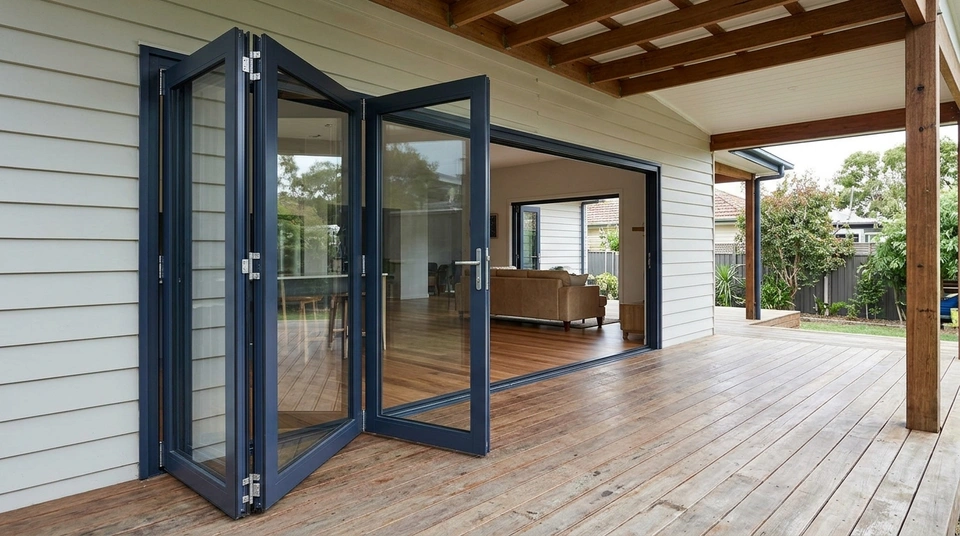
AI-generated illustrative image. Not a product test, certification record or project evidence.
Bifold door sizes follow the leaf, not the wall. SMIRO Living and Comfort leaves are 500 to 1000 mm wide and 2000 to 2700 mm high, so 2 leaves reach about 2 m and 4 leaves about 4 m before frame allowances. Nuline recommends 800 to 1000 mm leaves and suggests dividing the opening by 800 to find the panel count. Then pick odd or even for the access leaf and reserve stack space about one leaf width deep.
Getting bifold door sizes right means four decisions in order: height, panel count, odd or even layout, and where the folded stack parks. Key takeaways: a traffic leaf needs an odd leaf count or an odd-odd split such as 1+3. A folded stack has both a thickness and a projection. A 2 panel bifold is a clearance choice rather than a saving. A 3 panel bifold door and a 4 panel bifold door suit narrower openings; five or six panels cover wider walls. This guide uses SMIRO's Living and Comfort sheets and named Australian supplier charts, and labels any overseas figure.
Step 1: Set the height and measure the opening
Start with height, because it caps everything else. SMIRO Living and Comfort bifolds are listed at 2000 to 2700 mm high with a 75 mm frame depth. Australian charts sit lower. Wideline's Horizon chart uses a 2095 mm standard frame height and a 2400 mm maximum, and Doors Plus lists exterior aluminium bifolds at 1950 to 2400 mm. A taller leaf is a heavier leaf, and each SMIRO leaf is capped at 100 kg.
The opening is larger than the frame. Wideline's Horizon chart sets the stud opening at frame width plus 60 mm and frame height plus 40 mm, and Doors Plus gives the same allowance. Treat that as a supplier example, not a SMIRO rule. The SMIRO sheets list several fixing methods, including timber reveal and L angle, so the real allowance is confirmed at quote. Check the head too. Action Glass in Perth names lintel deflection as the most common cause of a bifold that will not latch cleanly.
Step 2: Match bifold door sizes to panel count
Divide the opening width by a working leaf width, then round to the layout you want. Nuline, a Melbourne manufacturer, recommends 800 to 1000 mm per leaf and suggests dividing the opening by 800 to find the panel count. Narrower leaves add hardware, metal and cost, and put more frames across the view.
At SMIRO's limits, leaf arithmetic gives these working spans before allowances. Multiplying SMIRO's 500 and 1000 mm limits gives about 1 to 2 m for two leaves, 1.5 to 3 m for three, 2 to 4 m for four, 2.5 to 5 m for five and 3 to 6 m for six. These are derived spans, not stock sizes. At the same SMIRO limits, a 4.8 m opening is 6 leaves of about 800 mm or 5 of about 960 mm.
Published ranges vary by system. Doors Plus lists exterior aluminium bifolds at 2100 to 3000 mm wide for 3 doors, 2800 to 3950 mm for 4 doors and 3500 to 4900 mm for 5 doors. Wideline's Horizon chart stops at a 6000 mm frame width with 900 mm leaves at 80 kg. SMIRO lists 1000 mm leaves at 100 kg, so do not carry another system's width table across to a SMIRO quote.
One Doors Plus table needs care. It publishes frame widths by lite count: 2 lite at 1330, 1570 or 1690 mm; 3 lite at 1810, 2330 or 2530 mm; 4 lite at 2690, 3110 or 3370 mm; 5 lite at 3110, 3590 or 4210 mm; and 6 lite at 4310, 4790 or 5050 mm. Doors Plus places the table under a Zone Living or Closet Bifolds heading, beside text giving a 900 to 4200 mm range that the 6 lite figures exceed. Use it for interior doors, not patio bifolds. For sliding panels that stack instead of fold, the stacker door sizes guide covers those widths separately.
Step 3: Choose an odd or even configuration and the traffic leaf
Bifold door configurations are described by how many leaves fold each way, such as 3L1R in Wideline's chart. The count on each side decides whether you get an everyday access leaf. The traffic leaf is a hinged leaf that opens like an ordinary door without folding the whole set. Wideline states the rule exactly: a layout with an even number of leaves on each side has no access door, so it has internal access only.
Wideline's chart shows that 3 and 5 panels always have a traffic leaf, because one side must be odd. Four panels have one only as a 1+3 split, six panels only as 1+5 or 3+3, and Wideline marks a 4+0, 2+2 or 6+0 set as having none. UK supplier Door and Window Experts adds that even sets folding all one way usually need a floating mullion at the locking side. That joint looks thicker than the others.
Odd is not always better. One Houzz UK commenter weighing 4 against 5 panels for a 4.5 m opening favoured a 4 panel 1+3 set. It lets you open the lead leaf alone, the lead plus one folding leaf for a French-style gap, or everything.
SMIRO's Living and Comfort sheets list leaf size, weight and frame limits but not leaf counts or access-leaf layouts. Ask for the layout drawing with the quote and check which leaf is the traffic leaf and which end it sits on.
Step 4: Plan the stack space inside or outside the line
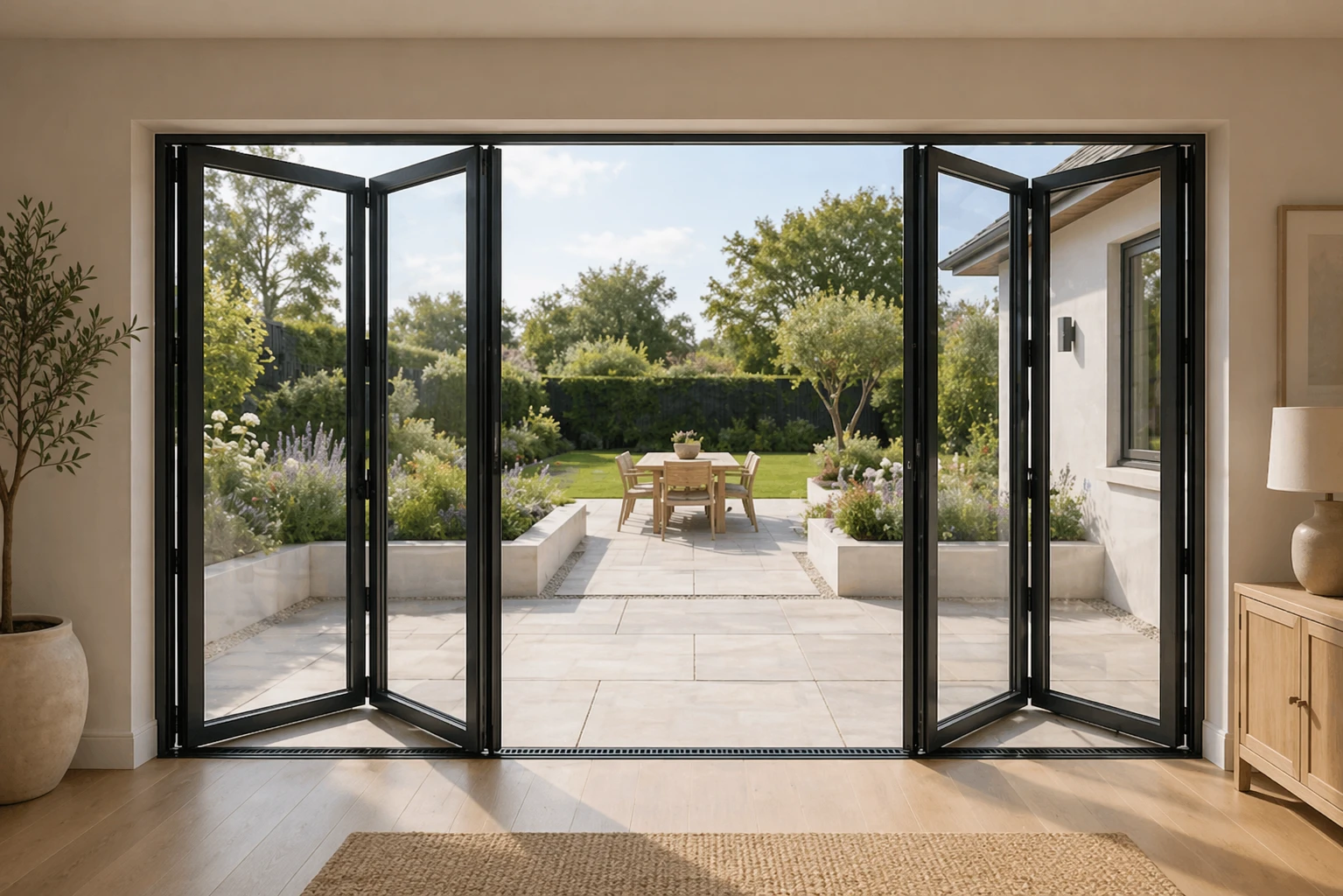
A folded stack has two dimensions, and suppliers often quote only one. The first is thickness along the opening, which grows with leaf count. The second is projection out from the opening line, which is set by leaf width.
For thickness, sources disagree. Sunseeker, a UK supplier, puts a stacked leaf at 80 to 100 mm plus handle space. Action Glass in Perth says folded panels are typically 100 to 150 mm deep each. Combining the Sunseeker and Action Glass ranges gives about 320 to 600 mm along the wall for a 4 leaf stack and about 480 to 900 mm for a 6 leaf stack. Treat these as planning figures: SMIRO's sheets publish a 75 mm frame depth, not a stacked leaf thickness.
For projection, US manufacturer Gladiator says the folded stack projects roughly one leaf width from the opening, whatever the total door width. Using Gladiator's rule, a 900 mm leaf needs about 900 mm of clear floor or patio beside the opening, not just the stack thickness. A split layout halves the thickness at each jamb but needs that clear zone at both ends.
Then choose the side. Folding outward keeps the room clear but needs patio space and leaves the folded panels exposed. Folding inward takes floor area; Origin's FAQ suggests outward when space inside is tight and outside is generous. Mark the stack footprint on the plan and check it against downpipes, posts and furniture.
2 panel bifold doors and bifold French doors versus a hinged pair
2 panel bifold doors suit narrow openings, roughly 1 to 2 m at SMIRO leaf limits, but they are not automatically the cheaper choice. APS Double Glazing, Smartaview and Vitrum each say a hinged French pair is the lower-cost format at narrow widths, because it has fewer leaves and simpler hardware. Price belongs in the bifold cost guide. The sizing point is that below about 2 m, a bifold's main advantage is not width.
Where a 2 panel bifold earns its place is swing clearance: a hinged pair sweeps two arcs, while a bifold pair folds against the jamb. Wideline's chart shows two panels folding one way as internal access only, and Door and Window Experts suggests a traffic-door layout, which starts at three panels. Bifold French doors, as searchers call them, are the centre-opening alternative. Exact Architectural Glazing says some systems let the bifold profile be configured as a French door for a slim profile.
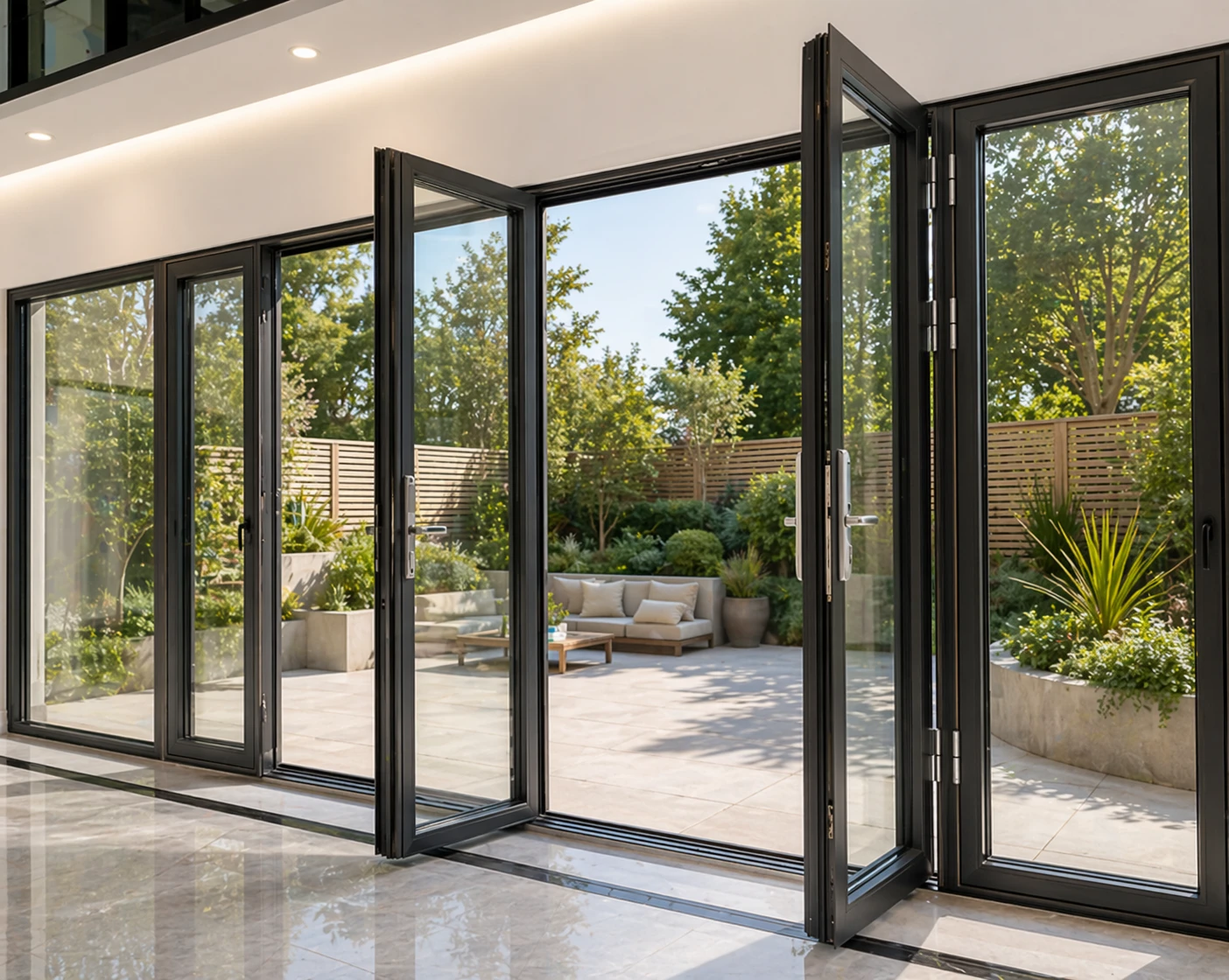
SMIRO hinged doors use a leaf up to 1000 mm wide and 80 kg. The French door sizes guide covers how two hinged leaves share a frame, and the opening-width comparison sets hinged, bifold and sliding doors side by side.
Frequently asked questions
What are standard bifold door sizes in Australia?
There is no single standard. Australian charts cluster at 2095 to 2400 mm high and list widths in frame steps, such as Wideline Horizon's 1570 to 5890 mm with 900 mm leaves. SMIRO Living and Comfort work to limits: leaf width 500 to 1000 mm, height 2000 to 2700 mm.
How wide is a 4 panel bifold door?
At SMIRO leaf limits, four leaves span about 2 to 4 m before allowances. Doors Plus lists exterior aluminium 4 door sets at 2800 to 3950 mm wide. Pick the leaf width from your opening, then add the allowance between frame and stud opening.
Does a 3 panel bifold door have a traffic door?
Normally yes. An odd leaf count means at least one side has an odd number of leaves, and an odd side has a hinged access leaf. Confirm which end the access leaf sits on, because that decides whether the set can serve as the everyday door.
How much room does a bifold door stack need?
Sunseeker and Action Glass support a planning range of roughly 80 to 150 mm of thickness per leaf along the opening. Gladiator's projection rule adds about one leaf width out from it. For a 900 mm leaf and four panels, that is about 900 mm out by 320 to 600 mm along the wall. Ask SMIRO for the stack drawing.
Can a 2 panel bifold door replace French doors?
Yes, where swing arcs are the problem. Wideline's chart shows that a 2 panel set folding one way has no external access, so choose a centre-opening layout if you want French-style use. APS Double Glazing, Smartaview and Vitrum each present a French pair as the cheaper format, so weigh clearance against cost.
Work through the steps in order: height, panel count, odd or even, then stack side. For a size check, send SMIRO your opening width and height, the lintel or ceiling height, your preferred fold direction and where the access leaf should sit. SMIRO lists its bifold range at a design SLS of 800 Pa and a ULS of 3000 Pa, so include your site's design wind pressure too. Every SMIRO series is tested to AS 2047, so ask for the test report for your exact size. The bifold cost guide and the double glazed bifold doors guide cover price and glazing once the size is settled.
Our Products
Hinged Doors
View system
Bi-folding Doors
View system
Sliding Doors
View system
Awning Windows
View system
Fixed Windows
View system