
Door Types
Double Glazed Bifold Doors: Thermal Break, Glass Weight and Sealing Across Many Panel Joints
By Sheng Xu · 10 November 2026
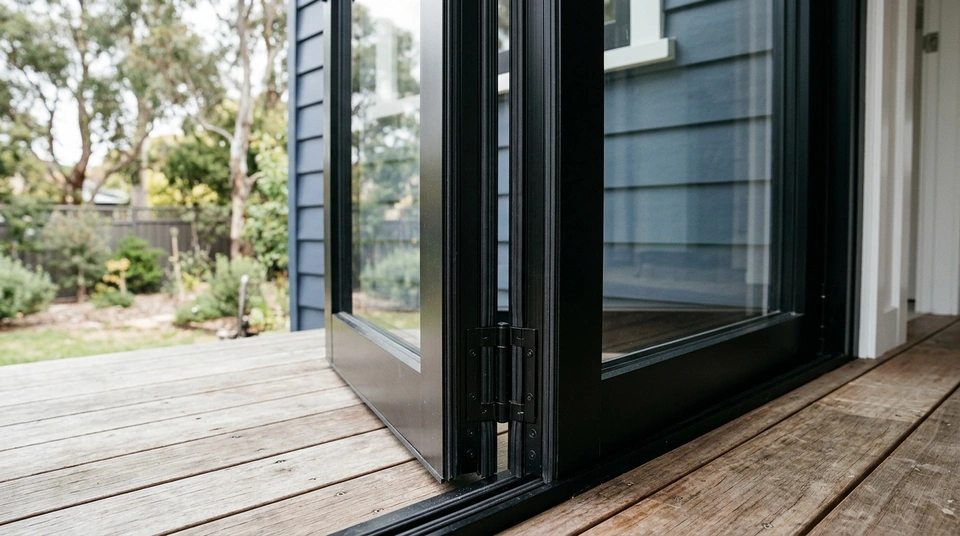
AI-generated illustrative image. Not a product test, certification record or project evidence.
Double glazed bifold doors need careful frame, seal and hardware specification because every hinged joint and leaf edge adds another seal line. SMIRO specifies a thermal break and 5 + 12Ar + 5 glazing for Comfort, together with leaves 500 to 1000 mm wide, 2000 to 2700 mm high and up to 100 kg. SMIRO lists a 75 mm frame and sound under 36 dB for its bifold system. SMIRO Living uses a non-thermal-break frame.
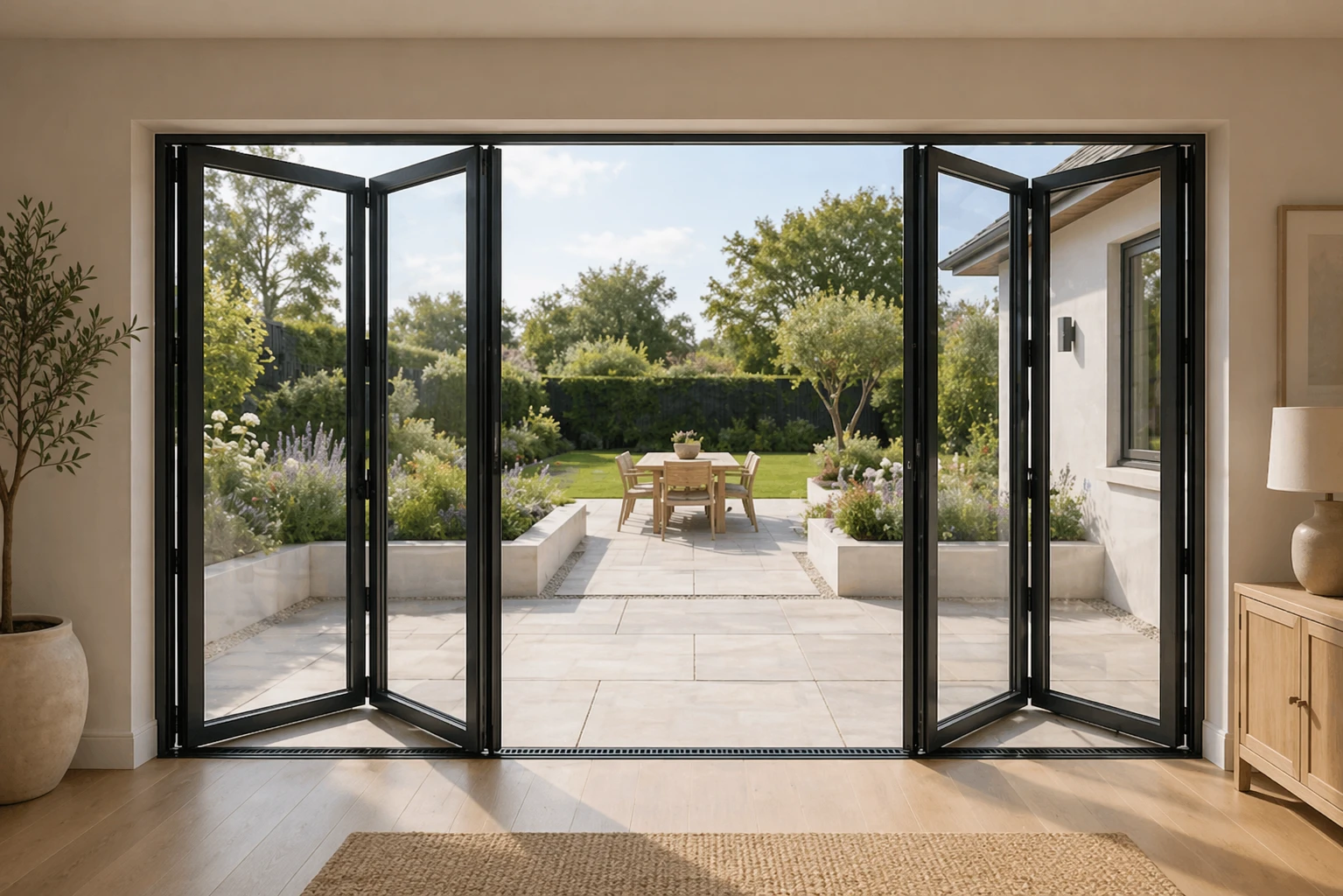
Double glazed bifold doors, also sold as double glazed folding doors or double glazed concertina doors, are bought for opening width, but the questions builders ask afterwards are about draughts, weight and sticking. All three come from one design choice: many narrow leaves instead of a few wide panels. This guide works through the joints, the thermal break, the glass weight and the hanging method, using published supplier data and the SMIRO configuration sheets rather than test claims of our own.
Why a bifold has more seal lines than a slider
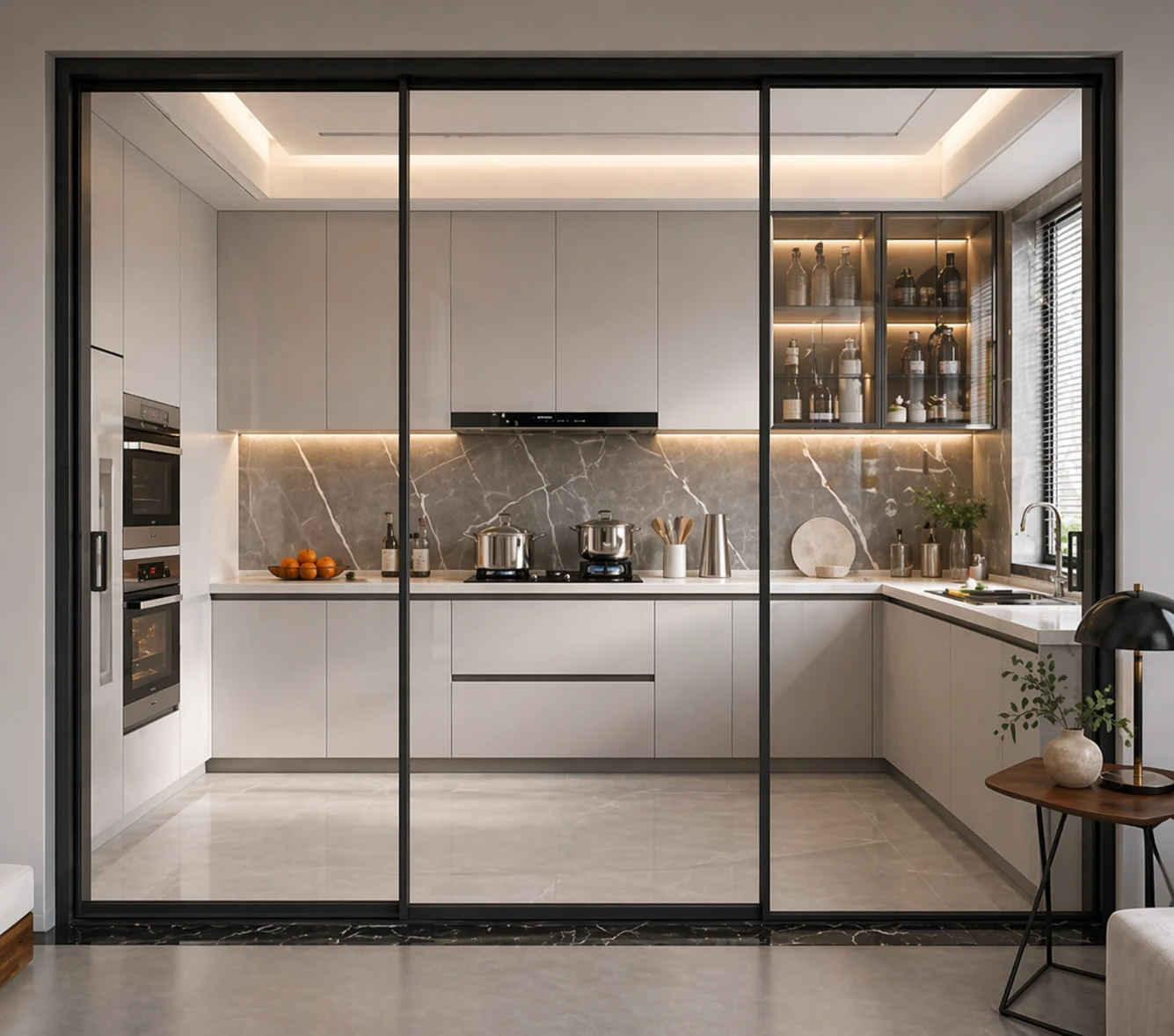
Start with the arithmetic. SMIRO bifold leaves are 500 to 1000 mm wide, so a 4 m opening needs at least four leaves and three hinged joints, plus head, sill and jamb seals on every leaf. SMIRO Urban sliding panels run up to 2000 mm wide, so the same 4 m frame can be two panels and one meeting joint, although a slider clears less of the opening. The NatHERS fact sheet ENR026 (July 2019) reflects that geometry. It puts bifold doors in default window Group A, the larger frame fraction group, and sliding doors in Group B, the smaller one.
Those joints are sealed in layers. Harmony Profiles, a UK aluminium bifold supplier, says its Visofold range uses EPDM gaskets and weather brushes, plus double-rebated EPDM centre gaskets. Rylock says the pull handles and flush-bolt compression latches on its Commercial Series bifold exist to resist air and water infiltration. Reimagined Habitat, an Australian design blog, argued in October 2026 that every joint between panels is a potential leak point and every hinge a small thermal bridge. That is an opinion, not a test result, but it names the right places to inspect: panel joints and hinges.
Thermally broken bifold doors: the break has to be in every leaf
In a folding door each leaf is a complete framed sash, so the break has to run through every leaf as well as the outer frame, or the many leaf frames stay bare aluminium. Alspec's ThermAFrame brochure describes Technoform fibreglass reinforced polyamide strips in its thermally broken framing. A break cannot close a panel joint or stop heat travelling through metal hinges and bolts, so the seals still decide air leakage. Our separate guide to thermal breaks covers the construction.
Published whole-window figures for Australian folding doors overlap, because Uw depends on size and glass as well as frame. AWS Vantage lists its thermally broken Series 730 ThermalHEART bifold at Uw 2.3 to 4.9. AWS says WERS data shows the door is 32 per cent more efficient than a standard non-thermally broken bifold with the same glass. Rylock lists Uw 4.1 for its Commercial Series bifold and notes that energy values rise as product size falls. Capral lists Uw 3.35 to 6.00 for its Artisan 996 folding door. Neither of those two pages mentions a thermal break. SMIRO lists one range for its bifold system, U 2.5 to 3.5 W/m²K and SHGC 0.38 to 0.65, so ask for the WERS label for your size and glass.
SMIRO 5 + 12Ar + 5 glass and what a 100 kg leaf carries
Glass is the heavy part. Affordable Glass Online puts glass at 2.5 kg per square metre for every millimetre of thickness. The Glass Calculator reference table lists a 5/12/5 double glazed unit at 25 kg per square metre, which is the 10 mm of glass alone. Using that Glass Calculator rate, a SMIRO leaf at 1000 by 2400 mm contains at most about 60 kg of glass before allowing for frame sightlines. At SMIRO's 1000 by 2700 mm leaf limit, the same calculation gives about 68 kg. The SMIRO sheets therefore leave roughly 32 to 40 kg of the 100 kg limit for the frame, hinges and rollers. Affordable Glass Online's rate also shows why thicker or laminated glass adds weight, so a glass change is a hardware question too.
Hardware ratings differ by system. Alspec's Carinya Select Bi-Fold lists 40 kg panels on F2 and E2A hardware and 80 kg on F3, with a 900 by 2400 mm maximum panel. Using the Glass Calculator's 25 kg per square metre rate, a leaf that size has about 54 kg of glass. Capral lists 100 kg per panel for its Artisan 996. The SMIRO sheets list hardware as China Brand, Doric or customised, so ask which roller and hinge set is rated for your leaf weight.
Top-hung or bottom-rolling: where the weight goes
A top-hung door hangs from the head track, so the lintel must carry the doors as well as the wall above; Origin Bifolds, a UK manufacturer, says that needs a strong overhead lintel or beam. A bottom-rolling door runs on floor track and rollers. Alspec says its Centor bottom-rolling hardware removes the structural beam a top-hung system needs, and AWS says bottom rollers reduce lintel sag. Rylock's Commercial Series bifold is bottom-rolling and Stegbar's residential bifold is top-hung, while P C Henderson, a folding door hardware maker, says top-hung doors run smoothly with less debris in the track. So supplier choice does not settle it. The SMIRO Living and Comfort sheets do not state the hang type, so confirm it in writing, with the lintel check, before the frame is ordered.
Living versus Comfort, and the NCC 2022 NatHERS context
SMIRO Living and Comfort share the same envelope: leaves 500 to 1000 mm wide and 2000 to 2700 mm high, up to 100 kg, a 75 mm frame and 5 + 12Ar + 5 glass. The SMIRO sheets differ in the thermal break, which is Comfort only, and in the listed installation methods: Comfort lists timber reveal and L angle, while Living adds fin fix, subhead and subsill. SMIRO lists its bifold system at design SLS 800 Pa, ULS 3000 Pa, water resistance 200 Pa and sound under 36 dB. Every SMIRO series is tested to AS 2047, so ask for the test report and WERS label for your exact size.
NCC 2022 sharpened the question. The ABCB's NCC 2022 and NatHERS tools webinar describes a seven-star-or-equivalent stringency for Class 1 buildings. Under the NatHERS compliance pathway, the ABCB requires a minimum seven-star rating, with a lower 6 or 6.5-star minimum available for qualifying outdoor living areas in climate zones 1 and 2. NatHERS models doors by whole-window U-value and SHGC, using either a custom window with tested values or a default window. The NatHERS default values assume more frame for a bifold than for a sliding door of the same width. A thermal break can improve the frame result, but whether Comfort or Living is enough depends on climate zone, orientation and the rest of the house, so the assessor's result decides.
Frequently asked questions
How thermally efficient are bifold doors?
It depends on frame, glass and size, and published figures overlap: AWS lists Uw 2.3 to 4.9 for its thermally broken bifold and Capral lists Uw 3.35 to 6.00 for its Artisan 996. A bifold has more frame and more joints than a slider of the same width, so the frame and seals carry more of the result. Ask for the WERS label for your size.
What are common problems with bifold doors?
Owners in Houzz Australia and Bunnings Workshop community threads report draughts and gaps, panels that stick or need adjusting, and tracks that collect dirt. These trace back to joint count, glass weight and fit. Daylight at a closed joint is an adjustment or a worn seal to fix, not a design feature.
Is a thermally broken bifold door worth it over a non-thermally broken one?
A break reduces heat flow through the frame, which matters more when a door has many leaf frames. AWS's 32 per cent figure is a supplier claim from WERS data, not an independent test. For a large opening in a cooler climate zone Comfort is the safer specification. For a small shaded opening in a mild zone, Living with the same glass may pass once the NatHERS result is checked.
Do double glazed bifold doors get too heavy for the hardware?
Not on the glass alone. The Glass Calculator lists a 5 + 12Ar + 5 unit at about 25 kg per square metre, so a SMIRO leaf at 1000 by 2700 mm contains roughly 68 kg of glass against the SMIRO sheet's 100 kg limit. Thicker or acoustic laminated glass changes that sum, so confirm roller and hinge ratings with the fabricator before upgrading the glass.
Specifying double glazed bifold doors with SMIRO
Key takeaways: count the joints, because every leaf adds seal lines. Put the thermal break in every leaf. Treat Uw ranges as size-specific and ask for the WERS label. Do the weight sum before changing glass. Settle top-hung or bottom-rolling with the lintel in writing. On the SMIRO sheets Comfort is the thermal break bifold and Living the non-thermal break version, on the same leaf size, glass and 100 kg limit.
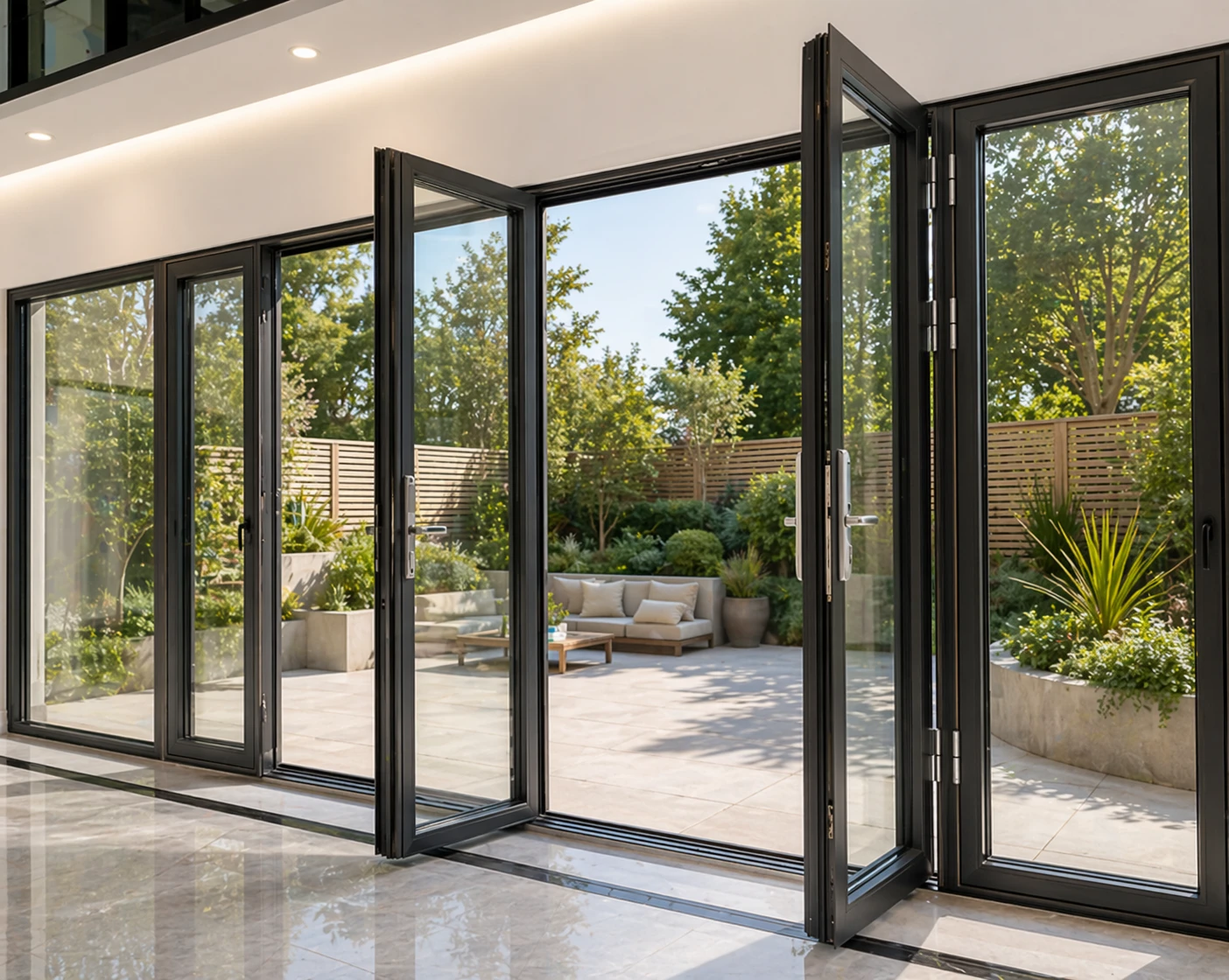
Using SMIRO's published panel limits, an opening closer to 2 m than 4 m can use hinged doors with far fewer joints, so they are worth pricing first. For custom bifold doors sized to an unusual opening, send the width, height, leaf count and orientation so the configuration can be checked against the leaf and height limits before the glass is chosen.
Our Products
Hinged Doors
View system
Bi-folding Doors
View system
Sliding Doors
View system
Awning Windows
View system
Fixed Windows
View system