
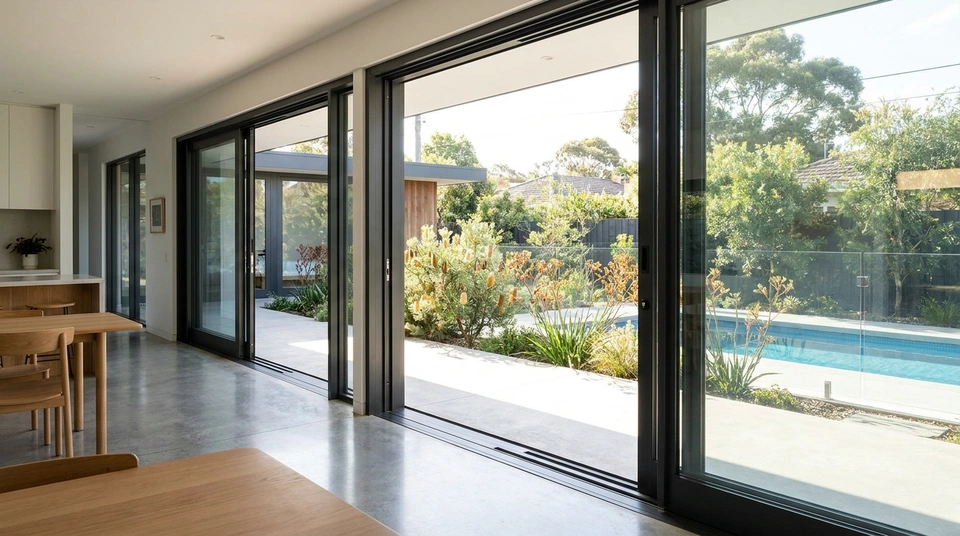
Energy & Thermal Performance
Double Glazed Stacker Doors: Choosing Glass for Heat, Noise and Safety (and Why Panel Weight Matters)
By Sheng Xu · 4 October 2026
AI-generated illustrative image. Not a product test, certification record or project evidence.
When specifying double glazed aluminium stacker doors under NCC 2022 7-star NatHERS mandates, energy assessors evaluate certified whole-window ratings (Uw 2.5 to 3.5 W/m²K and SHGCw 0.38 to 0.65 for high-performance non-thermally broken systems like SMIRO Vista 187 and Urban Reinforced 240) rather than isolated glass center-of-glass ratings. For acoustic attenuation, standard symmetrical double glazing achieves Rw 31 to 32 dB; blocking traffic noise requires asymmetrical glass thicknesses or acoustic laminated glass to reach Rw 35 to 38 dB. Crucially, higher glass thickness increases areal mass (25 kg/m² for standard 5+5mm up to 42 kg/m² for heavy acoustic laminates), capping maximum permissible panel dimensions on standard 80kg roller carriages.
Under the National Construction Code (NCC 2022), energy efficiency benchmarks for Australian residential buildings have fundamentally transformed how external doors are engineered. New homes and substantial renovations must now satisfy a rigorous 7-star NatHERS baseline, complete with stringent heating and cooling load caps under ABCB Standard Specification 42. In response, single glazing has been rendered obsolete across expansive patio openings, establishing double glazing as the national standard.
However, choosing the right glass for an aluminium stacker door involves far more than simply ticking a 'double glazing' box. In multi-panel sliding joinery, thermodynamics, building physics, acoustic resonance, and structural mechanical limits intersect. A glass make-up optimized purely for thermal insulation may transmit irritating traffic rumble, while a heavy acoustic specification can overload roller carriages and lead to premature hardware failure. Understanding the trade-offs between thermal U-values, solar heat gain, acoustic attenuation, and physical panel weight is vital when designing custom stacker doors.
Whole-Window Uw vs. Center-of-Glass Ug: The Area-Weighted Reality
One of the most persistent misunderstandings in window and door procurement is the gap between a glass manufacturer's 'center-of-glass' rating (Ug) and the certified 'whole-window' rating (Uw) published by the Window Energy Rating Scheme (WERS). Glass suppliers frequently advertise that an insulated glass unit (IGU) featuring a soft-coat Low-E surface and an argon gas cavity achieves an outstanding Ug of 1.2 to 1.4 W/m²K.
However, in Australian NatHERS energy ratings (calculated via FirstRate5, BERS Pro, or HERO), energy assessors are legally prohibited from entering center-of-glass ratings. Assessors must model the certified whole-window U-value (Uw), which is calculated in accordance with ISO 15099 as an area-weighted balance combining the glass, the aluminium frame, and the edge-of-glass spacer conductance:
Uw = (Glass Area x Ug + Frame Area x Uf + Glass Perimeter Length x Psi_g) / Total Window Area.
In a 3-panel or 6-panel aluminium stacker door, the outer perimeter frame, bottom sill, top head track, and interlocking vertical stiles account for 20% to 30% of the total face area. If the door utilizes standard, non-thermally broken aluminium extrusions, that metal frame conducts heat at a high frame U-value (Uf) of 7.0 to 9.0 W/m²K. Consequently, combining high-performance Low-E double glazing (Ug 1.4) with a non-thermally broken aluminium frame yields a certified whole-window Uw of approximately 2.5 to 3.5 W/m²K. For deeper foundational definitions, refer to our detailed guides on what is whole-window U-value and what are double glazed windows.
Non-Thermally Broken vs. Thermally Broken Frames: Knowing When You Need Each
Honest architectural specification requires clarity about aluminium extrusion construction. Not every Australian home requires an expensive thermally broken frame, but some projects cannot achieve compliance without one.
Non-Thermally Broken Stacker Doors (e.g., SMIRO Vista 187mm & Urban Reinforced 240mm Series): Feature solid architectural aluminium extrusions glazed with 5mm Toughened + 9mm/12mm Argon + 5mm Toughened IGUs. This configuration delivers certified whole-window performance of Uw 2.5 to 3.5 W/m²K and SHGCw 0.38 to 0.65. For projects across Sydney (Climate Zone 5), Brisbane (Zone 2), Perth (Zone 5), Adelaide (Zone 5), and coastal New South Wales, this specification easily satisfies NCC 7-star requirements when paired with proper eaves shading and wall insulation, delivering outstanding architectural strength at a cost-effective price point.
Thermally Broken Stacker Doors: Feature an internal structural polyamide insulating strut that physically separates the exterior and interior aluminium extrusions, preventing conductive heat bridging through the metal. Thermally broken systems (such as Stegbar EnviraLuxe or Alspec ProGlide TB) achieve lower whole-window ratings of Uw 1.7 to 2.4 W/m²K. These systems command a 30% to 60% price premium and are specifically engineered for alpine regions (Climate Zone 8), harsh sub-alpine southern climates like Canberra (Zone 7) or Ballarat (Zone 6), or homes featuring massive unshaded glass-to-floor ratios. To explore this distinction in detail, read our technical explainer on what is a thermal break.
Solar Heat Gain Coefficient (SHGCw): Tuning Glass by Australian Climate Zone
While U-value measures how effectively a door resists conductive heat flow, Solar Heat Gain Coefficient (SHGCw) measures how much solar radiation passes through the glazing into the home. Under NCC 2022 Specification 42, optimizing SHGCw is strictly dictated by climate zone and orientation:
Heating-Dominated Climates (Southern Australia - Melbourne, Hobart, Canberra): In cooler zones where space heating accounts for the vast majority of annual energy use, sliding stacker doors on north-facing elevations should be specified with high solar gain Low-E glazing (aiming for an SHGCw between 0.45 and 0.60). This allows the low winter sun to penetrate deep into living areas, delivering free passive solar heating that dramatically cuts space heating bills.
Cooling-Dominated Climates (Northern & Coastal Australia - Brisbane, Darwin, Perth): In warm climates where summer cooling loads dominate, stacker doors on east, west, and unshaded north elevations should specify solar-control Low-E coatings. Here, builders aim for a low SHGCw between 0.25 and 0.35. These specialized microscopic coatings reflect infrared solar heat back outdoors while admitting abundant visible daylight, preventing oppressive summer heat buildup. For complete guidance on solar ratings, explore our technical guides on what is SHGC and what is Low-E glass.
Acoustic Performance: Moving Beyond Marketing Claims to Certified Rw Ratings
Marketing brochures frequently claim that double-glazed doors provide '<40 dB sound insulation' or 'eliminate 80% of outdoor noise'. In the fenestration industry, these generic claims are often misleading. Real-world acoustic attenuation is governed by the Weighted Sound Reduction Index (Rw), tested under AS/NZS ISO 717.1.
The Symmetrical Glazing Trap: Many homeowners assume that ordering standard double glazing (such as 4mm Glass + 12mm Air + 4mm Glass, or 5mm + 9mm Ar + 5mm) will silence traffic noise. In reality, standard symmetrical double glazing achieves a certified rating of only Rw 31 to 32 dB—scarcely better than standard 6mm monolithic glass (Rw 31 dB). Because both panes of glass are of identical thickness and mass, they vibrate at the exact same resonant frequency (known as the acoustic coincidence dip, typically occurring between 2000Hz and 3000Hz). When sound waves hit the outer pane, the sealed air cavity acts as an acoustic spring, transmitting the vibration directly to the inner pane.
Asymmetrical Double Glazing (Rw 33 to 34 dB): To break this acoustic resonance, glass engineers specify panes of differing thicknesses—for example, a 6mm toughened outer pane, an argon cavity, and a 4mm toughened inner pane. Because each pane has a different mass and natural resonant frequency, one pane dampens the vibrations that pass through the other, noticeably improving the reduction of mid-frequency traffic noise.
Acoustic Laminated Double Glazing (Rw 35 to 38 dB): For homes adjacent to railway lines, arterial roads, or airport flight paths, high-performance acoustic laminated glass is required. In these IGUs, one pane is replaced with acoustic laminated glass (such as 6.5mm or 10.38mm Vlam Hush / Soundstop), which incorporates a specialized viscoelastic polyvinyl butyral (PVB) acoustic interlayer. The polymer interlayer absorbs sound wave energy through shear friction, flattening the coincidence dip and achieving certified ratings of Rw 35 to 38 dB. Combined with multi-fin woolpile seals along interlocking stiles, this eliminates low-frequency engine drone.
The Glass Weight Constraint: Why Thick Glazing Caps Panel Dimensions on 80 kg Rollers
One of the most critical structural engineering factors overlooked during architectural planning is the relationship between glass thickness and roller carriage capacity. Heavy-duty residential and architectural sliding stacker doors—such as the SMIRO Vista 187 and Urban Reinforced 240 series—are engineered around an operating weight limit of 80kg per panel.
Architectural soda-lime glass has a physical density of 2500 kg per cubic metre, which translates to exactly 2.5 kg per square metre for every millimetre of glass thickness. Calculating the areal mass of different glazing specifications reveals dramatic weight differences:
• Standard 5+9Ar+5 Double Glazing: Contains 10mm total glass thickness. 10mm x 2.5 kg/m² = 25.0 kg/m².
• Asymmetrical 6+12Ar+4 Double Glazing: Contains 10mm total glass thickness = 25.0 kg/m².
• High-Acoustic 6.38mm Lam + 10.38mm Lam IGU: Contains 16.76mm total glass thickness. 16.76mm x 2.5 kg/m² = 41.9 kg/m².
Now consider the impact on maximum panel dimensions under an 80kg roller rating (allowing 10kg to 12kg for the aluminium sash rails, interlocking stiles, and lock hardware, leaving roughly 68kg to 70kg allowable for glass):
With standard 5+9Ar+5 double glazing (25 kg/m²), an allowable glass mass of 68kg permits a maximum glass panel area of 2.72 square metres. A 2400mm high door can comfortably accommodate panel widths up to 1150mm (2.4m x 1.15m = 2.76 m²), allowing expansive 3-panel stackers spanning 3.4m to 3.6m.
However, if you upgrade to heavy acoustic laminated double glazing at 41.9 kg/m², that same 68kg allowance permits only 1.62 square metres of glass. At a standard 2400mm door height, the maximum permissible panel width shrinks to just 675mm (2.4m x 0.675m = 1.62 m²). Specifying a wide 1200mm x 2400mm panel with heavy acoustic glass creates a 120kg sash, rapidly flattening standard 80kg nylon or stainless rollers, grinding tracks, and voiding manufacturer warranties.
Architects and builders must recognize that panoramic panel dimensions (1100mm to 1200mm wide) and extreme acoustic laminate glazing cannot be combined on standard 80kg roller carriages; heavy commercial 150kg–200kg carriages and deep commercial tracks must be specified instead.
AS 1288 Safety Glazing Mandates for Australian Stacker Doors
Under Australian Standard AS 1288 (Glass in Buildings - Selection and Installation), external glazed doors are legally classified as high-risk human impact zones. Accidental human impact against large, floor-to-ceiling glass panels carries severe risk of fatal laceration.
Consequently, AS 1288 strictly mandates that all glass in sliding and stacker doors must be certified Grade A Safety Glass. Annealed (ordinary float) glass is strictly illegal. The two compliant types of Grade A safety glass function as follows:
1. Toughened Safety Glass: Glass that has undergone extreme thermal heat-treating. It is four to five times stronger than standard glass. When fractured, it instantly shatters into thousands of tiny, blunt, relatively harmless granular cubes, preventing catastrophic deep lacerations.
2. Laminated Safety Glass: Composed of two sheets of glass bonded permanently under heat and pressure with a tough polymer interlayer (PVB). Upon severe impact, the glass cracks but remains firmly adhered to the interlayer, preventing penetration, maintaining building security, and eliminating falling glass shards.
In double-glazed stacker doors, both the inner and outer panes must independently satisfy Grade A safety standards. Furthermore, when high-performance Low-E coatings or solar tints are specified, panes must be heat-strengthened or toughened to prevent thermal stress fractures caused by differential solar absorption across shaded frame areas.
Frequently Asked Questions
What whole-window U-value is required for NCC 2022 7-star compliance?
In southern and temperate Australian climate zones (Sydney, Melbourne, Adelaide, Canberra, Hobart, Perth), passing NatHERS 7-star heating load caps typically requires external sliding doors with a certified whole-window Uw between 2.5 and 3.5 W/m²K. Quality non-thermally broken aluminium systems with Low-E double glazing readily achieve this benchmark.
Does standard double glazing effectively block outdoor traffic noise?
No. Standard symmetrical double glazing (e.g. 5mm + 12mm cavity + 5mm) achieves an acoustic rating of only Rw 31 to 32 dB, which performs similarly to standard 6mm single glass because both panes resonate at the same frequency. Effective traffic noise reduction requires asymmetrical glass (e.g. 6mm + 4mm, Rw 33-34 dB) or acoustic laminated glass (Rw 35-38 dB).
What is the difference between toughened and acoustic laminated glass in stacker doors?
Toughened glass is heat-treated for extreme physical strength and safety, shattering into blunt dice on impact. Acoustic laminated glass incorporates a flexible sound-dampening PVB polymer interlayer that absorbs sound wave vibrations, dramatically improving acoustic attenuation and providing post-breakage barrier security.
How does glass weight limit the maximum size of a stacker door panel?
Standard residential stacker door roller carriages are rated to carry 80kg per panel. Standard 5+5mm double glazing weighs 25 kg/m², allowing panels up to ~2.7m² (e.g. 2400mm high x 1150mm wide). Heavy acoustic laminated double glazing weighs over 40 kg/m², restricting maximum panel area to ~1.6m² to prevent roller binding and track damage.
Specifying High-Performance Stacker Glass with SMIRO
Specifying glass for aluminium stacker doors requires balancing thermal efficiency, acoustic peace of mind, human safety, and mechanical operating limits. For most residential projects in temperate and coastal Australia, SMIRO's Vista 187 Series (5+9Ar+5) and Urban Reinforced 240 Series (5+12Ar+5) deliver the ideal synthesis of certified Uw 2.5–3.5 thermal performance, smooth 80kg roller glide, and Grade A safety compliance.
To review full engineering data, explore our certified ratings on the SMIRO Performance & Testing Page, view product details on the SMIRO Stacker Door System, or consult our sibling technical guides on stacker door sizes & dimensions, stacker door pricing, and stacker door fly screens & security screens to ensure your joinery schedule is fully optimized.
Our Products
Stacker Doors
View system
Sliding Doors
View system
Bi-folding Doors
View system
Fixed Windows
View system
Sliding Windows
View system