
Door Comparisons & Selection
French Doors vs Bifold vs Sliding Doors: Which Aluminium Door Suits Your Opening Width?
By Sheng Xu · 10 November 2026
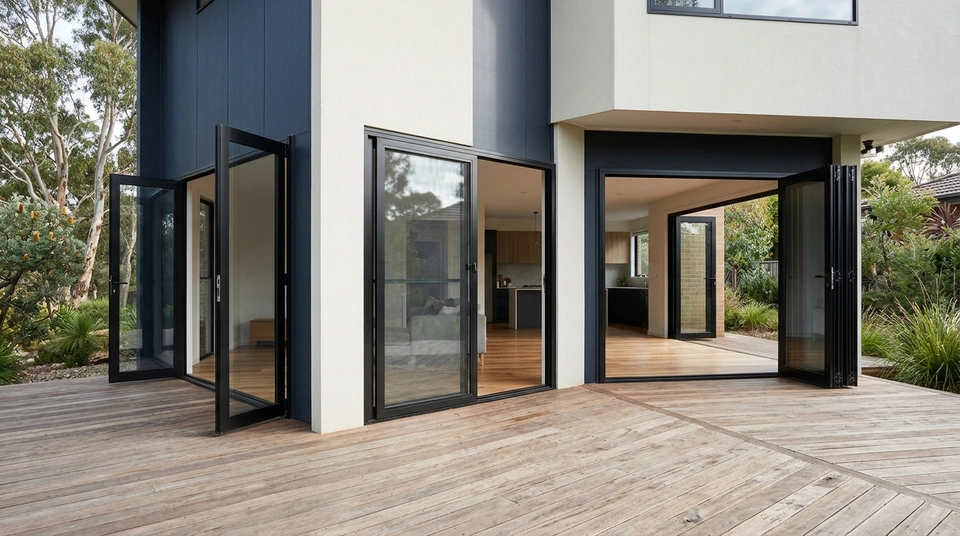
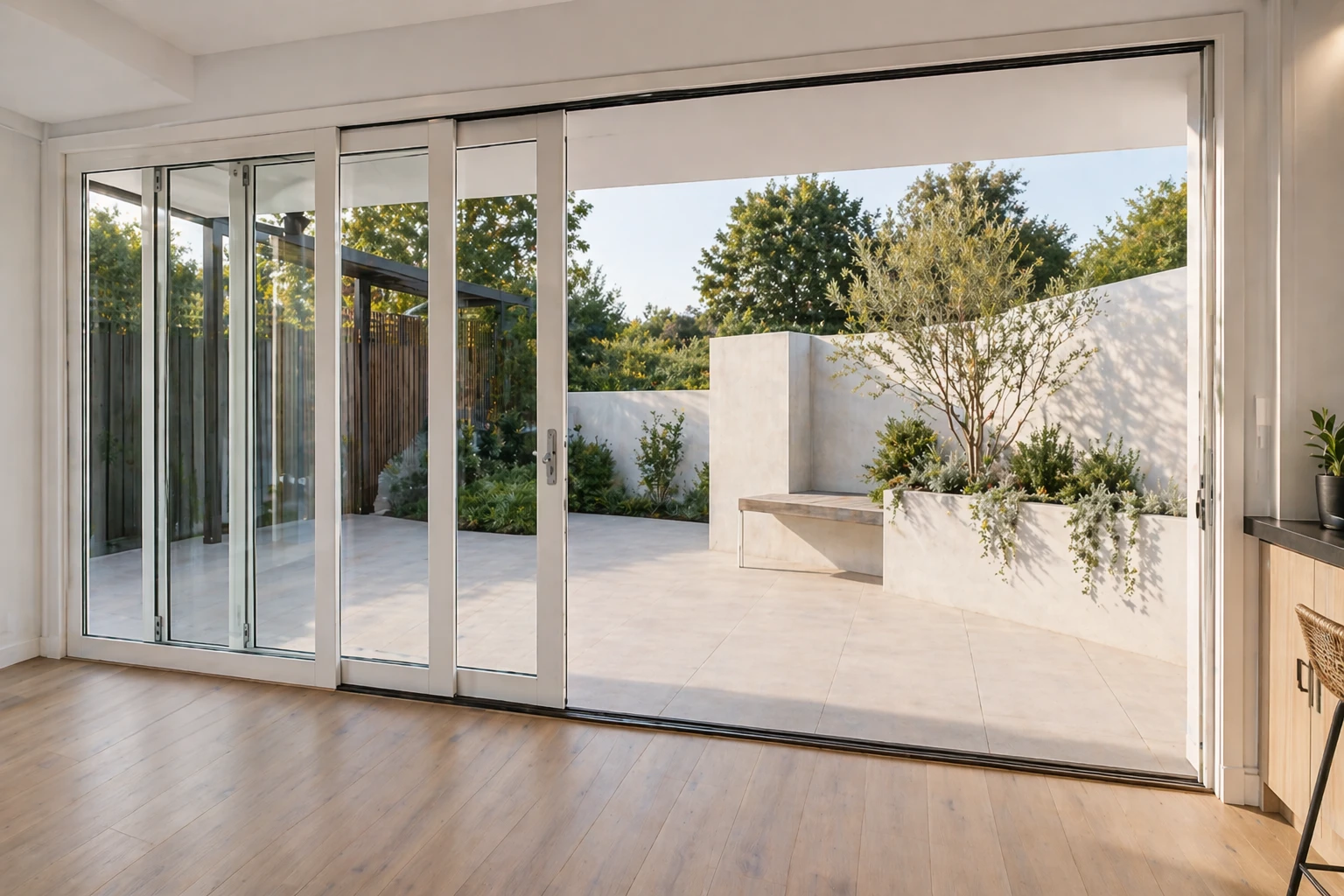
AI-generated illustrative image. Not a product test, certification record or project evidence.
French doors vs bifold doors is mostly a question of opening width. A hinged pair suits an opening around 2 m where swing space is available. From about 2.4 m, compare bifold or sliding panels, with stackers between. Then compare clear opening, movement space, site wind rating, screens and cost.
Most French doors vs bifold doors guides sort the choice by style and heritage, which does not help when you are holding a tape measure. This guide sorts it by opening width instead, using SMIRO's published configuration sheets, Australian supplier pages from 2026 and buyer threads. It covers hinged, bifold and sliding doors in aluminium, with one short stacker section that points to a separate comparison. SMIRO publishes hinged leaf specifications, so the French pair figures here are built from a single leaf's published width and weight plus other Australian systems.
Key takeaways. Width sets the shortlist: a hinged pair to about 2 m, a bifold or sliding doors from about 2.4 m, stackers between. SMIRO hinged and Comfort bifold leaves are 500 to 1000 mm wide, and Urban sliding panels go up to 2000 mm. A two-panel slider clears about half the opening, a bifold up to about 90 per cent and a French pair nearly all of its width. Hinged doors need a swing arc, bifolds a folded stack, sliders neither. SMIRO publishes design pressures of 600 Pa for hinged, 800 Pa for bifold and 1600 Pa for Urban sliding. All four Australian price guides checked put bifolds above sliding doors.
French doors vs bifold doors: the width-first decision ladder
Aluminium doors for wide openings means one thing in practice: an external glazed door chosen by the width of the wall opening it has to fill, not by its style. Width decides the shortlist before style does, and the cut-offs come from leaf size. A hinged leaf is one heavy sash on side hinges, so its maximum width caps the opening, while a bifold or a slider can simply add panels.
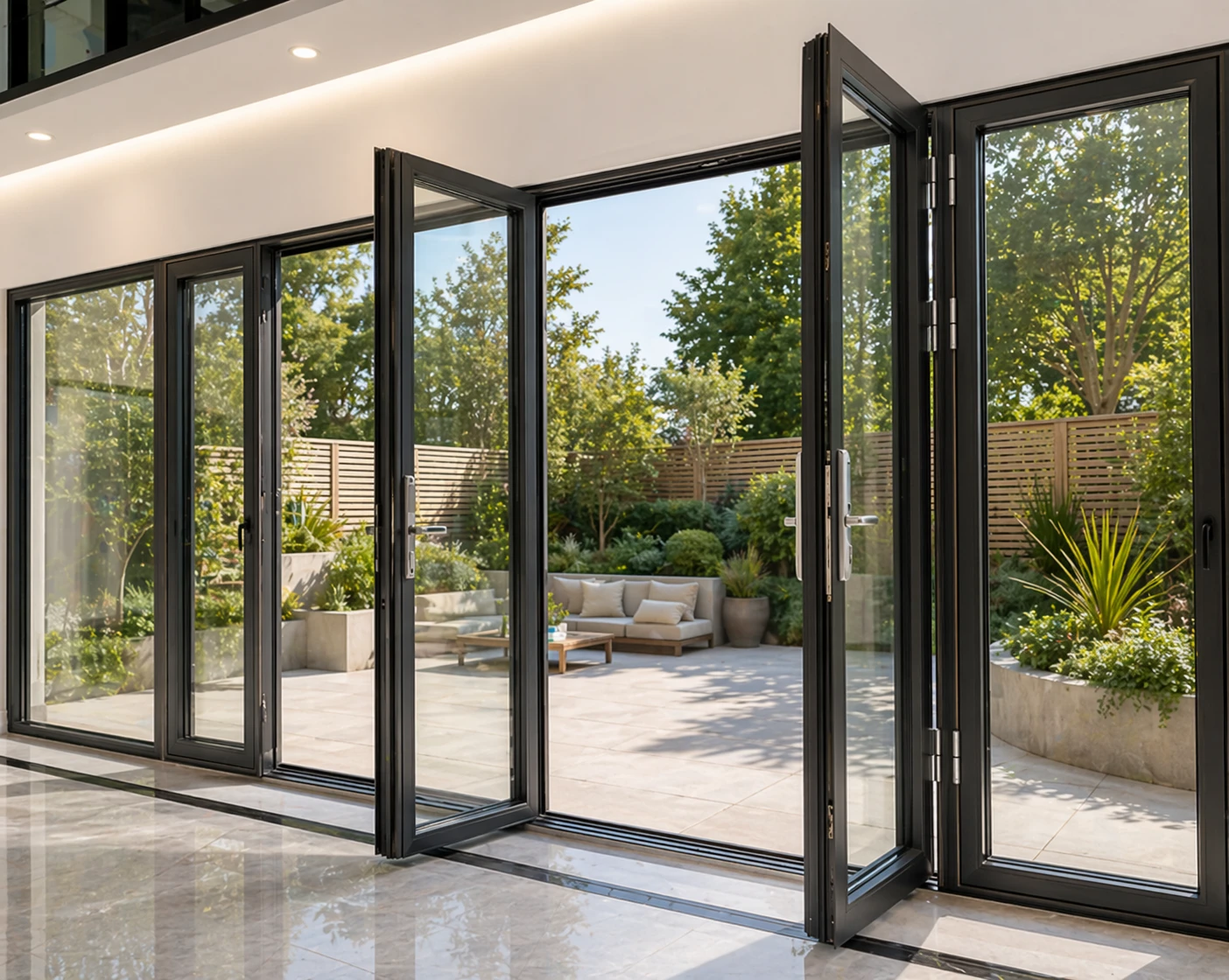
Rung one is up to about 2 m, where a hinged French pair can work. The SMIRO hinged series offers a leaf 500 to 1000 mm wide and 2000 to 3100 mm high, up to 80 kg per leaf, on a 100 mm frame. Capral's Futureline hinged door lists a maximum panel of 1000 mm wide by 2700 mm high at 115 kg. Stegbar's EnviraLuxe lists 1120 mm by 2620 mm and documents a double French configuration. A pair uses two leaves, so those limits give roughly 2.0 to 2.24 m of combined leaf width before allowing for the frame and meeting stiles. Sidelights can fill a wider structural opening.
Rung two is 2.0 to 2.4 m, where sources disagree. Clearview, a UK secondary glazing firm that sells neither door, puts French doors under 1,800 mm. A Mumsnet reply says go French if the space is under 2 m. Vitrums, another UK supplier, says up to 2.4 m. Australian leaf limits side with the lower figures. In this band a French pair with a fixed sidelight, a two-panel slider or a three-leaf bifold can all work, and the choice turns on view, traffic and budget.
Rung three starts near 2.4 m, which answers the common search for the best door for a 2.4 m opening. The checked hinged leaves provide 2.0 to 2.24 m of combined leaf width, so a supplier must confirm whether its complete frame can fill the opening without sidelights. A bifold covers 2.4 m with three leaves of about 800 mm, inside the SMIRO Comfort leaf range of 500 to 1000 mm. Comfort goes up to 2700 mm high, carries 100 kg per leaf, has a 75 mm frame and is a thermal break series. A slider covers the width with two panels of about 1200 mm, under the Urban sliding limit of 2000 mm wide at 120 kg, and a three-panel stacker sits between them. The French door sizes and swing guide, the bifold door sizes and panel configurations guide and the standard sliding door sizes guide give the full ranges.
How much of the opening actually clears?
A French pair clears nearly all of its width with both leaves open, as EE Windows (Brisbane, May 2026) notes, a bifold up to about 90 per cent and a two-panel slider about half. Vue Windows (May 2026) gives 90 per cent for a bifold and 50 per cent for a standard slider, and Smart Doors and Windows (Melbourne, September 2026) quotes 90 to 95 per cent for bifolds. Action Glass (Perth, August 2026) adds that a three-panel stacker clears roughly two thirds and a four-panel about three quarters, and that a bifold clears close to the full opening less the folded stack.
Applied to a 2.4 m opening, that is arithmetic rather than a test result: about 1.2 m clear for a two-panel slider, about 1.6 m for a three-panel stacker and about 2.1 m for a bifold before the stack. A French pair that fits, under about 2 m, clears most of its width, but only if both leaves open. Opening one leaf, which is how many people use a pair day to day, gives you half.
Frames, handles and interlocks trim every one of these figures, so ask for the clear-opening dimension on the drawing for your size instead of relying on a percentage.
Swing space or stack space: what each door takes from your floor
Hinged doors take a swing arc, bifolds take a folded stack and sliders take neither. EE Windows puts the clearance for an outward French leaf at about 800 to 950 mm. The pair therefore needs that much clear deck depth across its full width, not 1,900 mm of depth. Opening inwards moves the same arc into the room. A leaf held open in a gust can also slam, a point raised by a Houzz poster and by Vitrums.
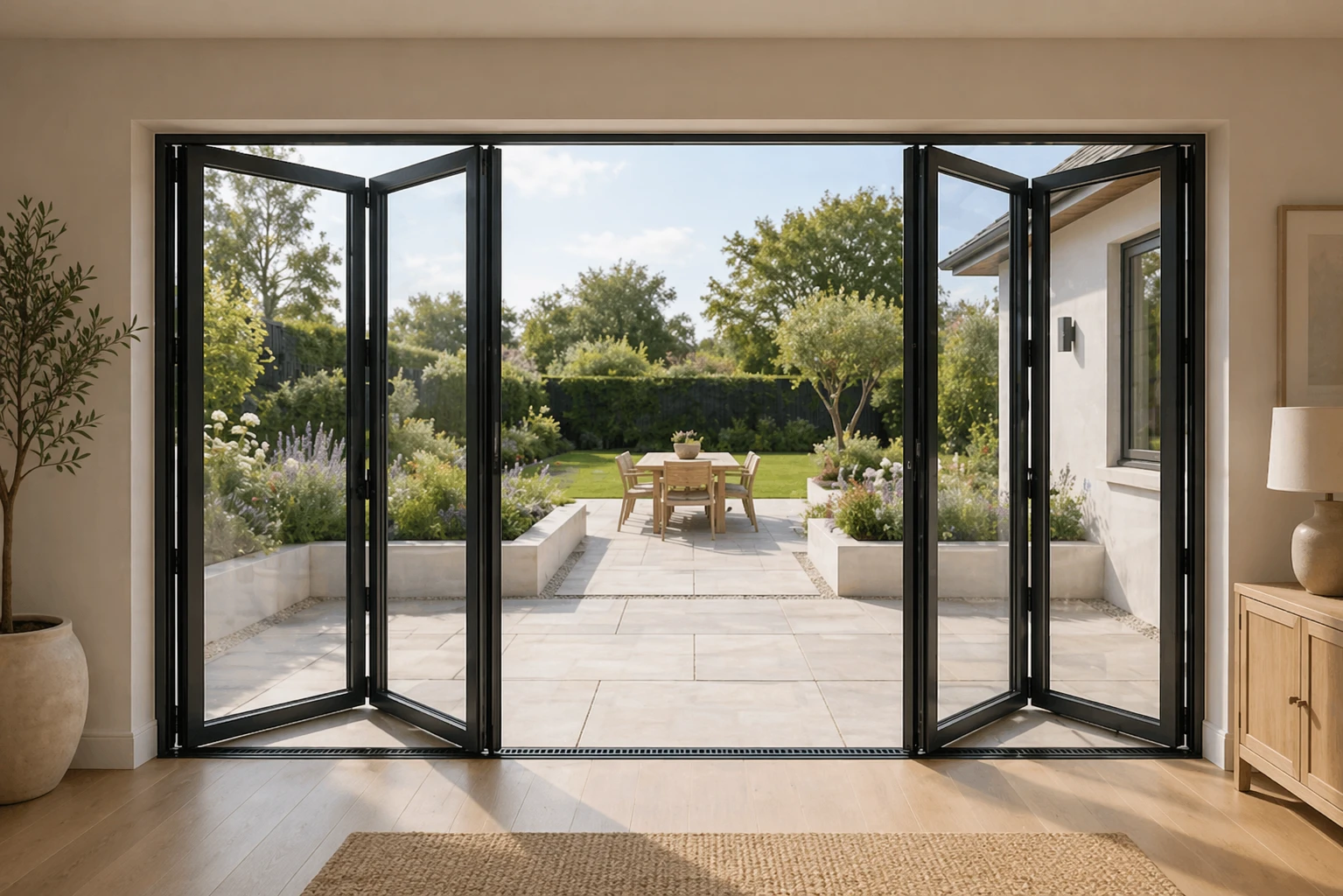
A bifold trades the arc for a stack. Action Glass says each folded leaf is about 100 to 150 mm deep, which puts a three-leaf set at roughly 300 to 450 mm of stack, and Vue Windows quotes 30 to 60 cm for a stack at the side of the opening. The stack stays in view when open and sits beside a barbecue, bench or column if one is there. One Houzz UK poster ruled bifolds out because they would protrude onto the decking.
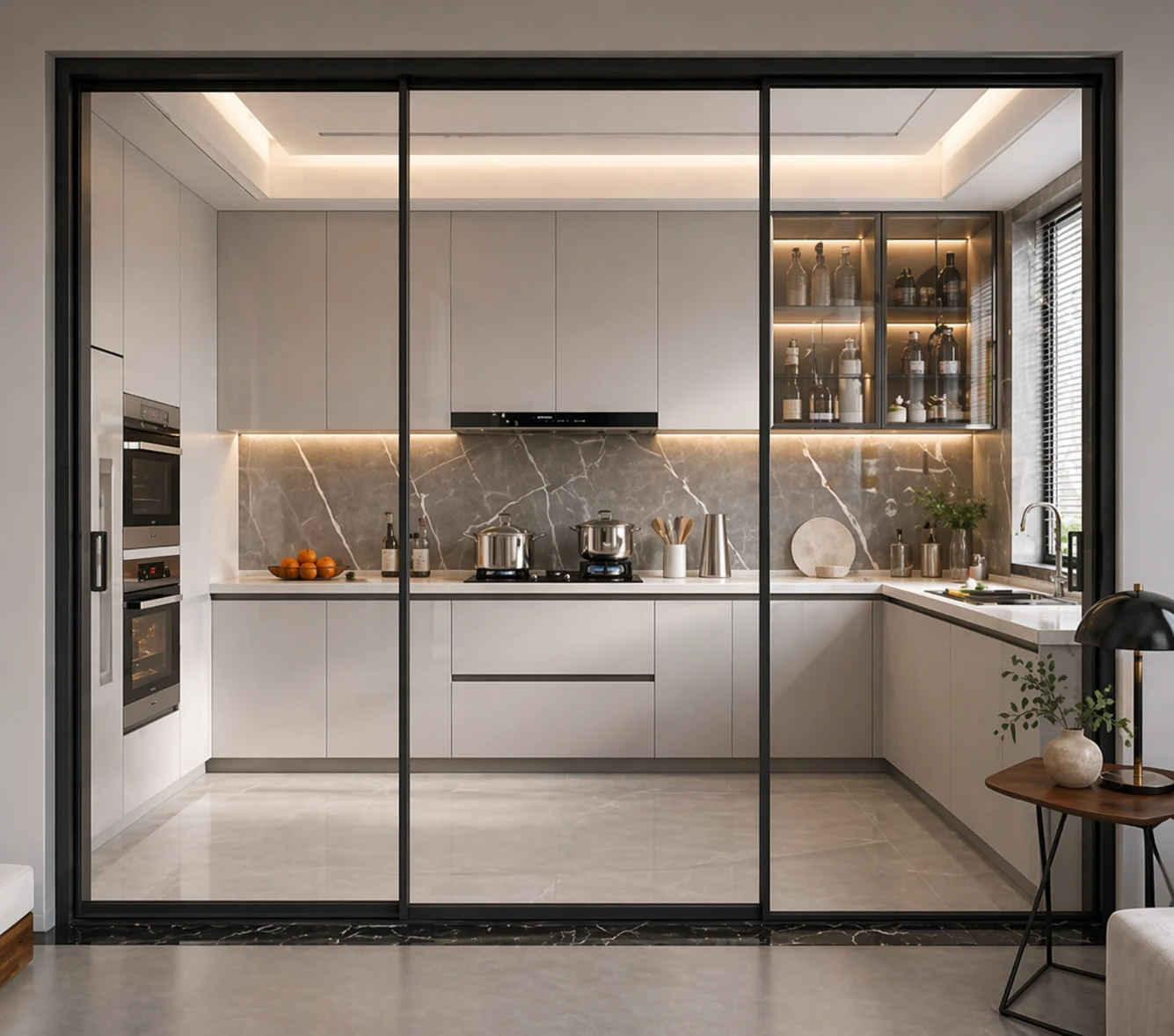
A slider keeps its panels in the plane of the wall, so furniture can sit right up to the track, at the cost of the fixed panel that limits the clear opening. Frame depth matters for the reveal. SMIRO's hinged and Urban sliding frames are 100 mm deep, the Comfort bifold frame is 75 mm and the Urban (Reinforced) sliding frame is 150 mm. The aluminium French door sizes and swing guide works through leaf arcs in more detail.
French doors vs sliding doors: sealing, wind rating, screens and thermal break
On sealing, a hinged leaf closes against a continuous perimeter seal, and a pair adds a mushroom stop at the meeting stiles, as Stegbar describes for its double doors. A slider relies on interlocking stiles, which Action Glass calls a more forgiving detail than a bifold's, because a bifold has more meeting stiles and a longer run of seal. No source checked publishes a like-for-like air-leakage comparison across all three, so treat this as an order of risk, not a ranking. The guide to whether aluminium hinged doors are worth it covers hinged sealing in depth.
Wind rating is where SMIRO's own figures differ most. The published design serviceability pressure (SLS) is 600 Pa for the hinged series, 800 Pa for the bifold series and 1600 Pa for Urban and Urban (Reinforced) sliding doors. Ultimate pressures are 1400, 3000 and 4500 Pa, and design water resistance is 200, 200 and 300 Pa. These are design values for the system, not a rating for your site, and not a rule for the format: Capral lists 1500 Pa SLS for its Futureline hinged door. On an exposed, elevated or coastal opening, check the site wind classification against the product and ask for the AS 2047 test report for your size and glass. Every SMIRO series is tested to AS 2047.
Screens often settle the sliding-versus-hinged question where insects are a problem. SMIRO's hinged page says the door is supplied without a flyscreen, the Urban sliding series list none and the bifold series list a retractable flyscreen. Facelift for Homes notes that retractable insect screens can be fitted to French doors. If the opening also needs heavy duty safety screens, confirm which screen option suits the series and the swing direction before you order.
Thermal break splits the range too. Among the SMIRO systems compared here, only the Comfort bifold is a thermal break series. The hinged and Urban sliding series are non-thermal break, and all of them use a 5 mm, 12 mm argon-filled gap and 5 mm glass unit. If energy performance drives the brief, the double glazed bifold doors and thermal break guide and the double glazed French doors glass guide explain what the glass and the frame each contribute.
What do French, bifold and sliding doors cost in Australia?
Bifolds are the dearest of the three in every Australian price guide checked, French and sliding doors overlap, and width and panel count move the price more than the type does. These are supplier website bands, not quotes, and two of the four are Melbourne suppliers.
Smart Doors and Windows (Melbourne, 21 September 2026) prices all three in one table, installed with standard double glazing, though at different widths. A 2.4 m two-panel slider is $1,200 to $2,500, a 3 m bifold of three or four panels is $2,500 to $4,500 and a 1.8 m French pair is $1,500 to $2,800 in standard aluminium. With thermally broken frames they rise to $1,800 to $3,800, $3,500 to $6,500 and $2,200 to $4,000. EZ Windows (Melbourne, published 3 December 2025, updated August 2026) lists hinged or French at $1,800 to $3,500, double sliding at $2,500 to $4,000, stackers at $3,000 to $6,500 and bifolds at $4,000 to $9,000. Meichen Windows and Doors (21 July 2026) lists French at $2,500 to $5,500, sliding at $2,000 to $6,500 and bifold at $4,000 to $12,000 or more, all installed.
Innovative Aluminium and Glass (August 2026) publishes supply-only prices including GST: sliders from $1,580 at $697 to $1,076 per metre of opening, and bifolds from $3,675 at $1,209 to $1,385 per metre, which it describes as roughly 30 per cent more per metre. Meichen adds that each extra panel costs roughly $800 to $1,500, which is why panel count is the cost lever. A bifold also hangs from its head track, so Action Glass warns that the lintel above must be adequate and stay level, and that structural work sits outside the door price. The bifold doors cost guide and the sliding doors cost guide go deeper on each.
Where do stackers fit in the middle band?
Stackers sit between a two-panel slider and a bifold. Several panels slide on separate tracks and park behind one fixed panel, so a three-panel stacker clears about two thirds of the opening and a four-panel about three quarters, with no swing and no folded stack. SMIRO stacker panels are 500 to 1200 mm wide, with frames 187 mm deep for Vista and 240 mm deep for Urban (Reinforced). Stacker costs, sizes and the full three-way comparison with sliding and bifold doors sit in the existing stacker doors versus sliding doors versus bifold doors page and the stacker door product page, not here.
What buyers say, and where the advice disagrees
Buyer threads and supplier guides agree on the broad shape. French doors suit narrower openings, bifolds suit wide ones, sliders give the cleanest closed view and take no floor space, and bifolds cost the most. A Houzz UK poster describes bifolds that were rarely opened fully, while Vitrums says many owners rely on a traffic leaf for daily use. Action Glass says to judge a bifold on whether you will use the full opening or just like the idea of it.
They disagree on the thresholds. A builder quoted by a Houzz UK poster advised against a three-panel bifold on a 2.4 m opening because it would obscure the view and make access harder, while another poster fitted three-panel bifolds on a 2.5 m opening and opens one leaf for daily use. UK pages sort by heritage and local security standards, and Australian ones by price and insects. Forum security claims are anecdotes, so this guide makes none. For swapping an existing slider, the sliding door replacement guide covers when repair beats replacement.
Which door for which width?
First, under about 2 m, choose a hinged French pair if you have the swing space and want a compression seal, or a slider if the deck is narrow. Second, from 2.0 to 2.4 m, choose a pair with a sidelight for character, a two-panel slider for the view and traffic, or a three-leaf bifold if the full opening matters more than the stack. Third, from about 2.4 m, choose a bifold for the biggest opening and a deck that can take the stack, sliding panels for a broad closed view and simple daily movement, or a stacker for more clear width than a two-panel slider without folding.
Two overrides apply at any width. An exposed or coastal site requires the specified system and size to meet the project's wind classification, rather than a generic choice by door type. A door used many times a day favours a slider, or a bifold set with a traffic leaf if the supplier offers one, because it avoids folding every panel for a trip outside.
Frequently asked questions
French doors vs bifold doors: which costs less?
French doors, where they fit. Smart Doors and Windows (September 2026) lists a 1.8 m French pair at $1,500 to $2,800 installed against $2,500 to $4,500 for a 3 m bifold, both in standard aluminium with standard double glazing, so the widths differ. EZ Windows (December 2025) lists hinged or French at $1,800 to $3,500 and bifold at $4,000 to $9,000. Once the opening exceeds the selected system's combined leaf limit, compare a pair with sidelights against a slider or bifold.
How wide can French doors be?
In Australian aluminium systems a pair is capped by leaf width. SMIRO's hinged leaf goes up to 1000 mm, Capral's Futureline to 1000 mm and Stegbar's EnviraLuxe to 1120 mm, so a pair spans roughly 2.0 to 2.24 m of leaf width before the frame. Wider openings add a sidelight or fixed panel, or move to a slider or bifold.
What is the best door for a 2.4 m opening?
At 2.4 m, the checked hinged leaf limits make a French pair dependent on the supplier's complete frame dimensions or sidelights. A three-leaf bifold, a two-panel slider or a three-panel stacker can fit. Choose the bifold for the largest clear opening, about 2.1 m by simple arithmetic, the slider for the broad closed view, and the stacker for roughly two thirds clear with no swing or folded stack.
What are the downsides of a sliding door?
A two-panel slider clears only about half the opening because one panel stays fixed. Its seal relies on interlocking stiles rather than compression onto a perimeter seal, and Vue Windows and Action Glass both note the track must be kept clear of debris and rinsed. In return it needs no swing or stack space.
Can you replace bifold doors with French doors?
Usually, if the opening is about 2 m or narrower. A wider bifold opening needs sidelights or infill framing around a pair, which a builder or engineer should check before you order. Clearview makes the reverse point: converting a window or wall section to bifolds typically means widening the structural opening and fitting a new lintel.
What are common problems with bifold doors?
Action Glass says lintel deflection is the most common cause of a bifold that will not latch cleanly, and it usually appears months after handover. More panels also mean more hinges and rollers to adjust, more junctions for wind-driven water and a folded stack that takes up deck space.
Measure the opening, then ask for the report
Before you compare quotes, measure the finished opening width and height, note the swing or stack space on both sides and find your site wind classification. Then ask each supplier for the clear-opening dimension, the AS 2047 report for your size and glass, the screen option and the frame depth. The SMIRO hinged, bifold, sliding and stacker product pages list the leaf and panel limits quoted here, and the quote service takes a measured opening.
Our Products
Hinged Doors
View system
Bi-folding Doors
View system
Sliding Doors
View system
Stacker Doors
View system
Awning Windows
View system