Importing & Compliance
Is it cheaper to buy windows direct from China, or through an Australian importer, once duty, liability and compliance are counted?
By Sheng Xu · 23 October 2026
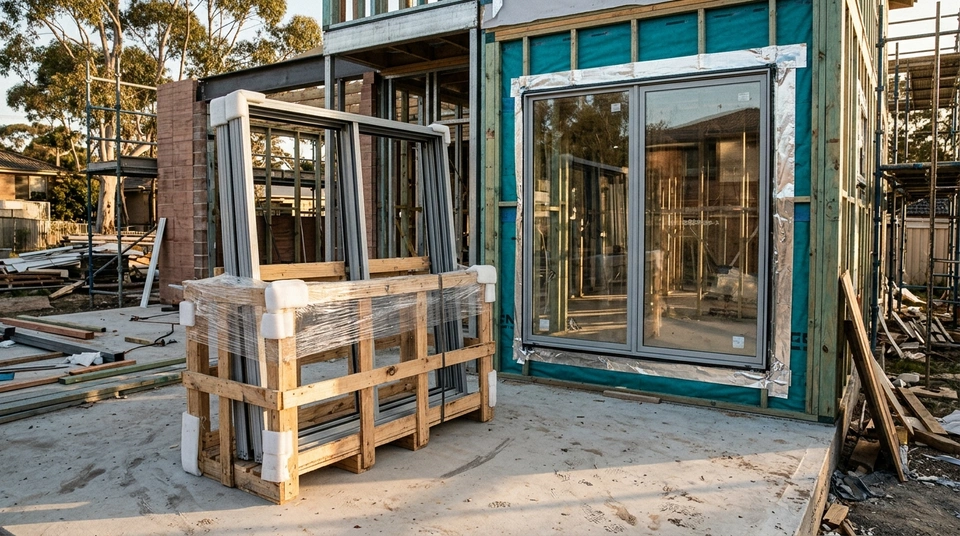
AI-generated illustrative image. Not a product test, certification record or project evidence.
The factory price is usually lower, and that saving is real but gross. Buying direct moves four things off your side of the table and onto it: the import declaration, the compliance evidence, the site measure and the party who answers a warranty claim in year three. An Australian importer charges a margin for carrying those four, and the honest comparison prices the bundle rather than the window.
The China quote is usually lower than the local one. That part of the forum consensus is not wrong. What matters is that buying direct from a factory does not only change the price. It also changes who lodges the import declaration, who holds the compliance evidence, who produces the site measurement and who answers a claim three winters after the windows go in. An Australian importer charges a margin for carrying those four things. The question is whether you can carry them more cheaply than the margin costs.
What direct actually means at the border
Direct is a customs status, not a feeling about who you emailed. The party named on the import declaration is the one the border deals with, and the Customs Act defines owner broadly enough to cover the importer, anyone holding themselves out as the owner, and anyone with a beneficial interest in or control of the goods.
This matters because the two routes can look identical on an invoice. Under delivered duty paid terms, the Australian Border Force's (ABF's) guidance says the overseas supplier may be named as the importer on the declaration and is treated as the owner for customs entry and as the importer for GST. A buyer who believes they bought direct may find the factory cleared the goods in its own name. A buyer who believes they used a local agent may find their own ABN on the entry.
Delivered duty paid is not the safe option it sounds like. Tax advisers have warned that the term carries specific risks for the Australian purchaser. Those are recovery of underpaid duty and GST from the consignee, denial of the input tax credit where the consignee's ABN appears on the declaration without an agency agreement, and duty embedded in the price that the buyer cannot see or mitigate.
The security introduced on 15 October 2026 sharpened the question, because securities on in-scope aluminium windows and doors from China apply by the date goods are entered for home consumption, not the date the order was placed. Where the importer of record is the buyer, that charge lands on the buyer's account before the container is released. Where it is an Australian supplier, whether the cost reaches the builder depends on the supply contract.
Is it cheaper? What the comparison usually leaves out
The savings people report online are gross figures, quoted at the factory gate. One detailed forum account from a project manager importing for her own build put the windows at roughly half the local market rate and shipping at about two thousand dollars to Sydney, and noted in the same post that a private importer pays ten per cent GST. No source found for this article presented a net comparison after duty, freight to site, installation labour and tax recovery.
Four lines go missing. Freight from the port to site, because a window package is bulky, heavy and easily damaged and the container does not arrive at the driveway. The security, where the goods are in scope. GST, which is a real cost to an owner-builder and a cash-flow item to a registered builder. And installation, because a local supply-and-install quote bundles labour, sealant, flashing and scaffolding.
There is also a cost of time that appears on no invoice. Builders reporting on 2026 lead times describe a brochure figure of 10 to 12 weeks against a delivered reality of 14 to 16 or more, with glass rather than frames as the bottleneck, and note that the clock starts when shop drawings stop moving. Compare on a landed, installed, tax-adjusted basis or you are comparing two different products.
Who is liable when the measurement is wrong
Of the four transfers, this is the one that bites first and most often. A factory builds to the numbers on the form. It has never seen the opening, cannot tell whether the frame is square, and has no way to know the slab moved forty millimetres on one corner. Whoever produces the measurement owns the tolerance, and on a direct import that is the buyer.
The clearest published account comes from a Sydney owner-builder who imported a package and also bought two sliding doors locally. His summary is unusually direct: with the local supplier, they come on site to measure and install, and when ordering from China the liability is with the owner-builder. His project had three people check the measurements and still had to reduce window sizes after the frames went up.
The remedy shape is the part people underestimate. A window wrong by twenty millimetres is not a service call. It is a return freight question, a re-order queue, and a hole in the building envelope in the meantime, where a local supplier who measured wrongly is answering a phone call and sending a crew.
Who holds the compliance evidence
AS 2047 certification attaches to a licence holder, and the register entries are specific. An entry for an offshore fabricator, for example, lists the licence in the Chinese company's name, the standard as AS 2047-2014, and a note that the certification excludes installation. That exclusion is doing a lot of work: the certificate covers the product as tested, and says nothing about whether the window was installed in a way that keeps water out.
The Australian Glass and Window Association's (AGWA's) consumer guidance is that compliance certificates should only be accepted where the issuer participates in an accreditation scheme, and that test reports should be requested wherever there is doubt. The Housing Industry Association (HIA) treats imported product distributed through an importer as a different chain-of-custody case from imported product supplied directly, with different verification documents expected in each. The builder has to hold whichever set applies.
Then there is the certifier, whose acceptance is discretionary for anything short of a current CodeMark certificate. Queensland's guidance on imported products tested overseas sets out that evidence can come from a laboratory accredited by the National Association of Testing Authorities (NATA) or one recognised through a mutual recognition arrangement, but that testing to a European or American standard removes the deemed-to-satisfy pathway and requires a performance solution. The pre-order question is not whether the factory has a certificate. It is what this certifier, on this project, will accept, in writing.
One more distinction matters. A trading company is often not the manufacturer, and freight forwarders advise importers to obtain the exact registered legal name of the exporting entity before booking. A certificate in one name sitting behind an invoice in another is the kind of mismatch that turns a compliance conversation into a delay.
Who answers in year three
Buying from an overseas business directly is covered by the law in principle and difficult in practice. The Australian Competition and Consumer Commission (ACCC) is explicit that such a business must follow the Australian Consumer Law. It is equally explicit that getting a repair, replacement or refund from one is hard, and that Australian agencies can offer only limited help.
Two case studies published by the Australian Window Association show how the gap behaves once money is spent. In one, an owner supplied imported windows to an installer, a certifier found the product non-compliant and uncertified, and the owner pursued the installer for a claim exceeding two hundred thousand dollars, settling before hearing. In the other, a developer contracted directly with a glass manufacturer, the windows failed after torrential rain a year later, and because the manufacturer had liquidated, the new owners pursued the builder. In both, liability followed the contract, not the fault. Installers also commonly decline to warrant product they did not supply, which leaves a builder who brought in their own windows with the workmanship warranted and the product not.
When direct import is the rational choice
The buyers who do it well have imported before and have a broker they use repeatedly. They carry the insurance and site-measure capability to absorb a wrong dimension, or they are matching an existing system a local supplier cannot source, or they have enough float that a four week slip is absorbed rather than paid for.
The pattern on the other side is just as consistent. A first-time importer, an owner-builder, a fixed-price contract and a certifier who has not been asked in advance are the four conditions that turn a saving into a problem. Any three together should push the decision toward a local supplier regardless of the price difference.
What to settle before the deposit
Whichever route is chosen, four things belong in writing before any money moves. Name the importer of record, and check that it matches the party who will lodge the declaration. Name who produces the site measurement and who carries the tolerance if it is wrong. Attach the evidence list the certifier has confirmed. And state who bears a change in duty, GST, freight or trade remedy measure between order date and entry date, because on a several-month lead time that is a live possibility rather than a theoretical one.
The direct question and the importer question are usually framed as a price argument. Stripped back, it is a question about which risks a buyer is equipped to hold. A supplier who holds them is charging for that, and the charge is only a middleman tax if the buyer was already holding them anyway.
This article is general information about how the two routes differ. It is not legal, customs or financial advice, and the right answer for a particular project depends on the contract, the certifier and the entity doing the buying.