Importing & Compliance
What AS 2047 compliance documents should you obtain before ordering imported windows?
By Sheng Xu · 23 October 2026
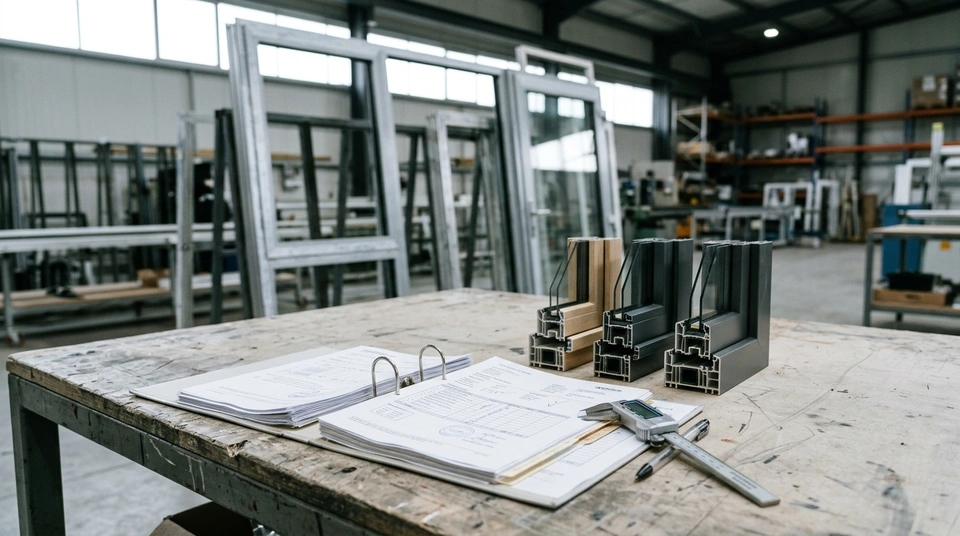
AI-generated illustrative image. Not a product test, certification record or project evidence.
Before ordering imported windows, obtain four things in this order: the site rating in writing from the project engineer or designer, a product compliance schedule for the exact series being quoted, a sample of the AS 2047 performance label and the certificate behind it, and the test report showing which laboratory ran the tests and under what accreditation. The laboratory accreditation matters most for imports, because the NCC only accepts a report from an Accredited Testing Laboratory, and testing to European or American standards instead of the referenced Australian Standards removes the deemed-to-satisfy pathway.
The National Construction Code applies to the window that ends up in the wall, not to the country it was made in, so an imported assembly needs the same evidence as a locally manufactured one. What differs is the paperwork trail: a domestic fabricator's laboratory, certifier and accreditation body usually appear on one certificate, while with an import those links sit in different jurisdictions. For a buyer asking about AS2047 compliance on an import, the question is rarely what the standard says; it is whether the file in front of you will survive scrutiny. This is a verification sequence rather than an explanation of the standard: what to obtain, in what order, and what a certifier will accept.
Start with the site rating, not the product
The first document to obtain is not a certificate. Under Appendix C of AS 2047:2014 the purchaser nominates the performance the window has to meet: for housing, the window rating, the exposure classification and whether the assembly is a corner window; for other residential and commercial buildings, the design wind pressures. The manufacturer then verifies its assembly meets what was nominated. That is why a factory datasheet showing a maximum rating is not the same thing as a site rating, and why a product that is compliant in the abstract can still be the wrong product for a particular block.
For a Class 1 or Class 10 building the rating should come from an engineer or other suitably qualified person applying AS 4055, including terrain category, topographic class and shielding. Outside the scope of AS 4055, or for Class 2 to 9 buildings, it should be determined under AS/NZS 1170.2 to give the serviceability limit state, ultimate limit state and water penetration requirements. The Queensland Building and Construction Commission's (QBCC's) window selection guide adds that the order should also carry plans showing room uses and window positions, and any acoustic, bushfire, balustrade or fall-prevention requirement attached to individual openings. Get the site figures in writing before discussing certificates, because they define what the certificates have to prove.
The AS 2047 label: four data points, one position
Clause 8.1 requires window assemblies for housing to be labelled. Timber windows for housing and assemblies for buildings other than housing may be labelled or supplied with a certificate under clause 8.3 instead, and where housing windows arrive as incomplete assemblies the note to clause 8.1 expects both. Clause 8.2 sets the position: the label must be placed so the window can still be identified in situ, which in practice means the inside of the frame or head rather than a face covered by a reveal.
The required content is short: the manufacturer's identification mark, the serviceability limit state wind pressure, the ultimate limit state wind pressure, and the water penetration resistance. It is marked anywhere on the assembly except on the glazing, with the single exception of a rating label applied to a fixed glazed timber window. A figure etched or stickered on the glass is therefore not an AS 2047 label, and its absence from the frame is a defect even where the number is right.
Read the number rather than the presence of the sticker. The Australian Glass and Window Association's (AGWA's) quick check is that water penetration resistance should be at least 30 per cent of the positive serviceability limit state load nominated for the site, and that the labelled SLS and ULS figures be compared with the site rating rather than the supplier's headline maximum. A label reading 450 Pa is only meaningful once that comparison is made, and the comparison falls to the purchaser because the purchaser supplied the site figures.
The certificate is only as good as the body behind it
A certificate of conformance should carry the same four pieces of information as the label, plus a clear statement of the Australian Standard it is issued against. The question worth asking is not whether a certificate exists but who stands behind it. AGWA's guidance is direct: a compliance certificate should only be deemed acceptable where the company providing it is part of an accreditation scheme such as the AGWA independent third party NATA accreditation scheme, and where it is not, a test report should be requested instead.
The distinction is between a statement and evidence. A certificate signed by the factory's own quality department, warranting compliance, is a statement by the party selling the product. One issued inside a scheme with independent auditing rests on a report from a laboratory assessed as competent to run the test. Both may be honest, but only the second lets a certifier check the chain without taking the supplier's word, so where an overseas manufacturer holds certification through a scheme the buyer does not recognise, ask for the report underneath it.
Where the test was done decides which pathway applies
This is the part of an imported compliance file with no domestic equivalent. NCC 2022 clause A5G3(1)(d) accepts a report issued by an Accredited Testing Laboratory, defined narrowly: an organisation accredited by NATA to run the relevant tests, an organisation outside Australia accredited by a body recognised by NATA through a mutual recognition agreement, or an organisation recognised as an Accredited Testing Laboratory under legislation at the time of testing. NATA is a signatory to the International Laboratory Accreditation Cooperation (ILAC) mutual recognition arrangement, so a laboratory accredited by another signatory can qualify, but the qualification runs through the laboratory's scope of accreditation, not through how the report is presented.
QBCC's guidance on imported building products tested outside Australia sets out both consequences. Testing by a laboratory not accredited in one of those three ways can still happen, but the report cannot be accepted as evidence of suitability under that provision. And testing to European or American standards rather than the NCC-referenced Australian Standards does not invalidate the testing, but it removes the deemed-to-satisfy pathway, so a Performance Solution is needed. For a window, that is the difference between an ordinary approval route and a project-specific argument.
The residual point is discretion. Acceptance of any evidence of suitability other than a current CodeMark certificate, and approval of a Performance Solution, rests with the appropriate authority, normally the building surveyor or certifier. Nothing in a supplier's pack overrides that. Read a test report by checking three things in order: which laboratory issued it, whether that laboratory's accreditation scope covers the relevant AS 4420 series tests, and which standard the tests were run to.
The glass stamp is a separate check
AS 2047 incorporates compliance with AS 1288, but the marking requirement lives in AS 1288 and is checked separately. Clause 5.23.3 requires each panel to be marked with the name, registered trademark or code of the manufacturer or supplier; the type of safety glass material, which may be a code such as T for toughened or L for laminated as defined in AS/NZS 2208; the standard to which the glass was tested; the grade of test classification; and a number indicating nominal thickness in millimetres, or minimum thickness to the nearest tenth of a millimetre for non-standard material.
The marking may be a permanent mark or a label that cannot be removed and reused, so a sticker is compliant while it is there. The problem is that it often is not there by inspection time. AGWA notes that missing safety glass labelling is one of the most common concerns raised by builders and certifiers, and that in most cases the labels were removed before inspection; its recommendation is that non-permanent labels stay on the product until after handover. Where a label has already gone, the glass type can sometimes be identified with specialist equipment, but only the original manufacturer can certify it is Grade A safety glass conforming to AS/NZS 2208. Record the marking at delivery, before the film comes off.
WERS is a different document entirely
Energy performance runs on a separate track and is the item most often confused with AS 2047 compliance. The Window Energy Rating Scheme (WERS) is managed by AGWA and accredited by the Australian Fenestration Rating Council (AFRC); its ratings are third party certified to AFRC requirements, compliant with the National Construction Code and able to be used to meet regulatory requirements, and rated products appear on a certified products directory. A what-if scenario result is not a certified rating and cannot prove compliance until audited, so a supplier quoting a U-value from a what-if run is quoting an intention. Nor do the schemes overlap: a WERS certificate says nothing about structural or water performance, and an AS 2047 certificate says nothing about U-value or solar heat gain coefficient.
The order to ask for things
In sequence, the file should contain: the site rating in writing, with exposure and corner status for housing; a product compliance schedule naming the exact series and profile quoted, not a generic brochure figure; a sample of the AS 2047 label showing the four data points and where it will sit; the certificate, with the accreditation scheme its issuer belongs to; the test report, with the laboratory named and its scope checkable; the AS 1288 marking recorded at delivery; and, where energy performance is in the specification, the WERS certificate and the directory listing it corresponds to.
A missing document is not proof that a window is non-compliant. It is proof that the file is incomplete, and an incomplete file is what a certifier responds to, because the decision has to rest on evidence of suitability rather than the supplier's assurance. The cheapest time to close those gaps is before the order is placed, when the answer can still change which product ships.
This article is general information about the documentation an imported window is expected to carry. It is not compliance advice for a particular project, and where it differs from the view of the building surveyor or certifier determining that project, that decision governs.