Energy & Thermal Performance
Louvre Windows for Passive Cooling & Airflow
By Sheng Xu · 15 October 2026
AI-generated illustrative image. Not a product test, certification record or project evidence.
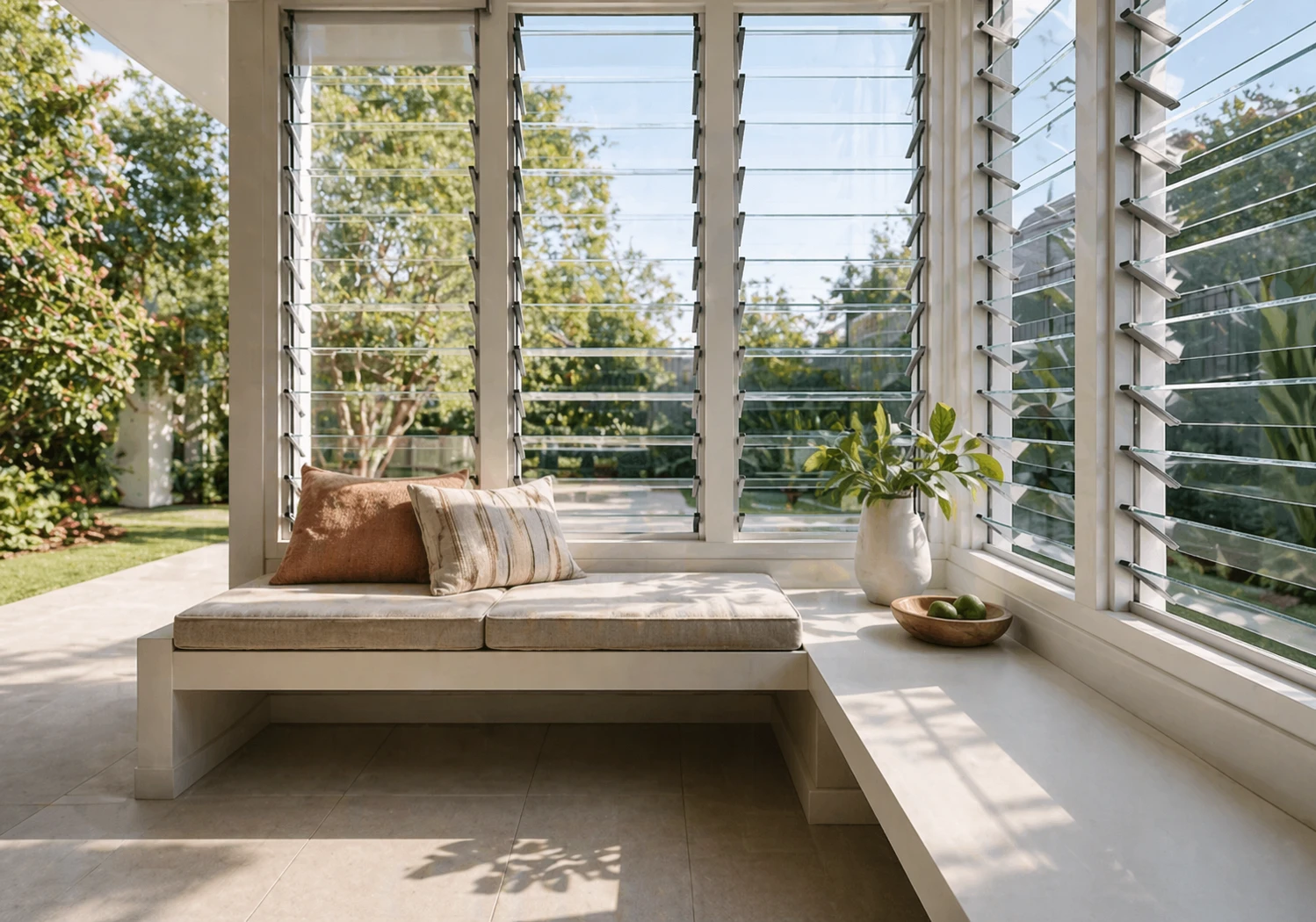
Louvre windows are the highest openable-area window in the residential range, which makes them the strongest ventilation and night-purging tool available for passive cooling. YourHome rates a two-pane louvre at 90 per cent maximum opening against 45 per cent for a sliding window. High level louvres act as the outlet half of a stack, louvres above internal doors keep a breeze path alive, and a louvre paired with a sliding or stacker door creates the inlet and outlet that cross ventilation needs. The trade-off is airtightness: SMIRO's louvre is non-thermal-break with a whole-window U-value of 3.5 to 5.5 W/m2K, so it is a summer asset and a winter liability in mixed and heating-dominated climate zones.
A passive cooling design rests on two things: keeping heat out, and flushing the building once the outside air is cooler than the air inside. Louvre windows matter for the second, and only when they are placed to work with the airflow path rather than against it. Climate zone decides how many months of the year that strategy pays, and how much the louvre's weak airtightness costs back in winter.
How Much Ventilation Do Louvre Windows Actually Provide?
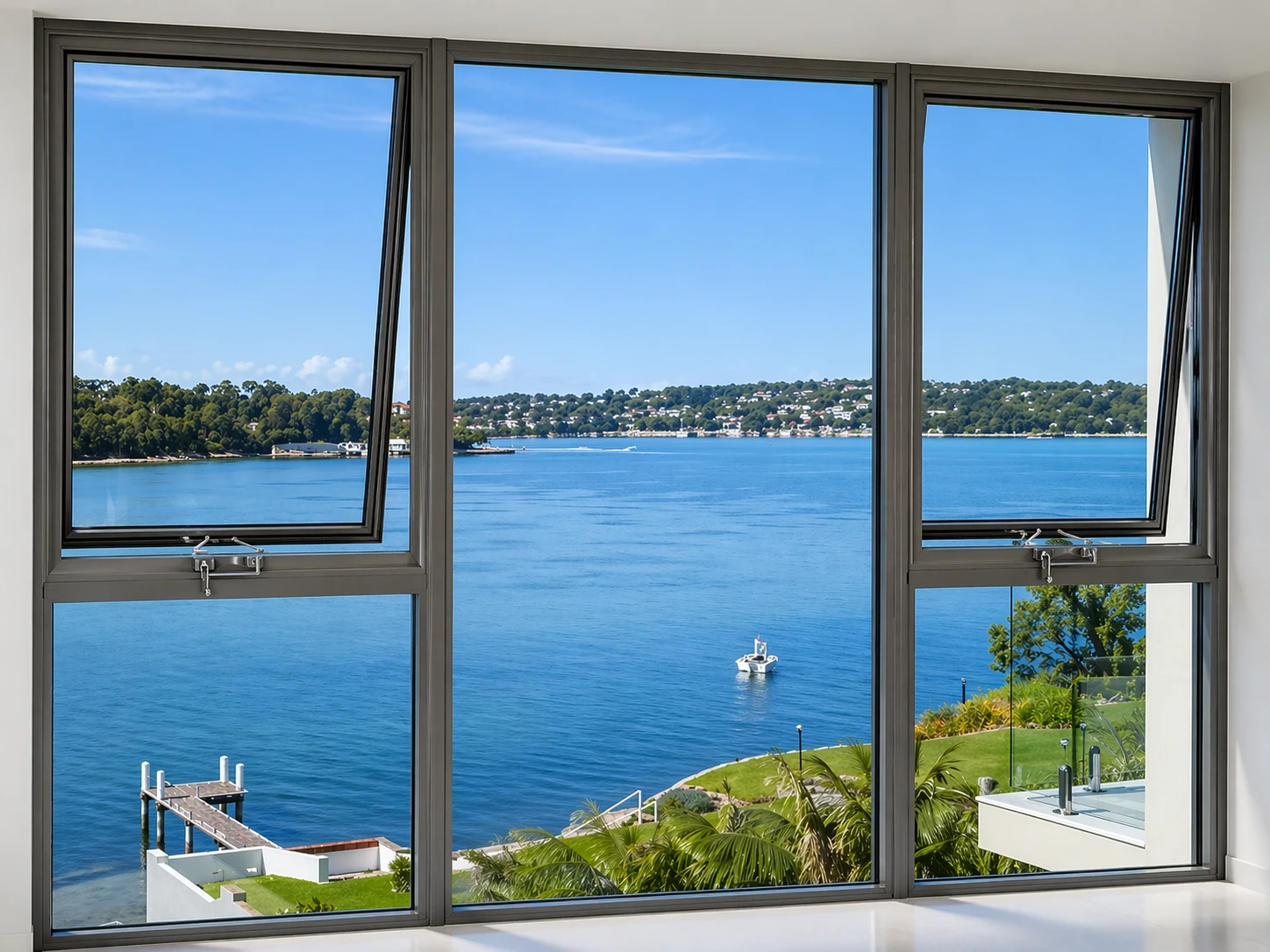
YourHome rates the maximum opening of a two-pane window at 90 per cent for a louvre, against 95 per cent for a casement, 45 per cent for sliding and 20 to 30 per cent for an awning. Openable area decides how much a window contributes to passive cooling, and glazing is both the main source of heat gain and the main source of cooling, so an aperture that opens almost completely gives ventilation far more to work with.
Night purging is the largest opportunity. A CSIRO study cited in Australian building physics guidance found Brisbane houses sitting well above outdoor temperature in the small hours, suggesting occupants miss the free cooling ventilation offers. Openable area is not ventilation performance, though: airtightness when closed and the whole-window U-value decide the annual result, and on both a louvre is the weakest product in the range.
High Level Louvre Windows and the Stack Effect
High level louvre windows are the outlet half of a stack. Warm air is less dense than the cooler air below it, so it rises and escapes through the high opening, and that outflow draws replacement air in at a low opening. BRANZ Bulletin 607 defines it the same way: hot air is expelled through high-level windows or doors, with fresh air drawn in at lower levels to replace it. The driver is vertical separation, and VELUX says the higher the windows and the larger the temperature difference, the more powerful the stack effect.
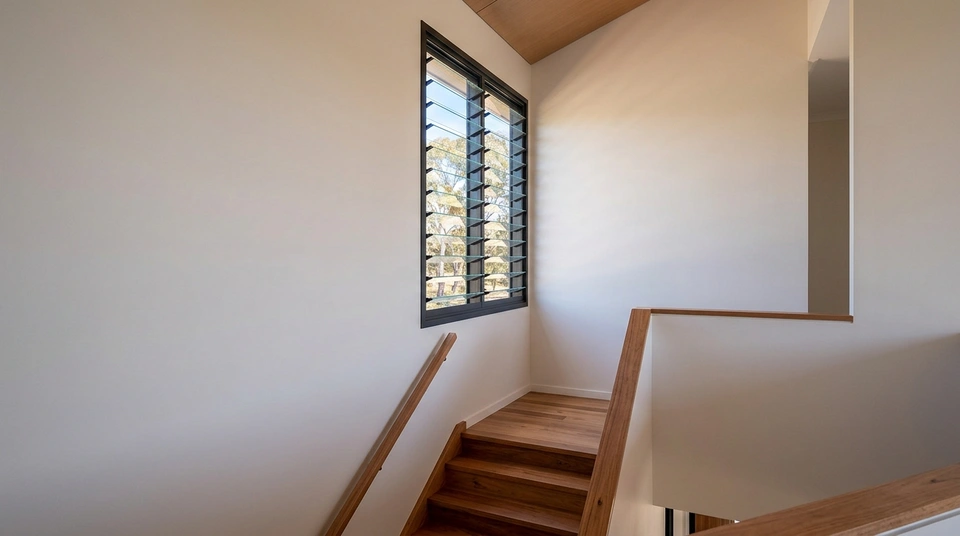
Stack ventilation works when wind does not. YourHome notes that even with no breeze, convection lets heat leave a building through high clerestory windows or roof ventilators. Place the louvre genuinely high, near the ceiling line where the warmest air collects, with a low opening beneath it as the inlet. High is also the safest ventilation position on a facade, out of reach of the sleeping zone, so it works overnight without the fall prevention restrictions that apply to low sills.
Stack Ventilation Is Not Cross Ventilation
Stack ventilation is buoyancy driven and vertical: warm air leaves high, cooler air enters low, and the temperature difference and the height between the openings set the flow. Cross ventilation is wind driven and horizontal, entering on the windward side and leaving on the leeward. Separate mechanisms with separate placement logic, and many supplier pages describe one while recommending the other.
Louvre Windows Cross Ventilation: Pairing with Sliding and Stacker Doors
Cross ventilation sizing catches most people out. YourHome points out that wind is not so much blown through a building as sucked toward areas of lower pressure, and recommends larger opening areas on the leeward side and smaller ones on the windward side to draw the breeze through.
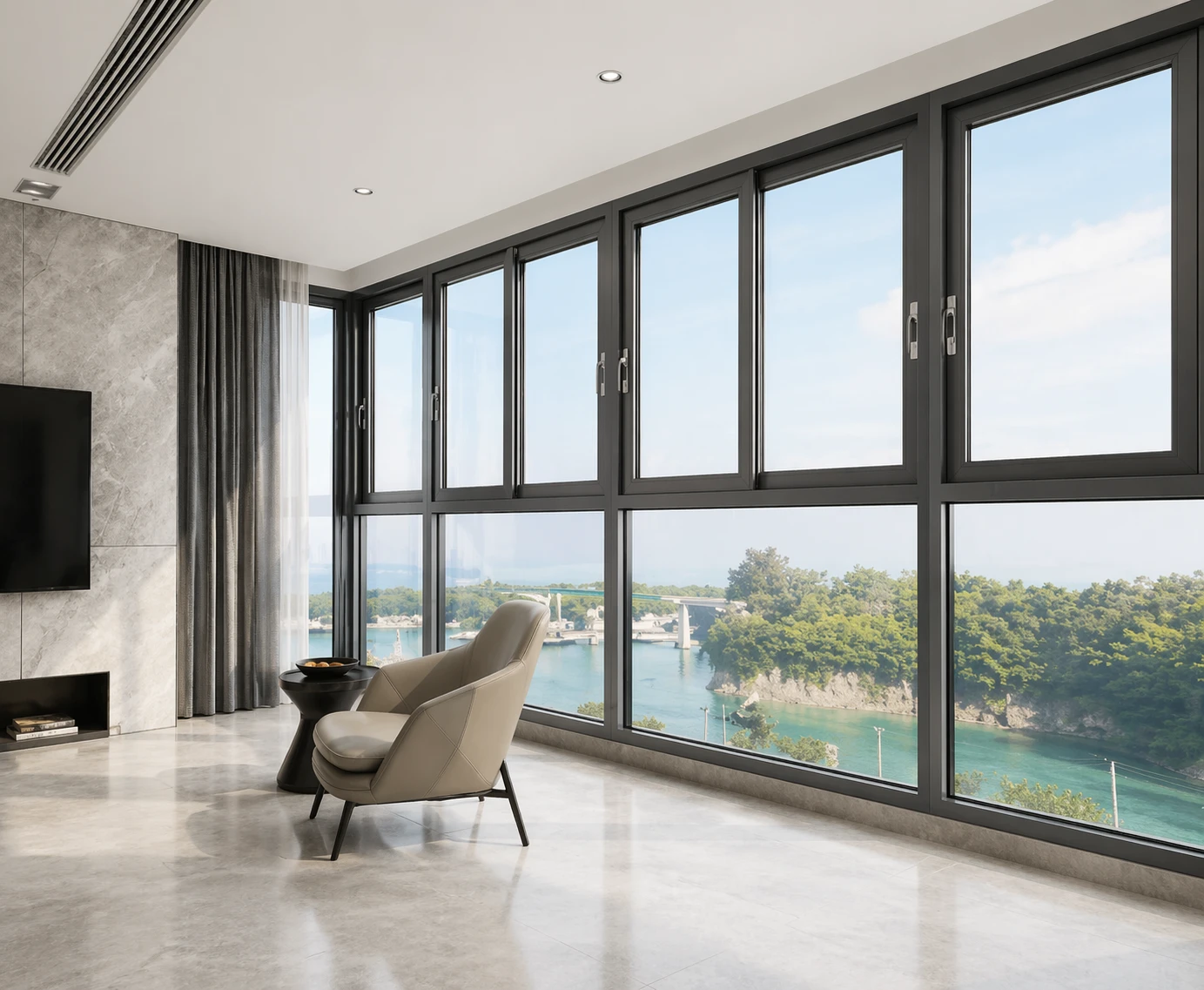
That is where pairing a louvre with a wide-opening door earns its place. The louvre is the controllable inlet; a sliding or stacker door is the large, low-resistance outlet opposite. SMIRO's louvre sits in the Urban series and the range also covers stacker doors, so inlet and outlet come from one set of extrusions. A room with one opening and no second path gets only single-sided ventilation, far weaker whatever the window type.
Louvre Windows Above Doors
A louvre above a door is an air transfer device. It keeps a breeze path open through a building when the door itself is shut, one of the most common reasons a cross ventilation design underperforms. YourHome recommends it directly: consider installing a louvre or awning window above internal doors to let breezes pass through the building while maintaining privacy and security. In cooling-only climates it suggests similar panels above head height in internal walls to move the hottest air out, and BRANZ agrees, noting louvres can also go on internal walls to allow airflow between rooms.
At body height a closed door blocks the path, so an opening above restores flow without giving up privacy or acoustic separation. Openable area rules favour the high position too: BRANZ records that fitted restrictors may require more opening sashes to still meet the net openable area requirement, and YourHome notes the NCC rule restricting windows with sills below 1.7 metres to a 125 millimetre opening limits windows that open wide for cross ventilation.
Louvre Windows Passive Cooling Advice by NCC Climate Zone
YourHome groups the NCC's eight climate zones into three passive cooling regimes: zone 1 hot humid with a warm winter where no heating is required, zones 2 to 6 where both heating and cooling are required, and zones 7 and 8 where heating needs are most important.
Zones 1 and 3 are the clear cases. Zone 1 has no heating season to pay for, so the louvre's airtightness weakness does not become a winter energy bill. Zone 3 is where night purging is strongest: YourHome describes cool night air as reliable where the day to night range exceeds 6 to 8 degrees Celsius.
Zones 2 to 6 are the mixed case and the honest one. YourHome states all Australian climates apart from tropical zone 1 need some winter heating, and this affects cooling advice. The right specification is usually split: louvres where ventilation is the priority, such as bathrooms, laundries, corridors and upper level purge positions, and better sealing windows in rooms you want to hold heat in. In zones 7 and 8, which should pay most attention to effective heating, the case for a non-thermal-break louvre narrows to moisture control in wet rooms.
The Trade-Off: Airflow Against Airtightness
Louvres maximise openable area and minimise airtightness, and both follow from the same construction. Practitioners state the cost plainly. In an Australian home forum thread on louvre windows, one member writes that the usual type are no good as a noise barrier and can be very draughty, and another says they cannot see how louvered windows can be good at insulating. An Adelaide supplier guide agrees: in a cool, wet Adelaide winter that can mean draughts and heat escaping.
The frame carries half the problem. YourHome notes frames made of uPVC, timber or thermally broken aluminium insulate better than conventional single extrusion aluminium. SMIRO's Urban series louvre is a 6063-T5 extrusion at 2.0 millimetres and is non-thermal-break, with a whole-window U-value of 3.5 to 5.5 W/m2K. That is the number to weigh against a better sealing window if the room needs to hold heat.
The louvre energy modelling that circulates most widely is a manufacturer's own: the louvre building needed 37 per cent less cooling energy, 76 per cent more heating energy off a small base, and 23 per cent less total annual energy in Sydney. Read it with all four caveats the author attaches: that manufacturer's own modelling, of its own product, in Climate Zone 5, and the results do not apply to other louvre products. It is not a SMIRO result.
Frequently Asked Questions
Do louvre windows actually cool a house?
They cool by ventilating, not by insulating. A high openable area and an easy night purge move heat out, and they do not stop heat coming in. The gain is climate dependent, and the winter airtightness and U-value cost is the counterweight.
What is the difference between cross ventilation and stack ventilation?
Cross ventilation is wind driven and horizontal: inlet on the windward side, outlet on the leeward side. Stack ventilation is buoyancy driven and vertical: warm air out at a high opening, cooler air in at a low opening. They are separate mechanisms that can be used together.
Where should louvre windows go in a passive cooling design?
Three positions do the work. High level near the ceiling line as the stack outlet, with a low inlet beneath it. Above internal doors wherever a closed door would break the breeze path. And on the breeze-facing elevation as a cross ventilation inlet, paired with a wide-opening stacker door opposite.
Are louvre windows a good choice in a heating-dominated climate?
Less so. In NCC zones 6 to 8 the airtightness and U-value penalty weighs more heavily against the ventilation benefit, and the case narrows to moisture control in bathrooms, laundries and other wet rooms rather than primary living areas.
Are Louvre Windows the Right Passive Cooling Window for Your Home?
Louvres are the right passive cooling window when the job is moving air, and the wrong one when the job is holding heat. On a high level opening they are close to ideal, because the position is a stack outlet, a security advantage and a fall prevention advantage at once.
The checklist is short. A genuinely high outlet with a low inlet beneath it. A flow path with an opposite or adjacent opening rather than a single-sided room. An above-door louvre wherever a closed internal door would otherwise break that path. And an honest U-value and airtightness comparison before louvres go on a living room that also has to stay warm in July.